Review · Fighting · iOS · Wii · Apple II
Karate Champ (1984)
By the LumiKin editors
Reviewed: 29 May 2026
iOS · Wii · Apple II · PlayStation 4 · NES · Commodore / Amiga
Technōs Japan · 1984
LumiScore
64/100
Good
Growth (BDS)
47
Risk (RIS)
1
Daily limit
120min
Age guidance
—
Developmental benefits
| B1 | Cognitive | 0.60 | |
| B2 | Social-emotional | 0.07 | |
| B3 | Motor | 0.75 | |
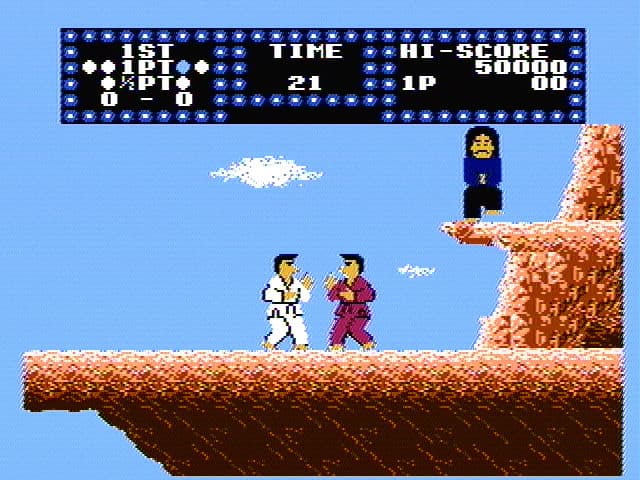
Karate Champ is a foundational fighting game that significantly contributes to the development of cognitive skills such as spatial awareness, strategic thinking, critical thinking, and reaction time. Its dual-joystick controls demand high hand-eye coordination and fine motor skills. The game offers adaptive challenges through its AI and player-versus-player modes, encouraging continuous learning and improvement in a competitive setting.
Design risks
| R1 | Dopamine pressure | 0.00 | |
| R2 | Monetization | 0.00 | |
| R3 | Social risk | 0.06 | |
As an early arcade fighting game, Karate Champ presents minimal risks related to dopamine manipulation or monetization, as it lacks modern manipulative design mechanics, microtransactions, or social pressures. The primary risk is a low level of competitive toxicity inherent in one-on-one fighting games. Content-wise, it features stylized martial arts violence, common for the genre.
Heads up
- Monthly spendTypical real-money spend by engaged players: $0–0/mo.