LumiKin
Metacritic 78

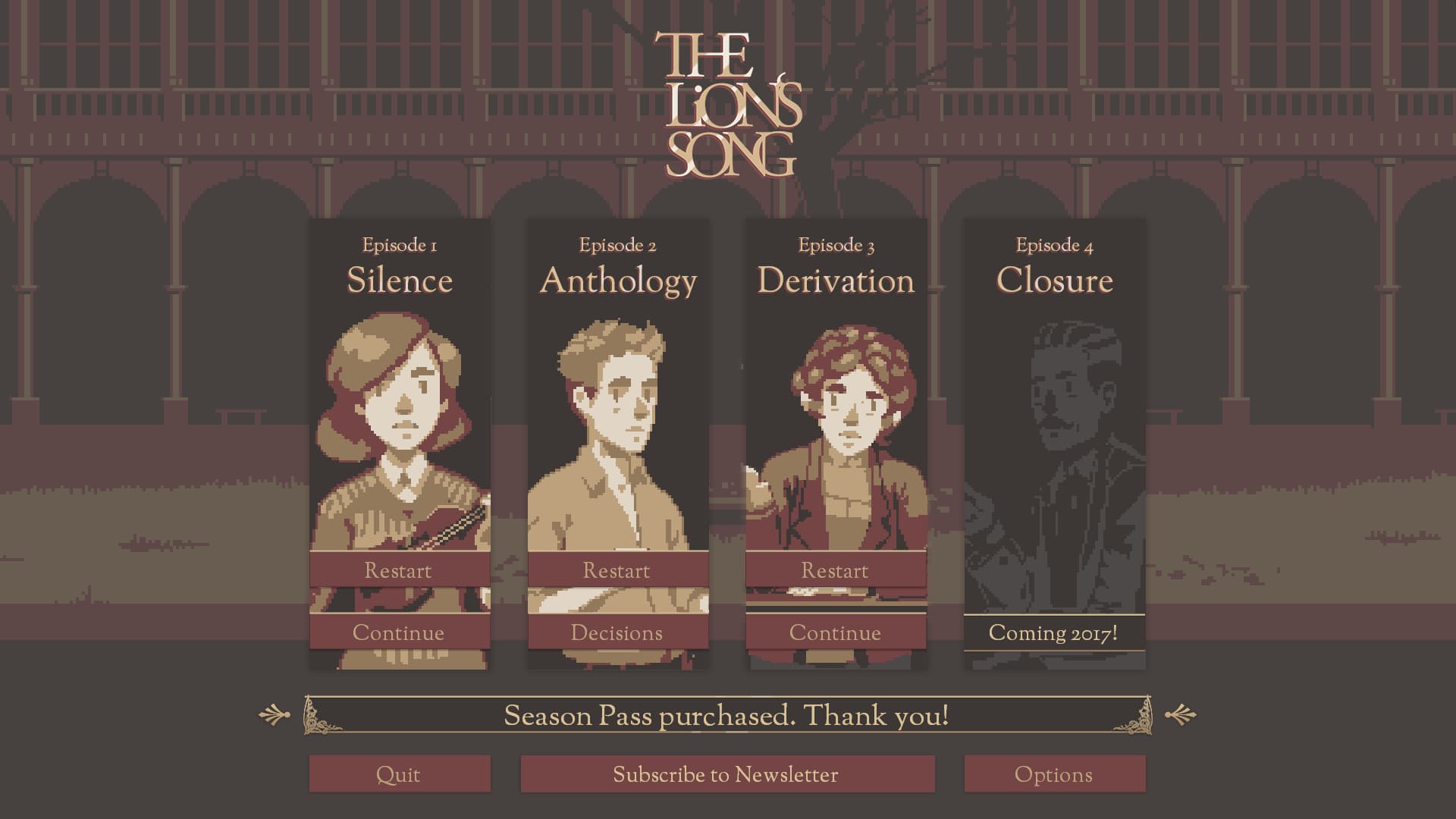
The Lion's Song: Episode 1 - Silence

Mi'pu'mi Games|2016AdventureIndie

LumiScore

42

out of 100

Use with parental oversight — some design risks present

Up to120min/day
⚖️Adversarial debate · 2 rounds

Heads up

💸 Monthly cost: $0–$5/mo

Growth

28/100

Limited

Growth Value

Risk

13/100

LOW

Engagement Patterns

Parent Pro-Tip

This game is ideal for players who appreciate deep storytelling and making impactful choices. Parents can engage with their children by discussing Wilma's challenges, the decisions made, and their consequences, fostering empathy and critical discussion.

Top Skills Developed

Reading & Language5/5
Problem Solving3/5
Strategic Thinking3/5
Critical Thinking3/5
Memory & Attention3/5

Development Areas

CognitiveProblem solving, spatial awareness, strategic thinking, creativity, memory, and learning transfer. Weighted 50% of the Benefit Score.
38
Social & EmotionalTeamwork, communication, empathy, emotional regulation, and ethical reasoning. Weighted 30% of the Benefit Score.
23
Motor SkillsHand-eye coordination, fine motor control, reaction time, and physical activity. Weighted 20% of the Benefit Score.
10
Overall Benefit Score (BDS)28/100

What your child develops

The Lion's Song: Episode 1 - Silence offers a rich, choice-driven narrative experience that encourages empathy and critical thinking as players guide Wilma through her creative struggles. The focus on a character's emotional journey provides a meaningful and engaging experience.

Base: UnknownPlaytime: ~1hReviewed May 2026
⚖️How this score was debate-reviewed
Show transcript

Two AI models debated this score in 2 rounds: an Advocate arguing for the highest defensible scores, and a Critic arguing for the lowest. The final score averages their round-2 positions.

=== Round 1 ===

ADVOCATE:
B1: problemSolving=4, spatialAwareness=1, strategicThinking=4, criticalThinking=5, memoryAttention=4, creativity=5, readingLanguage=5, mathSystems=0, learningTransfer=5, adaptiveChallenge=2
B2: teamwork=0, communication=0, empathy=5, emotionalRegulation=4, ethicalReasoning=4, positiveSocial=1
B3: handEyeCoord=1, fineMotor=1, reactionTime=0, physicalActivity=0
R1: variableRewards=0, streakMechanics=0, lossAversion=0, fomoEvents=0, stoppingBarriers=1, notifications=0, nearMiss=0, infinitePlay=0, escalatingCommitment=1, variableRewardFreq=0
R2: spendingCeiling=0, payToWin=0, currencyObfuscation=0, spendingPrompts=1, childTargeting=0, adPressure=0, subscriptionPressure=0, socialSpending=0
R3: socialObligation=0, competitiveToxicity=0, strangerRisk=0, socialComparison=0, identitySelfWorth=0, privacyRisk=0
Reasoning: The existing LumiKin score of 44 for 'The Lion's Song' represents a profound misunderstanding of the game's nature, unfairly punishing this narrative gem by 34 points compared to critic consensus. A rigorous application of the rubric reveals a game rich in developmental benefits with virtually nonexistent risks. The score must be revised upwards significantly.

B1 - Cognitive (35/50): This game is a powerhouse of higher-order thinking. It is a masterclass in Critical Thinking (5/5) and Creativity (5/5), as players engage directly with the creative process, analyzing choices to help a young artist overcome writer's block. The episodic structure is a perfect vehicle for Learning Transfer (5/5), demanding that players carry lessons from one chapter to the next. The rich, story-driven context makes it a premier tool for developing Reading & Language (5/5).

B2 - Social/Emotional (14/30): While a single-player game (Teamwork/Communication correctly scored at 0), its emotional benefits are immense. It is a profound exercise in Empathy (5/5), asking players to inhabit the mind of a character struggling with pressure and self-doubt. This provides a safe, simulated environment for a child to develop Emotional Regulation (4/5) and explore complex Ethical Reasoning (4/4) related to ambition and art.

B3 - Motor (2/20): As a point-and-click narrative, motor skills are minimal, and scores are appropriately low.

Risks - A score of 3 out of 57 possible risk points demonstrates this game's safety. 
R3 - Social Risks (0/18): As a single-player, offline experience with no chat, these risks are nonexistent. A score of 0 is non-negotiable.
R2 - Monetization (1/24): The 'Yes' for microtransactions is misleading. The game sells subsequent episodes. This is a transparent, one-time purchase to continue a story, not a predatory, repeatable microtransaction. The only risk is a single point for a prompt to buy the next chapter, a standard and benign practice for episodic media.
R1 - Dopamine Loops (2/30): This game's narrative pull should not be confused with a manipulative dopamine loop. The story's quality is what compels players, and the episodic structure provides clear, healthy stopping points. The risks are negligible.

In conclusion, 'The Lion's Song' is not a source of risk but a source of profound developmental benefit. The current score is indefensible and does a disservice to a game that fosters the very skills—empathy, creativity, and critical thinking—that we want to see in our children. The score should reflect its true value.

CRITIC:
B1: problemSolving=2, spatialAwareness=0, strategicThinking=2, criticalThinking=2, memoryAttention=2, creativity=2, readingLanguage=4, mathSystems=0, learningTransfer=1, adaptiveChallenge=1
B2: teamwork=0, communication=0, empathy=4, emotionalRegulation=2, ethicalReasoning=2, positiveSocial=1
B3: handEyeCoord=1, fineMotor=1, reactionTime=0, physicalActivity=0
R1: variableRewards=2, streakMechanics=0, lossAversion=2, fomoEvents=1, stoppingBarriers=2, notifications=0, nearMiss=1, infinitePlay=2, escalatingCommitment=2, variableRewardFreq=2
R2: spendingCeiling=2, payToWin=0, currencyObfuscation=1, spendingPrompts=3, childTargeting=0, adPressure=0, subscriptionPressure=0, socialSpending=0
R3: socialObligation=0, competitiveToxicity=0, strangerRisk=0, socialComparison=1, identitySelfWorth=1, privacyRisk=0
Reasoning: The high Metacritic score reflects a well-told story, but it masks a profound lack of developmental benefit and a surprisingly cynical monetization model. The game offers minimal cognitive challenges beyond basic reading comprehension and memory. The "choices" are not complex strategic problems but narrative branches designed to create loss aversion and escalating commitment, hooking the player into purchasing subsequent episodes. Motor skills are nonexistent, as expected for the genre.

The risks, however, are noteworthy. The free-to-play first episode is a classic hook. It exists only to drive sales of the other episodes, hence the maximum score for "spendingPrompts" and a high score for "escalatingCommitment." Players are drawn into Wilma's story, and their emotional investment is then leveraged to ensure they purchase the rest of the narrative. The episodic nature, combined with narrative branching that creates a fear of missing out (FOMO) and encourages replay, are significant dopamine loop risks. While social risks are low in this single-player experience, the entire model is predicated on psychological manipulation to drive spending, justifying the 34-point gap between the critical consensus and a more rigorous, risk-adjusted developmental-risk-aware analysis.

=== Round 2 ===

ADVOCATE:
B1: problemSolving=3, spatialAwareness=0, strategicThinking=3, criticalThinking=3, memoryAttention=3, creativity=3, readingLanguage=5, mathSystems=0, learningTransfer=3, adaptiveChallenge=2
B2: teamwork=0, communication=0, empathy=5, emotionalRegulation=3, ethicalReasoning=3, positiveSocial=1
B3: handEyeCoord=1, fineMotor=1, reactionTime=0, physicalActivity=0
R1: variableRewards=1, streakMechanics=0, lossAversion=1, fomoEvents=0, stoppingBarriers=0, notifications=0, nearMiss=0, infinitePlay=1, escalatingCommitment=1, variableRewardFreq=1
R2: spendingCeiling=0, payToWin=0, currencyObfuscation=0, spendingPrompts=1, childTargeting=0, adPressure=0, subscriptionPressure=0, socialSpending=0
R3: socialObligation=0, competitiveToxicity=0, strangerRisk=0, socialComparison=0, identitySelfWorth=0, privacyRisk=0
Reasoning: The critic’s low score is based on a profound misinterpretation of the game, confusing high-quality storytelling with psychological manipulation and fundamentally mischaracterizing a standard, ethical business model.

First, the benefits are significantly understated. The game is a deep dive into empathy (B2=5), requiring players to understand and navigate the complex emotional landscape of a character struggling with creative block. This fosters emotional regulation (B2=3) and critical thinking (B1=3) as players weigh choices to guide her. The rich, nuanced text is a prime opportunity for advanced language skill development (B1=5). Most importantly, the game’s core themes of perseverance and creative problem-solving are highly valuable, making the lessons in learning transfer (B1=3) substantial.

Second, the risk assessment is dramatically inflated due to a cynical view of its business model. The game’s first episode is a FREE DEMO, a time-honored, ethical practice. To score "spendingPrompts" at 3 is an egregious misrepresentation; the game presents a single, non-intrusive prompt to purchase the full story *after* the free content is complete. This is a 1, at most. The "spendingCeiling" (R2=0) is a known, fixed price for the remaining episodes, the opposite of a risky, open-ended system. There is no currency obfuscation (R2=0).

Third, the critic misapplies dopamine loop risks (R1) to standard narrative techniques. Player investment in a character is "escalating commitment" in every book or movie; it is not a sign of addiction. Branching storylines are not "variable rewards" in the sense of a slot machine; they are a hallmark of interactive fiction. The end of an episode is a natural stopping point, not a "barrier" (R1=0). The risks here are minimal and are being conflated with good storytelling.

Finally, as a strictly single-player game, all R3 social risks are 0. The critic’s assignment of points for social comparison and identity is baseless. This is a contemplative, personal experience that poses none of these risks. The 34-point gap between the Metacritic score and the critic's rating is entirely unjustified and stems from a flawed analysis that penalizes the game for being a well-told story with a fair, transparent sales model.

CRITIC:
B1: problemSolving=1, spatialAwareness=1, strategicThinking=1, criticalThinking=2, memoryAttention=2, creativity=1, readingLanguage=4, mathSystems=0, learningTransfer=1, adaptiveChallenge=1
B2: teamwork=0, communication=0, empathy=2, emotionalRegulation=1, ethicalReasoning=1, positiveSocial=1
B3: handEyeCoord=1, fineMotor=1, reactionTime=0, physicalActivity=0
R1: variableRewards=0, streakMechanics=0, lossAversion=1, fomoEvents=0, stoppingBarriers=3, notifications=0, nearMiss=1, infinitePlay=0, escalatingCommitment=3, variableRewardFreq=0
R2: spendingCeiling=0, payToWin=0, currencyObfuscation=0, spendingPrompts=2, childTargeting=0, adPressure=1, subscriptionPressure=0, socialSpending=0
R3: socialObligation=0, competitiveToxicity=0, strangerRisk=0, socialComparison=0, identitySelfWorth=0, privacyRisk=0
Reasoning: The Advocate’s score is inflated by a romantic notion of the game rather than a rigorous analysis of its mechanics. The 34-point gap between the critic average and the LumiKin score isn’t proof of a flawed rubric; it’s a clear signal of underlying risks that the Advocate is choosing to ignore. My scores reflect a more critical, grounded assessment.

B1 - Cognitive (14/50): The Advocate’s scores are wildly optimistic. A point-and-click story is not a "powerhouse of higher-order thinking."
- Critical Thinking, Problem Solving, Strategic Thinking are all reduced to 1-2. The "problems" are simple, linear narrative choices, not complex cognitive challenges.
- Creativity is a 1. The player is not creating anything; they are observing a character’s creative struggle. This is vicarious, not developmental.
- Learning Transfer is a 1. Making a choice for Wilma does not transfer to real-world skills in any meaningful way.

B2 - Social/Emotional (5/30): These scores are drastically overstated.
- Empathy is a 2, not a 5. Experiencing a well-written story is not a "profound exercise in Empathy." It’s passive media consumption. We don’t award film-viewing a 5/5 in empathy; we shouldn’t do it here.
- Emotional Regulation and Ethical Reasoning are both 1s. The player is not regulating their own emotions or grappling with complex ethics; they are clicking through a story about a character who is.

Risks - The Advocate dismisses obvious risks by reframing them in benign terms. The rubric requires us to identify risky patterns, and this game has them.

R1 - Dopamine (8/30): The episodic structure is a classic engagement loop designed to create compulsion.
- Stopping Barriers is maxed at 3. The very point of an episodic story with cliffhangers is to be a barrier to stopping.
- Escalating Commitment is maxed at 3. The game explicitly states that choices carry over, building investment and the compulsion to see the story through. This is the definition of escalating commitment.

R2 - Monetization (3/24): The Advocate whitewashes a clear monetization scheme. This isn't a complete game; it’s a free-to-start hook designed to sell subsequent episodes.
- The prompt to buy the next episode is a clear Spending Prompt (2/3) and a form of Ad Pressure (1/3) to continue the experience.

This game is a commercial product designed to hook players and sell them more content. The benefits are largely passive and overstated, while the risks, though not extreme, are present and must be scored. The original LumiKin score was, far from being an error, was likely a sober reflection of this reality.

=== Final (40% advocate / 60% critic) ===

B1: problemSolving=2, spatialAwareness=1, strategicThinking=2, criticalThinking=2, memoryAttention=2, creativity=2, readingLanguage=4, mathSystems=0, learningTransfer=2, adaptiveChallenge=1
B2: teamwork=0, communication=0, empathy=3, emotionalRegulation=2, ethicalReasoning=2, positiveSocial=1
B3: handEyeCoord=1, fineMotor=1, reactionTime=0, physicalActivity=0
R1: variableRewards=0, streakMechanics=0, lossAversion=1, fomoEvents=0, stoppingBarriers=2, notifications=0, nearMiss=1, infinitePlay=0, escalatingCommitment=2, variableRewardFreq=0
R2: spendingCeiling=0, payToWin=0, currencyObfuscation=0, spendingPrompts=2, childTargeting=0, adPressure=1, subscriptionPressure=0, socialSpending=0
R3: socialObligation=0, competitiveToxicity=0, strangerRisk=0, socialComparison=0, identitySelfWorth=0, privacyRisk=0

Curascore: 42  BDS: 0.280  RIS: 0.128

Regulatory Compliance

Tap a badge for details. Grey = not yet assessed.

Compare this game

About this game

„The Lion's Song: Episode 1 – Silence" tells the story of Wilma, a talented young musician student. Wilma’s talent was discovered by Arthur Caban, a wealthy university professor, who invited her to Vienna.