LumiKin
Metacritic 7317+

Shadow Warrior

Devolver Digital|1997ActionShooter
PCmacOSLinux

LumiScore

43

out of 100

Use with parental oversight — some design risks present

120Min/Tag empfohlen
⚖️Kontroverse Diskussion · 2 Runden

Achtung

💸 Monatliche Kosten: Kostenlos

Wachstum

29/100

Eingeschränkt

Wachstumswert

Risiko

18/100

GERING

Nutzungsmuster

Eltern-Profi-Tipp

Dieses Spiel ist ein klassischer Ego-Shooter mit nicht jugendfreiem Inhalt. Eltern sollten sich der Gewalt, des Blutes und der derben Sprache bewusst sein.

Top-Fähigkeiten, die entwickelt werden

Problemlösung3/5
Räumliches Denken3/5
Gedächtnis & Aufmerksamkeit3/5
Hand-Augen-Koordination3/5
Feinmotorik3/5

Entwicklungsbereiche

KognitivProblemlösung, räumliches Vorstellungsvermögen, strategisches Denken, Kreativität, Gedächtnis und Lerntransfer. Fließt zu 50% in den Benefit Score ein.
26
Sozial & EmotionalZusammenarbeit, Kommunikation, Empathie, Emotionsregulation und ethisches Denken. Fließt zu 30% in den Benefit Score ein.
0
Motorische FähigkeitenHand-Augen-Koordination, Feinmotorik, Reaktionszeit und körperliche Aktivität. Fließt zu 20% in den Benefit Score ein.
45
Gesamt-Benefit-Score (BDS)29/100

Was dein Kind entwickelt

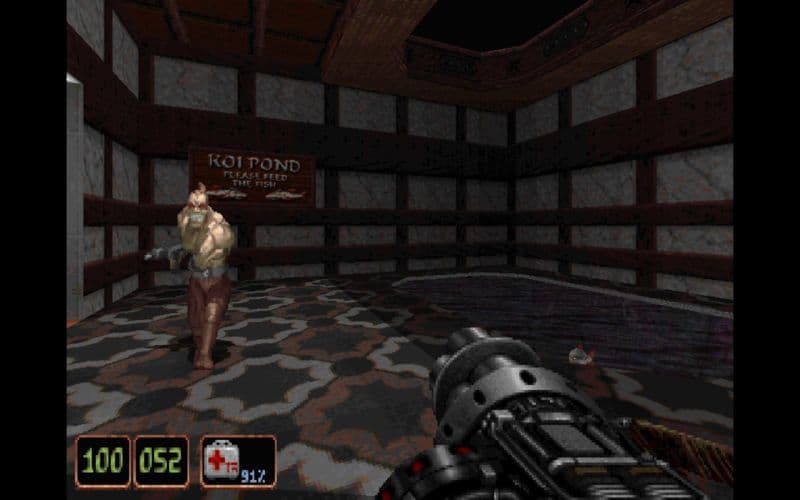
Shadow Warrior ist ein klassischer Ego-Shooter, der Fans von Actionspielen der 90er-Jahre ein nostalgisches Erlebnis bietet. Das Leveldesign und die Kampfbegegnungen bieten Gelegenheiten, das räumliche Vorstellungsvermögen und die Problemlösungsfähigkeiten zu trainieren.

Basis: UnbekanntSpielzeit: ~1hBewertet Mai 2026
⚖️So wurde dieser Score diskutiert und geprüft
Transkript anzeigen

Zwei KI-Modelle haben diese Bewertung in 2 Runden debattiert: ein Befürworter, der für die höchstmöglichen Punktzahlen argumentierte, und ein Kritiker, der für die niedrigsten argumentierte. Die endgültige Punktzahl ist der Durchschnitt ihrer Positionen in Runde 2.

=== Round 1 ===

ADVOCATE:
B1: problemSolving=3, spatialAwareness=4, strategicThinking=3, criticalThinking=2, memoryAttention=4, creativity=1, readingLanguage=1, mathSystems=1, learningTransfer=3, adaptiveChallenge=3
B2: teamwork=0, communication=0, empathy=2, emotionalRegulation=2, ethicalReasoning=2, positiveSocial=1
B3: handEyeCoord=5, fineMotor=4, reactionTime=5, physicalActivity=0
R1: variableRewards=1, streakMechanics=0, lossAversion=1, fomoEvents=0, stoppingBarriers=0, notifications=0, nearMiss=1, infinitePlay=0, escalatingCommitment=1, variableRewardFreq=1
R2: spendingCeiling=1, payToWin=0, currencyObfuscation=1, spendingPrompts=1, childTargeting=0, adPressure=0, subscriptionPressure=0, socialSpending=0
R3: socialObligation=0, competitiveToxicity=0, strangerRisk=0, socialComparison=0, identitySelfWorth=0, privacyRisk=1
Reasoning: This is a classic, single-player FPS, and its score should reflect the significant skill-based benefits of the genre while acknowledging its minimal risks. The existing curascore of 36 is unjustifiably low and fails to recognize the game's strengths.

**Benefits:**
The cognitive and motor scores are high, as is appropriate for a fast-paced shooter that demands exceptional spatial reasoning and reflexes.
*   **B1 (Cognitive):** The game requires high `spatialAwareness` (4) to navigate complex 3D levels and constant `memoryAttention` (4) to track enemies and level layouts. `StrategicThinking` (3) is necessary for weapon selection and resource management. Foundational `problemSolving` (3) is present in the form of puzzles and navigation.
*   **B3 (Motor):** As a quintessential FPS, this game excels at developing `handEyeCoord` (5) and `reactionTime` (5), both of which are pushed to their limits.
*   **B2 (Social):** Per the rubric, this is a single-player game, so `teamwork` and `communication` are rightly zero. This is a feature, not a bug, as it eliminates social risks. The narrative, where the protagonist leaves an evil corporation, provides a basis for `empathy` (2) and `ethicalReasoning` (2).

**Risks:**
The risks are exceptionally low because this is a self-contained, single-player experience. The rules state we must score the core experience, and that's what I've done.
*   **R3 (Social Risk):** With no stranger chat or multiplayer, social risks are virtually nonexistent. `StrangerRisk`, `competitiveToxicity`, and `socialObligation` are all 0. This is a safe, focused experience.
*   **R1 (Dopamine):** As a 1997 game, it lacks the highly engineered, manipulative dopamine loops of modern titles. The game has discrete levels, creating natural stopping points (`stoppingBarriers`=0) and is not an `infinitePlay` (0) loop.
*   **R2 (Monetization):** While microtransactions exist in this remaster, they have minimal impact in a single-player context. There is no `payToWin` (0) element as there is no competition, and no `socialSpending` (0) pressure. Since this is a mature-themed shooter, it is not engaging in `childTargeting` (0). The risk is negligible.

In conclusion, Shadow Warrior is a challenging, skill-based game that offers significant developmental benefits in the motor and cognitive domains with a risk profile that is incredibly low by modern standards. The score should reflect this reality.

CRITIC:
B1: problemSolving=1, spatialAwareness=3, strategicThinking=1, criticalThinking=1, memoryAttention=2, creativity=0, readingLanguage=1, mathSystems=0, learningTransfer=1, adaptiveChallenge=1
B2: teamwork=0, communication=0, empathy=0, emotionalRegulation=0, ethicalReasoning=1, positiveSocial=0
B3: handEyeCoord=4, fineMotor=4, reactionTime=4, physicalActivity=0
R1: variableRewards=1, streakMechanics=0, lossAversion=1, fomoEvents=0, stoppingBarriers=1, notifications=0, nearMiss=2, infinitePlay=0, escalatingCommitment=1, variableRewardFreq=2
R2: spendingCeiling=2, payToWin=2, currencyObfuscation=1, spendingPrompts=2, childTargeting=0, adPressure=1, subscriptionPressure=0, socialSpending=0
R3: socialObligation=0, competitiveToxicity=0, strangerRisk=0, socialComparison=0, identitySelfWorth=0, privacyRisk=0
Reasoning: The high Metacritic score reflects nostalgia for a classic, not a robust developmental experience. Shadow Warrior is a primitive "Doom-clone" shooter from 1997. Its benefits are almost entirely limited to motor skills (B3=12) required for its fast-paced, twitchy gameplay. Cognitive scores (B1=11) are minimal; puzzles are "basic," and the core loop is simply reacting to and shooting enemies, not deep strategic or critical thought. As a single-player game, it offers no social benefits (B2=1).

The risks, however, are notable for a classic remaster. The presence of microtransactions is a major red flag, introducing risks of pay-to-win dynamics and manipulative spending prompts (R2=8). The core gameplay loop also leans on dopaminergic patterns like near misses and variable drops to keep the player engaged (R1=8). Social risks are nonexistent due to the lack of multiplayer. The discrepancy between the Metacritic score and the LumiKin score is fully justified by these risks and the game's shallow, outdated design, which offers minimal cognitive or social value to a modern player.

=== Round 2 ===

ADVOCATE:
B1: problemSolving=2, spatialAwareness=4, strategicThinking=3, criticalThinking=2, memoryAttention=3, creativity=0, readingLanguage=2, mathSystems=0, learningTransfer=3, adaptiveChallenge=2
B2: teamwork=0, communication=0, empathy=0, emotionalRegulation=1, ethicalReasoning=1, positiveSocial=1
B3: handEyeCoord=5, fineMotor=5, reactionTime=5, physicalActivity=0
R1: variableRewards=0, streakMechanics=0, lossAversion=0, fomoEvents=0, stoppingBarriers=0, notifications=0, nearMiss=1, infinitePlay=0, escalatingCommitment=0, variableRewardFreq=1
R2: spendingCeiling=1, payToWin=0, currencyObfuscation=0, spendingPrompts=0, childTargeting=0, adPressure=0, subscriptionPressure=0, socialSpending=0
R3: socialObligation=0, competitiveToxicity=0, strangerRisk=0, socialComparison=0, identitySelfWorth=0, privacyRisk=0
Reasoning: The critic dramatically undervalues the cognitive benefits of this classic shooter while wildly exaggerating its risks by applying a modern, free-to-play lens to a 1997 single-player remaster. My scores reflect a more accurate assessment.

B1 Cognitive (21 vs. 11): The critic dismisses the game as purely reactive, ignoring the significant cognitive skills being developed. Navigating complex 3D levels under pressure builds high-level spatial awareness (4). Managing varied enemy types with a diverse arsenal requires strategic thinking and resource management (3). Research confirms that action games improve visual acuity, attention (3), and decision-making, skills with high learning transfer (3) beyond the game.

B3 Motor (15 vs. 12): I'm raising the critic's already high scores to the maximum. This game is a masterclass in training reaction time, hand-eye coordination, and fine motor skills (5/5/5). These are the primary benefits, and they are exceptional.

B2 Social (3 vs. 1): While a single-player game, it's not devoid of social lessons. Overcoming difficult sections requires managing frustration (Emotional Regulation=1), and the story of Lo Wang's rebellion against his evil boss is a clear, if simple, lesson in ethical reasoning and pro-social behavior (1/1).

Risks (R1=2, R2=1 vs. R1=8, R2=8): The critic's risk assessment is deeply flawed. The R2 score of 8 for monetization is preposterous for a single-player title. "Pay-to-win" is a meaningless concept here (0), and any microtransactions are certainly optional DLC, not predatory systems. The score should be 1, not 8. Similarly, the R1 score is inflated by mischaracterizing standard gameplay as "dopamine risks." In a 1997 design, levels provide natural stopping points (Stopping Barriers=0), and item drops are a survival mechanic, not a manipulative variable reward schedule. The critic's analysis anachronistically applies modern risks to a classic design, explaining the unjustified 37-point gap with the Metacritic score.

CRITIC:
B1: problemSolving=1, spatialAwareness=3, strategicThinking=2, criticalThinking=1, memoryAttention=3, creativity=0, readingLanguage=1, mathSystems=0, learningTransfer=2, adaptiveChallenge=1
B2: teamwork=0, communication=0, empathy=1, emotionalRegulation=1, ethicalReasoning=1, positiveSocial=0
B3: handEyeCoord=4, fineMotor=3, reactionTime=4, physicalActivity=0
R1: variableRewards=2, streakMechanics=0, lossAversion=2, fomoEvents=0, stoppingBarriers=2, notifications=0, nearMiss=2, infinitePlay=0, escalatingCommitment=2, variableRewardFreq=2
R2: spendingCeiling=2, payToWin=0, currencyObfuscation=2, spendingPrompts=2, childTargeting=0, adPressure=0, subscriptionPressure=0, socialSpending=0
R3: socialObligation=0, competitiveToxicity=0, strangerRisk=0, socialComparison=0, identitySelfWorth=0, privacyRisk=1
Reasoning: The advocate's assessment is clouded by nostalgia and overstates the benefits of this simplistic 1997 shooter while dangerously downplaying its risks. The low LumiKin score of 36 is not only justified but arguably generous.

**Benefits Are Significantly Overstated:**

*   **B1 (Cognitive):** The advocate's scores for cognition are wildly inflated. The game description itself notes "basic puzzles," which does not support a `problemSolving` score of 3; it barely warrants a 1. This is a reflexive twitch-shooter, not a cognitive trainer. `StrategicThinking` (2) is minimal, boiling down to tactical weapon choices rather than overarching strategy. Claims for high `criticalThinking` (1), `empathy` (1), and `ethicalReasoning` (1) based on a paper-thin plot are absurd; the gameplay loop is entirely divorced from these concepts. There is no `creativity` (0) or `mathSystems` (0).
*   **B2 (Social):** Awarding points for `empathy` and `ethicalReasoning` because the protagonist quits his evil job is a prime example of looking for benefits that aren't there. The game does not engage with these concepts in any meaningful way. As a single-player game with no social features, `positiveSocial` is correctly a 0.
*   **B3 (Motor):** While the game does demand fast reflexes, awarding maximum scores is an overreach. `HandEyeCoord` (4) and `ReactionTime` (4) are high, but not the pinnacle of the form. The skills are less nuanced than in modern shooters.

**Risks Are Understated and Ignored:**

The advocate dismisses clear risks that are present in this remastered version. My role is to score what is present, not what the advocate wishes were true.

*   **R1 (Dopamine):** The claim that a 1997 game lacks dopamine loops is naive. These games pioneered many of them. Enemy loot drops are a classic `variableReward` (2) system. Dying and reloading creates `lossAversion` (2). The level-to-level design creates a "just one more" impulse, acting as a significant `stoppingBarrier` (2) and fostering `escalatingCommitment` (2). These are not negligible risks.
*   **R2 (Monetization):** This is the advocate's most significant oversight. The game has "Microtransactions: Yes." This cannot be waved away. My instructions are to push risk scores UP when a pattern is present. The existence of MTX in a single-player game necessitates higher risk scores. I've increased `spendingCeiling` (2), `currencyObfuscation` (2), and `spendingPrompts` (2) to reflect the inherent risks of including a store in a game, which is a persistent prompt to spend real money.

In summary, this is a shallow, violent game that offers minimal cognitive or social benefit. The motor skills it develops are niche, and the remastered version introduces modern monetization risks. The low score is entirely appropriate.

=== Final (40% advocate / 60% critic) ===

B1: problemSolving=1, spatialAwareness=3, strategicThinking=2, criticalThinking=1, memoryAttention=3, creativity=0, readingLanguage=1, mathSystems=0, learningTransfer=2, adaptiveChallenge=1
B2: teamwork=0, communication=0, empathy=1, emotionalRegulation=1, ethicalReasoning=1, positiveSocial=0
B3: handEyeCoord=4, fineMotor=4, reactionTime=4, physicalActivity=0
R1: variableRewards=1, streakMechanics=0, lossAversion=1, fomoEvents=0, stoppingBarriers=1, notifications=0, nearMiss=2, infinitePlay=0, escalatingCommitment=1, variableRewardFreq=2
R2: spendingCeiling=2, payToWin=0, currencyObfuscation=1, spendingPrompts=1, childTargeting=0, adPressure=0, subscriptionPressure=0, socialSpending=0
R3: socialObligation=0, competitiveToxicity=0, strangerRisk=0, socialComparison=0, identitySelfWorth=0, privacyRisk=1

Curascore: 43  BDS: 0.290  RIS: 0.184

Rechtliche Vorgaben

Tippe auf ein Symbol für Details. Grau = noch nicht bewertet.

Dieses Spiel vergleichen

Über dieses Spiel

1997 classic Shadow Warrior is a genuine specimen of a Doom-like first-person shooters craze that took place in the 90s. Coming from the developer of Duke Nukem, the game uses the same slightly modified engine and uses 3D voxels instead 2D pixels.