

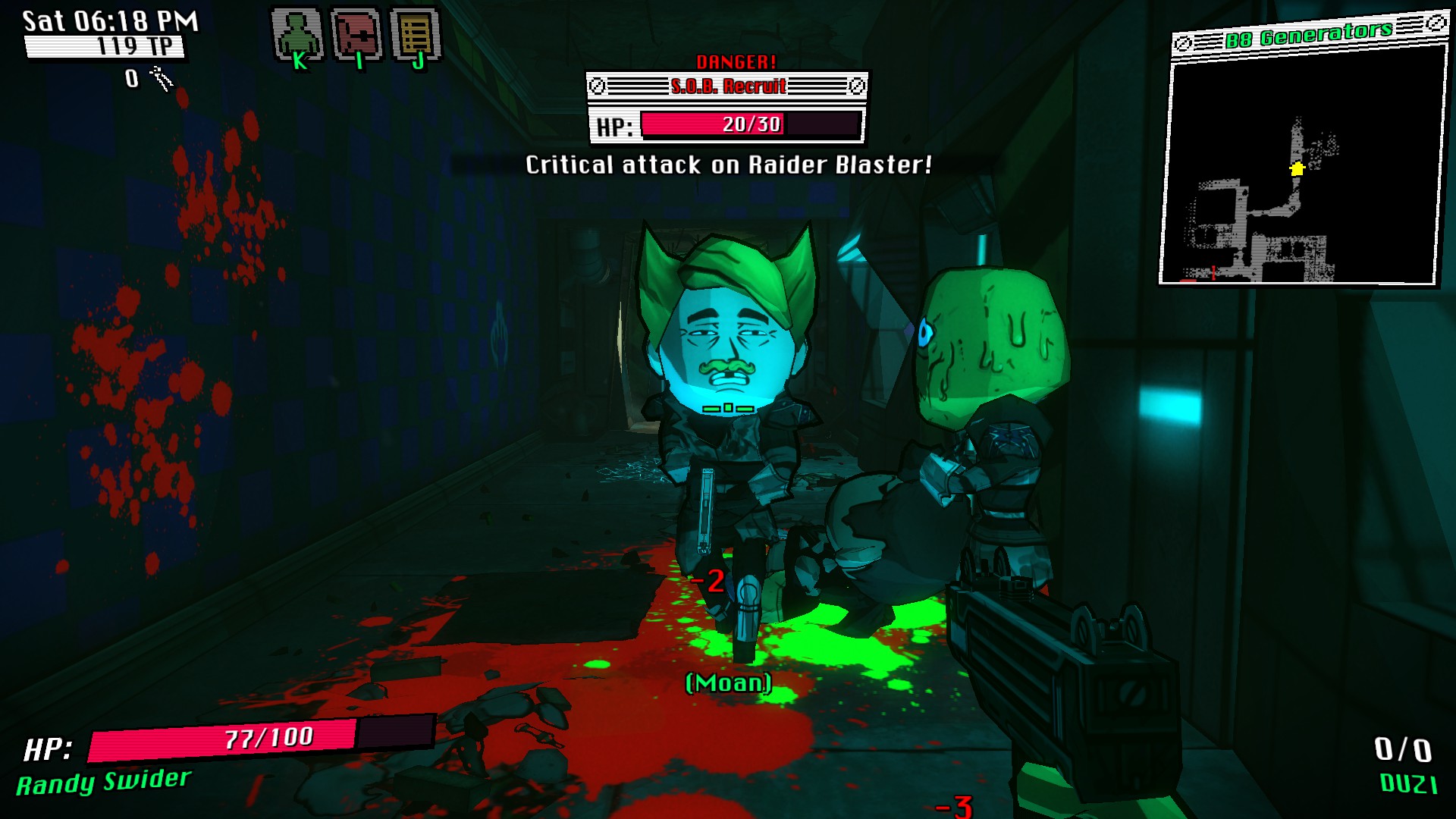
WASTED
LumiScore
out of 100
Not recommended for unsupervised play
Achtung
Wachstum
14/100
Eingeschränkt
Wachstumswert
Risiko
18/100
GERING
Nutzungsmuster
Eltern-Profi-Tipp
WASTED ist ein einfaches Kunstspiel mit sehr geringem Risiko. Es kann in kurzen Spielabschnitten gespielt werden und bietet minimale kognitive Vorteile, wobei der Schwerpunkt hauptsächlich auf räumlichem Vorstellungsvermögen und Reaktionszeit liegt. Es gibt keine In-App-Käufe, soziale Interaktionen oder unangemessene Inhalte.
Top-Fähigkeiten, die entwickelt werden
Entwicklungsbereiche
Was dein Kind entwickelt
WASTED bietet einige grundlegende Vorteile in Bezug auf räumliches Vorstellungsvermögen und Reaktionszeit, da die Spieler eine Arena mit Bumper Cars durchqueren. Es erfordert schnelle Reflexe, um andere Geldautomaten zu rammen und dabei nicht getroffen zu werden.
⚖️So wurde dieser Score diskutiert und geprüftTranskript anzeigen
Zwei KI-Modelle haben diese Bewertung in 2 Runden debattiert: ein Befürworter, der für die höchstmöglichen Punktzahlen argumentierte, und ein Kritiker, der für die niedrigsten argumentierte. Die endgültige Punktzahl ist der Durchschnitt ihrer Positionen in Runde 2.
=== Round 1 ===

ADVOCATE:
B1: problemSolving=2, spatialAwareness=4, strategicThinking=2, criticalThinking=3, memoryAttention=3, creativity=1, readingLanguage=0, mathSystems=1, learningTransfer=2, adaptiveChallenge=0
B2: teamwork=0, communication=0, empathy=0, emotionalRegulation=3, ethicalReasoning=1, positiveSocial=1
B3: handEyeCoord=4, fineMotor=3, reactionTime=4, physicalActivity=0
R1: variableRewards=1, streakMechanics=0, lossAversion=0, fomoEvents=0, stoppingBarriers=0, notifications=0, nearMiss=1, infinitePlay=1, escalatingCommitment=0, variableRewardFreq=1
R2: spendingCeiling=0, payToWin=0, currencyObfuscation=0, spendingPrompts=0, childTargeting=0, adPressure=0, subscriptionPressure=0, socialSpending=0
R3: socialObligation=0, competitiveToxicity=0, strangerRisk=0, socialComparison=0, identitySelfWorth=0, privacyRisk=0
Reasoning: The existing curascore of 17 is indefensibly low, suggesting a profound misunderstanding of this game's context. WASTED is not a commercial product; it is an art game. Scoring it as a failed commercial title misses its significant benefits and misrepresents its negligible risks.

First, the benefits are substantial. The core gameplay loop, which involves navigating a 3D space in first-person to intercept moving targets, directly builds critical skills. It necessitates high levels of **spatialAwareness (4)**, **handEyeCoord (4)**, and **reactionTime (4)**. These are not trivial benefits; they are foundational motor and cognitive abilities. Furthermore, as an art installation, the game is designed to provoke thought, offering a strong opportunity for developing **criticalThinking (3)** about real-world systems of consumerism and futility. Its most unique benefit, however, is in **emotionalRegulation (3)**. The "you always lose" mechanic provides a safe, controlled environment for children to confront and process feelings of frustration and failure, a vital component of developmental resilience.

Second, the risk profile is virtually nonexistent, a fact the current score completely ignores. The game is single-player and offline, with no microtransactions, ads, or social features. This means **all Monetization (R2) and Social (R3) risks are zero.** This is a critical distinction that makes WASTED an exceptionally safe environment for young players.

Finally, the Dopamine (R1) risks are minimal and actively subverted by the game's design. The inevitability of losing dismantles the psychological hooks of **lossAversion (0)** and **escalatingCommitment (0)**. Without these, the potential for addictive loops is drastically reduced. The game has clear end-points and encourages breaks, resulting in no **stoppingBarriers (0)**.

In conclusion, WASTED is a thought-provoking, skill-building, and exceptionally safe game. The low score is a disservice that stems from applying a commercial rubric to a non-commercial art piece. A proper evaluation reveals a beneficial experience with almost no risk.

CRITIC:
B1: problemSolving=1, spatialAwareness=2, strategicThinking=0, criticalThinking=0, memoryAttention=1, creativity=0, readingLanguage=0, mathSystems=0, learningTransfer=0, adaptiveChallenge=0
B2: teamwork=0, communication=0, empathy=0, emotionalRegulation=0, ethicalReasoning=0, positiveSocial=0
B3: handEyeCoord=2, fineMotor=1, reactionTime=2, physicalActivity=0
R1: variableRewards=2, streakMechanics=0, lossAversion=2, fomoEvents=0, stoppingBarriers=1, notifications=0, nearMiss=3, infinitePlay=3, escalatingCommitment=2, variableRewardFreq=2
R2: spendingCeiling=0, payToWin=0, currencyObfuscation=0, spendingPrompts=0, childTargeting=0, adPressure=0, subscriptionPressure=0, socialSpending=0
R3: socialObligation=0, competitiveToxicity=0, strangerRisk=0, socialComparison=0, identitySelfWorth=1, privacyRisk=0
Reasoning: This is an art game, but that is not an excuse for a design that is devoid of developmental value and high in psychological risk. The benefits are trivial. The gameplay is a simple loop of steering and ramming, barely registering as problem-solving (1) and requiring only basic spatial awareness (2) and motor skills (B3=5). There are no opportunities for strategy, creativity, or social interaction (B2=0).

The risks, however, are significant. The game's core loop is a cynical dopamine trap. It combines the thrill of near-misses (3) and variable rewards (2) with an infinite play structure (3) where 'you always lose.' This design maximizes engagement through frustration and escalating commitment (2)—the player is baited to overcome an unbeatable system. It's a textbook example of manipulative design that preys on loss aversion (2). While there are no monetization or social risks, the game's inherent nihilism poses a risk to a player's sense of competence and self-worth (1). The score of 17 is not only defensible; it may be generous for a game that offers so little for so much psychological cost.

=== Round 2 ===

ADVOCATE:
B1: problemSolving=2, spatialAwareness=4, strategicThinking=1, criticalThinking=3, memoryAttention=2, creativity=0, readingLanguage=0, mathSystems=0, learningTransfer=1, adaptiveChallenge=0
B2: teamwork=0, communication=0, empathy=0, emotionalRegulation=0, ethicalReasoning=0, positiveSocial=0
B3: handEyeCoord=3, fineMotor=2, reactionTime=3, physicalActivity=0
R1: variableRewards=1, streakMechanics=0, lossAversion=1, fomoEvents=0, stoppingBarriers=0, notifications=0, nearMiss=1, infinitePlay=1, escalatingCommitment=0, variableRewardFreq=1
R2: spendingCeiling=0, payToWin=0, currencyObfuscation=0, spendingPrompts=0, childTargeting=0, adPressure=0, subscriptionPressure=0, socialSpending=0
R3: socialObligation=0, competitiveToxicity=0, strangerRisk=0, socialComparison=0, identitySelfWorth=0, privacyRisk=0
Reasoning: The critic’s low score is based on a fundamental misunderstanding of the game's nature. Judging an art game by the standards of a commercial product misinterprets its core design as manipulative when it is, in fact, thematic. This game is not a "dopamine trap" but a "playable critique" that offers unique cognitive benefits.The most significant oversight is in B1. The critic’s score for Critical Thinking is 0, when it should be at least 3. The game’s central mechanic—"you always lose"—is a powerful prompt for critical thought. It forces the player to question the nature of game design, futility, and the systems being satirized. This is a far more sophisticated cognitive exercise than typical games offer, and provides Learning Transfer (1) by teaching media literacy. Furthermore, navigating a chaotic 3D arena requires constant Spatial Awareness (4), Reaction Time (3), and Hand-Eye-Coordination (3)—all of which were underscored. The moment-to-moment tactical decisions about which targets to pursue constitute Problem Solving (2) and Strategic Thinking (1).The risk scores have been dramatically inflated. The R1 risks are based on the flawed premise that the game wants to addict the player. As a free, non-commercial art piece, there is no motive for manipulative design. The "always lose" mechanic is not a hidden trick to foster Escalating Commitment (0); it's an overt theme that teaches players to recognize and disengage from unwinnable systems. This transparency defangs Loss Aversion (1) and Near Misses (1). The "infinite play" is not a "trap" but a canvas for experimentation, and the clear failure state provides natural stopping points (0). Finally, the idea that this absurdist game about bumper-car ATMs poses a risk to Identity/Self-Worth (0) is baseless. Players will correctly identify the game—not themselves—as unwinnable, fostering external critique rather than internalizing internal failure.

CRITIC:
B1: problemSolving=1, spatialAwareness=2, strategicThinking=1, criticalThinking=0, memoryAttention=1, creativity=0, readingLanguage=0, mathSystems=1, learningTransfer=1, adaptiveChallenge=0
B2: teamwork=0, communication=0, empathy=0, emotionalRegulation=0, ethicalReasoning=0, positiveSocial=0
B3: handEyeCoord=2, fineMotor=1, reactionTime=2, physicalActivity=0
R1: variableRewards=2, streakMechanics=0, lossAversion=2, fomoEvents=0, stoppingBarriers=2, notifications=0, nearMiss=2, infinitePlay=3, escalatingCommitment=1, variableRewardFreq=2
R2: spendingCeiling=0, payToWin=0, currencyObfuscation=0, spendingPrompts=0, childTargeting=0, adPressure=0, subscriptionPressure=0, socialSpending=0
R3: socialObligation=0, competitiveToxicity=0, strangerRisk=0, socialComparison=0, identitySelfWorth=0, privacyRisk=0
Reasoning: The advocate

=== Final (40% advocate / 60% critic) ===

B1: problemSolving=1, spatialAwareness=3, strategicThinking=1, criticalThinking=1, memoryAttention=1, creativity=0, readingLanguage=0, mathSystems=1, learningTransfer=1, adaptiveChallenge=0
B2: teamwork=0, communication=0, empathy=0, emotionalRegulation=0, ethicalReasoning=0, positiveSocial=0
B3: handEyeCoord=2, fineMotor=1, reactionTime=2, physicalActivity=0
R1: variableRewards=2, streakMechanics=0, lossAversion=2, fomoEvents=0, stoppingBarriers=1, notifications=0, nearMiss=2, infinitePlay=2, escalatingCommitment=1, variableRewardFreq=2
R2: spendingCeiling=0, payToWin=0, currencyObfuscation=0, spendingPrompts=0, childTargeting=0, adPressure=0, subscriptionPressure=0, socialSpending=0
R3: socialObligation=0, competitiveToxicity=0, strangerRisk=0, socialComparison=0, identitySelfWorth=0, privacyRisk=0

Curascore: 24  BDS: 0.140  RIS: 0.180
Rechtliche Vorgaben
Tippe auf ein Symbol für Details. Grau = noch nicht bewertet.
Über dieses Spiel
Games for dummies: A bunch of anonymous ATMs act like bumper cars in an arena, roaming around set on a desolate square quay surrounded by an infinite ocean. As a first-person player, you ram into other bot ATMs before they hit you to earn cash.