Review · Family · iOS
3d Voxel Art: Color by Number
Reviewed: 15 Apr 2026
iOS
Virede · 2018
Ludograph rating
E
Avoid
22 /100
3d Voxel Art: Color by Number is a puzzle game that fosters spatial awareness and emotional regulation, though its monetization targets families.
Growth (BDS)
13
Risk (RIS)
23
Daily limit
90min
Age guidance
–
Developmental benefits
| B1 | Cognitive | 0.14 | |
| B2 | Social-emotional | 0.07 | |
| B3 | Motor | 0.20 | |
3D Voxel Art offers minimal cognitive benefits, primarily focused on relaxation rather than skill development. Players engage in simple color-by-number activities that require basic spatial awareness (2/5) as they rotate and manipulate 3D models, and minimal problem-solving (1/5) in identifying which numbered blocks to color. The activity provides modest stress relief and emotional regulation benefits (2/5) through its meditative, low-pressure gameplay. Fine motor skills (2/5) and hand-eye coordination (2/5) receive light exercise through tapping and gesture controls. The game includes some mathematical awareness (1/5) through number recognition and minimal creativity (1/5) within the constrained coloring framework. Overall cognitive engagement is very low (B1=7/50), with essentially no social-emotional development (B2=2/30) and minimal motor benefits (B3=4/20).
Design risks
| R1 | Compulsion-loop pressure | 0.20 | |
| R2 | Monetization | 0.42 | |
| R3 | Social risk | 0.06 | |
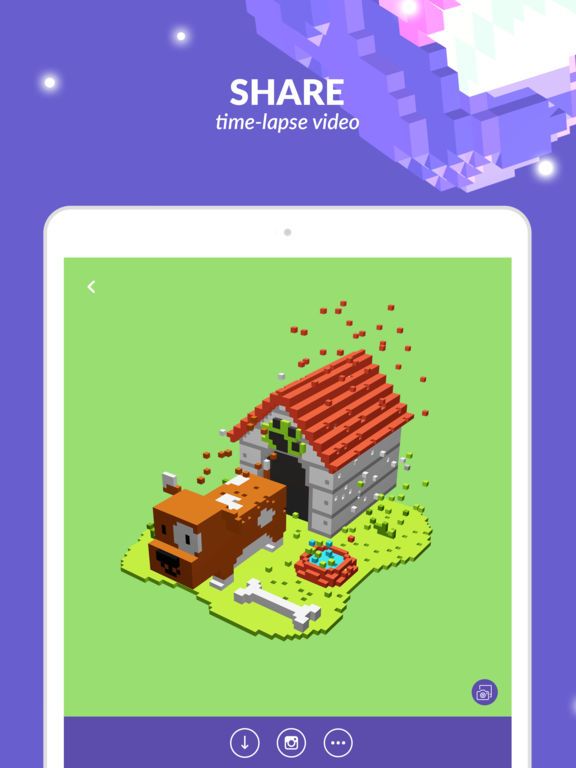
The primary concern with 3D Voxel Art is its aggressive monetization targeting families and children. The $2.99/week subscription ($12.99/month) is extremely expensive for such a simple activity, and ads are present throughout unless users subscribe, creating significant ad pressure (3/3). The subscription model is heavily promoted (3/3) for what amounts to basic coloring content. The app specifically targets children with cute animals (unicorns, cats, dogs, ponies) while implementing family-friendly pricing tactics (2/3 child targeting). The game encourages extended play through infinite content and daily updates (2/3 infinite play) with some FOMO elements around daily content (1/3). The content itself is completely benign (R4=0/15) with no concerning material, and social risks are minimal (R3=1/18) with only basic privacy concerns from data collection. Total risk scores: R1=6/30, R2=10/24.
Content (not in risk score)
| R4.1 | Violence Level | 0.00 | |
| R4.2 | Sexual Content | 0.00 | |
| R4.3 | Language | 0.00 | |
| R4.4 | Substance References | 0.00 | |
| R4.5 | Fear / Horror | 0.00 | |
Content risk is displayed separately and does not affect the time recommendation.
Heads up
- Monthly spendTypical real-money spend by engaged players: $0 – $13/mo.
Regulatory design checks · DSA — Assessed: concerns noted·GDPR-K — Assessed: concerns noted·ODDS — Assessed: meets criteria
- DSA:What Ludograph checks: whether the game's design gives minors the transparency the EU Digital Services Act expects: plain terms, honest defaults, and clear reporting routes.: Estimated from review data. Likely violations: monetisation that deliberately targets children.
- GDPR-K:What Ludograph checks: whether age assurance and consent flows are designed for under-16s, in the spirit of GDPR Article 8.: Estimated from review data. Likely violations: profiling or targeting of children for marketing.
- ODDS:What Ludograph checks: whether paid random-reward drop rates are disclosed, as required in China, Japan and South Korea.: Estimated from review data. No paid random-reward mechanics found, so drop-rate disclosure requirements do not apply.
These reflect Ludograph's assessment of the game's design practices against each framework's criteria, not a legal compliance determination.