Review · Puzzle · Web
Covid19: Facts & Fake News
Reviewed: 18 Apr 2026
Web
One Man Battleship · 2020
Ludograph rating
D
Caution
38 /100
Covid19: Facts & Fake News is an educational quiz that develops critical thinking and reading skills, but may subtly promote equating institutional authority with truth.
Growth (BDS)
24
Risk (RIS)
3
Daily limit
120min
Age guidance
7+
Developmental benefits
| B1 | Cognitive | 0.36 | |
| B2 | Social-emotional | 0.13 | |
| B3 | Motor | 0.10 | |
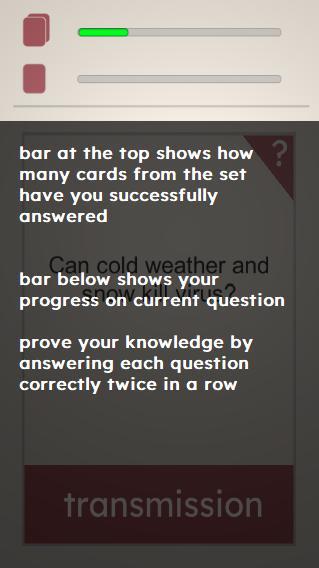
Covid19: Facts & Fake News is a lean, purposeful educational quiz that directly exercises critical thinking and media literacy. Players must evaluate real-world health claims and distinguish verified facts from misinformation — a genuinely valuable cognitive skill. The confirmation mechanic (answering twice before the result is revealed) discourages guessing and lightly reinforces active recall, boosting memory retention. Reading comprehension is meaningfully exercised as players must parse nuanced public-health statements. The learning-transfer potential is notable: the habit of asking 'is this a fact or misinformation?' is directly applicable to everyday news consumption, especially relevant during a pandemic.
Design risks
| R1 | Compulsion-loop pressure | 0.07 | |
| R2 | Monetization | 0.00 | |
| R3 | Social risk | 0.00 | |
The primary risk is subtle: by framing WHO and governmental guidance as the definitive arbiter of 'fact', the game may inadvertently teach children to equate institutional authority with truth rather than to interrogate evidence independently. This mild propagandistic framing warrants a parent conversation. The subject matter (a global pandemic, disease, death statistics) could generate low-level anxiety in sensitive or younger children. Beyond that, the game is remarkably clean — no monetization, no manipulative mechanics, no social risks, no inappropriate content.
Content (not in risk score)
| R4.1 | Violence Level | 0.00 | |
| R4.2 | Sexual Content | 0.00 | |
| R4.3 | Language | 0.00 | |
| R4.4 | Substance References | 0.00 | |
| R4.5 | Fear / Horror | 0.33 | |
Content risk is displayed separately and does not affect the time recommendation.
Regulatory design checks · DSA — Assessed: meets criteria·GDPR-K — Assessed: meets criteria·ODDS — Assessed: meets criteria
- DSA:What Ludograph checks: whether the game's design gives minors the transparency the EU Digital Services Act expects: plain terms, honest defaults, and clear reporting routes.: Estimated from review data. No dark pattern or child-targeting concerns found.
- GDPR-K:What Ludograph checks: whether age assurance and consent flows are designed for under-16s, in the spirit of GDPR Article 8.: Estimated from review data. No privacy or child-targeting concerns found.
- ODDS:What Ludograph checks: whether paid random-reward drop rates are disclosed, as required in China, Japan and South Korea.: Estimated from review data. No paid random-reward mechanics found, so drop-rate disclosure requirements do not apply.
These reflect Ludograph's assessment of the game's design practices against each framework's criteria, not a legal compliance determination.