Review · Action · PC
Decksplash Free Week
Reviewed: 21 May 2026
PC
Bossa Studios · 2017
Ludograph rating
Growth (BDS)
36
Risk (RIS)
38
Daily limit
60min
Age guidance
7+
Developmental benefits
| B1 | Cognitive | 0.40 | |
| B2 | Social-emotional | 0.23 | |
| B3 | Motor | 0.45 | |
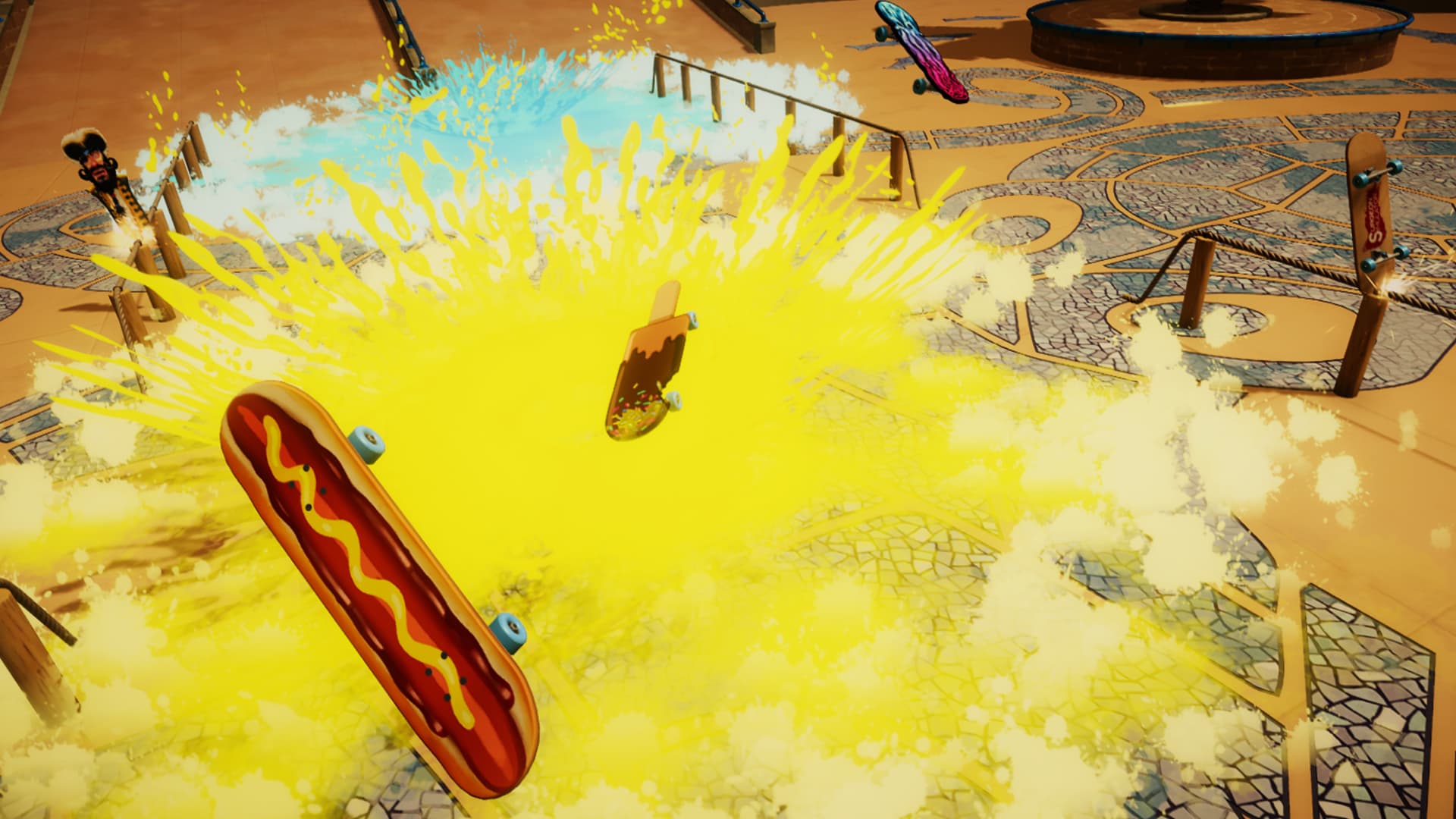
Decksplash offers engaging 3v3 competitive gameplay that can foster strategic thinking, problem-solving, and spatial awareness through its trick system and 3D controls. Teamwork and positive social interaction are encouraged through its 'Party Up' feature. Players can also develop hand-eye coordination, fine motor skills, and reaction time in its fast-paced matches.
Design risks
| R1 | Compulsion-loop pressure | 0.43 | |
| R2 | Monetization | 0.00 | |
| R3 | Social risk | 0.72 | |
The 'Splash N' Grab' launch event heavily utilizes FOMO (Fear Of Missing Out) and loss aversion by tying the game's release to a download count and offering exclusive, time-limited rewards like the Eirik board. This creates significant social obligation and pressure on players to recruit others. The game's competitive nature, combined with leaderboards and explicit encouragement to 'look down on those around you,' can lead to competitive toxicity, social comparison, and tie a child's identity and self-worth to their performance and the game's success. Variable rewards from loot boxes also contribute to engagement manipulation.
Content (not in risk score)
| R4.1 | Violence Level | 0.33 | |
| R4.2 | Sexual Content | 0.00 | |
| R4.3 | Language | 0.33 | |
| R4.4 | Substance References | 0.00 | |
| R4.5 | Fear / Horror | 0.00 | |
Content risk is displayed separately and does not affect the time recommendation.
Regulatory design checks · DSA — Assessed: meets criteria·GDPR-K — Not yet assessed·ODDS — Assessed: meets criteria
- DSA:What Ludograph checks: whether the game's design gives minors the transparency the EU Digital Services Act expects: plain terms, honest defaults, and clear reporting routes.: Estimated from review data. No dark pattern or child-targeting concerns found.
- GDPR-K:What Ludograph checks: whether age assurance and consent flows are designed for under-16s, in the spirit of GDPR Article 8.
- ODDS:What Ludograph checks: whether paid random-reward drop rates are disclosed, as required in China, Japan and South Korea.: Estimated from review data. No paid random-reward mechanics found, so drop-rate disclosure requirements do not apply.
These reflect Ludograph's assessment of the game's design practices against each framework's criteria, not a legal compliance determination.