Review · Action · PC · Android · Linux
10000000
Reviewed: 12 May 2026
PC · Android · Linux · macOS · iOS
EightyEight Games · 2012
Ludograph rating
D
Caution
41 /100
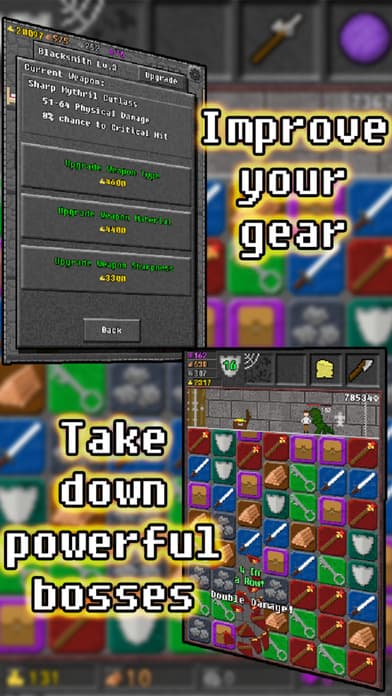
10000000 is a fast-paced puzzle RPG that develops problem-solving and strategic thinking, but has a moderate risk for excessive screen time.
Growth (BDS)
28
Risk (RIS)
24
Daily limit
90min
Age guidance
7+
Developmental benefits
| B1 | Cognitive | 0.36 | |
| B2 | Social-emotional | 0.00 | |
| B3 | Motor | 0.45 | |
10000000 is a fast-paced puzzle RPG that challenges players with resource management, quick decision-making, and strategic planning. Its core mechanic of matching tiles to progress and defeat enemies engages problem-solving and critical thinking skills. The game's escalating difficulty and continuous goal of improving one's character and castle offer a sense of achievement and encourage adaptive learning. While primarily a single-player experience, the engaging gameplay loop can be highly satisfying.
Design risks
| R1 | Compulsion-loop pressure | 0.43 | |
| R2 | Monetization | 0.00 | |
| R3 | Social risk | 0.00 | |
The game's 'just one more run' nature, coupled with its 'infinite play' design and variable reward schedule, presents a moderate risk for excessive screen time. Players might find themselves compelled to continue playing for longer than intended due to the constant progression and the desire to achieve the 10,000,000 score. The lack of natural stopping points further contributes to this risk. Content-wise, the violence is minimal and cartoonish, primarily involving fantasy creatures.
Content (not in risk score)
| R4.1 | Violence Level | 0.33 | |
| R4.2 | Sexual Content | 0.00 | |
| R4.3 | Language | 0.00 | |
| R4.4 | Substance References | 0.00 | |
| R4.5 | Fear / Horror | 0.00 | |
Content risk is displayed separately and does not affect the time recommendation.
Regulatory design checks · DSA — Assessed: meets criteria·GDPR-K — Assessed: meets criteria·ODDS — Assessed: meets criteria
- DSA:What Ludograph checks: whether the game's design gives minors the transparency the EU Digital Services Act expects: plain terms, honest defaults, and clear reporting routes.: Estimated from review data. No dark pattern or child-targeting concerns found.
- GDPR-K:What Ludograph checks: whether age assurance and consent flows are designed for under-16s, in the spirit of GDPR Article 8.: Estimated from review data. No privacy or child-targeting concerns found.
- ODDS:What Ludograph checks: whether paid random-reward drop rates are disclosed, as required in China, Japan and South Korea.: Estimated from review data. No paid random-reward mechanics found, so drop-rate disclosure requirements do not apply.
These reflect Ludograph's assessment of the game's design practices against each framework's criteria, not a legal compliance determination.