Review · Arcade · iOS
Jewel Jive
Reviewed: 14 Apr 2026
iOS
Raimond Kuhlman · 2015
Ludograph rating
D
Caution
37 /100
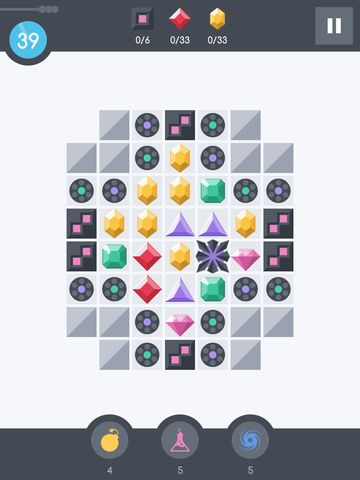
Jewel Jive is an arcade puzzle game that develops problem solving, spatial awareness, and strategic thinking, but uses moderate compulsion-loop design.
Growth (BDS)
26
Risk (RIS)
35
Daily limit
60min
Age guidance
10+
Developmental benefits
| B1 | Cognitive | 0.40 | |
| B2 | Social-emotional | 0.03 | |
| B3 | Motor | 0.25 | |
Jewel Jive provides solid cognitive benefits through its match-3 puzzle mechanics. The core gameplay requires problem-solving as players must identify optimal gem combinations and plan moves strategically. With 215 levels featuring 'cunningly designed' challenges and evolving 'jewel viruses,' the game offers meaningful spatial awareness development and strategic thinking. The adaptive challenge increases as levels progress and viruses evolve, keeping players engaged. Power-ups add tactical depth, requiring players to decide when to deploy special moves. The puzzle format encourages pattern recognition and planning ahead to maximize matches. However, creative expression is limited by the predetermined level structures, and there's minimal reading, math, or learning transfer beyond basic puzzle-solving skills.
Design risks
| R1 | Compulsion-loop pressure | 0.53 | |
| R2 | Monetization | 0.33 | |
| R3 | Social risk | 0.06 | |
Jewel Jive employs moderate compulsion-loop design tactics typical of free-to-play match-3 games. The game features variable rewards through star ratings and power-up drops, with near-miss scenarios common to the genre (almost completing a level or nearly matching gems). Loss aversion is present through the lives system where players can pay for 'extra moves or lives,' creating pressure to spend rather than lose progress. The 215-level structure with episodic unlocks encourages escalating commitment. Stopping barriers exist when lives run out, though the game claims to be playable offline. Monetization pressure centers on purchasing extra moves and lives at failure points, which can feel pay-to-win when stuck on difficult levels. Spending prompts likely appear after failed attempts. However, there's no subscription pressure, no social spending mechanics, and no multiplayer toxicity since it's a single-player experience. Content is completely family-friendly with no concerning themes.
Content (not in risk score)
| R4.1 | Violence Level | 0.00 | |
| R4.2 | Sexual Content | 0.00 | |
| R4.3 | Language | 0.00 | |
| R4.4 | Substance References | 0.00 | |
| R4.5 | Fear / Horror | 0.00 | |
Content risk is displayed separately and does not affect the time recommendation.
Heads up
- Monthly spendTypical real-money spend by engaged players: $0 – $15/mo.
Regulatory design checks · DSA — Assessed: concerns noted·GDPR-K — Not yet assessed·ODDS — Assessed: meets criteria
- DSA:What Ludograph checks: whether the game's design gives minors the transparency the EU Digital Services Act expects: plain terms, honest defaults, and clear reporting routes.: Estimated from review data. Likely violations: frequent spending prompts in a children-rated game.
- GDPR-K:What Ludograph checks: whether age assurance and consent flows are designed for under-16s, in the spirit of GDPR Article 8.
- ODDS:What Ludograph checks: whether paid random-reward drop rates are disclosed, as required in China, Japan and South Korea.: Estimated from review data. No paid random-reward mechanics found, so drop-rate disclosure requirements do not apply.
These reflect Ludograph's assessment of the game's design practices against each framework's criteria, not a legal compliance determination.