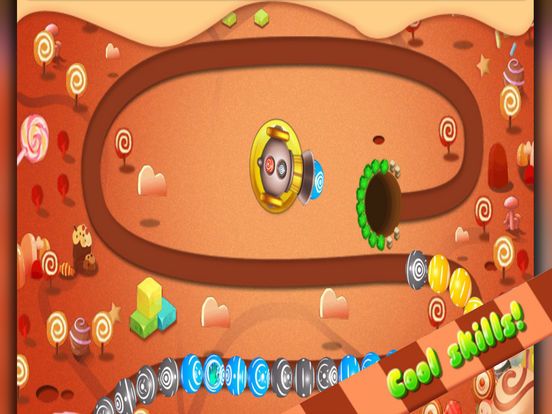
Review · Arcade · iOS
Jungle Ball Shoot
Reviewed: 21 Apr 2026
iOS
NGUYEN THE DONG · 2018
Ludograph rating
D
Caution
41 /100
Jungle Ball Shoot is an arcade puzzle game that develops problem solving, spatial awareness, and strategic thinking, but may include ads.
Growth (BDS)
28
Risk (RIS)
23
Daily limit
90min
Age guidance
10+
Developmental benefits
| B1 | Cognitive | 0.40 | |
| B2 | Social-emotional | 0.03 | |
| B3 | Motor | 0.35 | |
Jungle Ball Shoot is a classic marble-shooter puzzle game that offers a modest set of cognitive benefits for younger players. The core mechanic of matching three or more same-colored balls requires spatial planning and shot-angle estimation, giving handEyeCoordination and spatialAwareness a genuine workout. Choosing which ball to shoot next and when to swap introduces light strategic thinking and problem-solving. The game's level-based progression with multiple path layouts means children encounter new spatial puzzles regularly, providing some adaptive challenge and learning transfer as they apply marble-trajectory skills to novel configurations.
Design risks
| R1 | Compulsion-loop pressure | 0.40 | |
| R2 | Monetization | 0.08 | |
| R3 | Social risk | 0.11 | |
The primary risk in Jungle Ball Shoot is typical of free casual mobile games: likely ad-supported monetization. Mobile titles of this type commonly display interstitial or banner ads between levels, which can expose children to inappropriate advertising content and interrupt the play experience. The three-star scoring system and level structure create mild near-miss tension (just missing a third star) and some loss-aversion pressure to replay levels. These mechanics are relatively low-intensity compared to live-service games, and the absence of loot boxes, battle passes, subscriptions, and stranger chat keeps the risk profile light overall.
Content (not in risk score)
| R4.1 | Violence Level | 0.00 | |
| R4.2 | Sexual Content | 0.00 | |
| R4.3 | Language | 0.00 | |
| R4.4 | Substance References | 0.00 | |
| R4.5 | Fear / Horror | 0.00 | |
Content risk is displayed separately and does not affect the time recommendation.
Regulatory design checks · DSA — Assessed: meets criteria·GDPR-K — Assessed: meets criteria·ODDS — Assessed: meets criteria
- DSA:What Ludograph checks: whether the game's design gives minors the transparency the EU Digital Services Act expects: plain terms, honest defaults, and clear reporting routes.: Estimated from review data. No dark pattern or child-targeting concerns found.
- GDPR-K:What Ludograph checks: whether age assurance and consent flows are designed for under-16s, in the spirit of GDPR Article 8.: Estimated from review data. No privacy or child-targeting concerns found.
- ODDS:What Ludograph checks: whether paid random-reward drop rates are disclosed, as required in China, Japan and South Korea.: Estimated from review data. No paid random-reward mechanics found, so drop-rate disclosure requirements do not apply.
These reflect Ludograph's assessment of the game's design practices against each framework's criteria, not a legal compliance determination.