Review · Educational · PC
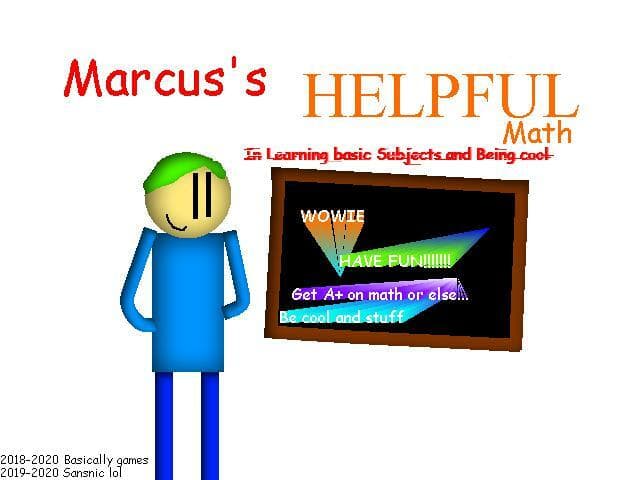
Marcus's Helpful math in learning basic subjects in being cool
Reviewed: 11 May 2026
PC
Sansnic. · 2020
Ludograph rating
B
Good
58 /100
Marcus's Helpful math in learning basic subjects in being cool is an educational game that develops math skills and spatial awareness, but has mild survival horror elements.
Growth (BDS)
42
Risk (RIS)
5
Daily limit
120min
Age guidance
10+
Developmental benefits
| B1 | Cognitive | 0.64 | |
| B2 | Social-emotional | 0.03 | |
| B3 | Motor | 0.45 | |
Marcus's Helpful Math offers a unique blend of educational math challenges and light survival horror gameplay. Players must solve math problems to progress, enhancing problem-solving, critical thinking, and basic math skills. The game also requires spatial awareness and quick reactions to navigate the environment and avoid the antagonist.
Design risks
| R1 | Compulsion-loop pressure | 0.10 | |
| R2 | Monetization | 0.00 | |
| R3 | Social risk | 0.00 | |
The game's survival horror elements, involving being chased by a hostile character, may induce mild fear or anxiety in some players. While not designed for manipulation, the 'game over' state upon being caught could be seen as a minor form of loss aversion. There are no significant social, monetization, or compulsion-loop design risks.
Content (not in risk score)
| R4.1 | Violence Level | 0.33 | |
| R4.2 | Sexual Content | 0.00 | |
| R4.3 | Language | 0.00 | |
| R4.4 | Substance References | 0.00 | |
| R4.5 | Fear / Horror | 0.67 | |
Content risk is displayed separately and does not affect the time recommendation.
Regulatory design checks · DSA — Assessed: meets criteria·GDPR-K — Assessed: meets criteria·ODDS — Assessed: meets criteria
- DSA:What Ludograph checks: whether the game's design gives minors the transparency the EU Digital Services Act expects: plain terms, honest defaults, and clear reporting routes.: Estimated from review data. No dark pattern or child-targeting concerns found.
- GDPR-K:What Ludograph checks: whether age assurance and consent flows are designed for under-16s, in the spirit of GDPR Article 8.: Estimated from review data. No privacy or child-targeting concerns found.
- ODDS:What Ludograph checks: whether paid random-reward drop rates are disclosed, as required in China, Japan and South Korea.: Estimated from review data. No paid random-reward mechanics found, so drop-rate disclosure requirements do not apply.
These reflect Ludograph's assessment of the game's design practices against each framework's criteria, not a legal compliance determination.