Review · Racing · Wii U · Wii · Nintendo 64
Mario Kart 64 (1996)
Reviewed: 15 May 2026
Wii U · Wii · Nintendo 64
Nintendo · 1996
Ludograph rating
C
Mixed
57 /100
Mario Kart 64 is a classic racing game that builds spatial awareness and hand-eye coordination through its 3D environments, with minor competitive risks.
Growth (BDS)
45
Risk (RIS)
23
Daily limit
90min
Age guidance
7+
Developmental benefits
| B1 | Cognitive | 0.42 | |
| B2 | Social-emotional | 0.27 | |
| B3 | Motor | 0.65 | |
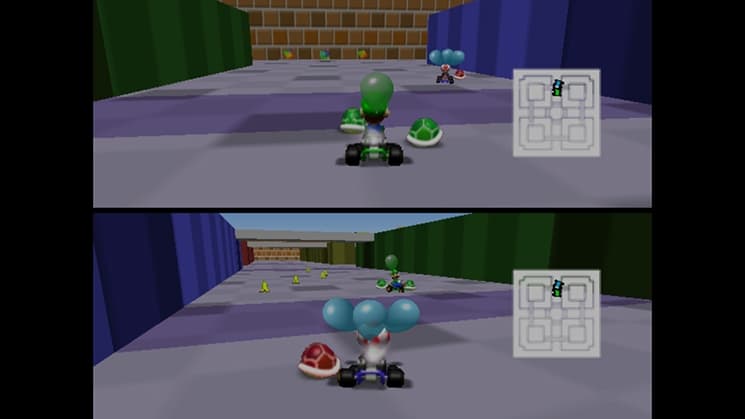
Mario Kart 64 excels in developing spatial awareness and hand-eye coordination through its 3D racing environments. Players need to learn track layouts and anticipate turns, boosting cognitive skills. The competitive nature can also foster healthy rivalry and emotional regulation, especially in local multiplayer settings. The game's straightforward mechanics and clear goals make it easy to pick up and play, promoting learning transfer.
Design risks
| R1 | Compulsion-loop pressure | 0.10 | |
| R2 | Monetization | 0.00 | |
| R3 | Social risk | 0.11 | |
While largely benign, the game can induce some competitive toxicity, especially when playing with others. The simple item system, while fun, can lead to frustration for younger players. There is minimal representation beyond gender, and no real-world social risks due to its local multiplayer focus and lack of online interaction.
Content (not in risk score)
| R4.1 | Violence Level | 0.33 | |
| R4.2 | Sexual Content | 0.00 | |
| R4.3 | Language | 0.00 | |
| R4.4 | Substance References | 0.00 | |
| R4.5 | Fear / Horror | 0.00 | |
Content risk is displayed separately and does not affect the time recommendation.
Regulatory design checks · DSA — Assessed: meets criteria·GDPR-K — Assessed: meets criteria·ODDS — Assessed: meets criteria
- DSA:What Ludograph checks: whether the game's design gives minors the transparency the EU Digital Services Act expects: plain terms, honest defaults, and clear reporting routes.: Estimated from review data. No dark pattern or child-targeting concerns found.
- GDPR-K:What Ludograph checks: whether age assurance and consent flows are designed for under-16s, in the spirit of GDPR Article 8.: Estimated from review data. No privacy or child-targeting concerns found.
- ODDS:What Ludograph checks: whether paid random-reward drop rates are disclosed, as required in China, Japan and South Korea.: Estimated from review data. No paid random-reward mechanics found, so drop-rate disclosure requirements do not apply.
These reflect Ludograph's assessment of the game's design practices against each framework's criteria, not a legal compliance determination.