LumiKin
Metacritic 8713+

Miracle Merchant

Arnold Rauers|2017Board GamesCard

LumiScore

33

out of 100

Not recommended for unsupervised play

Up to120min/day
⚖️Adversarial debate · 2 rounds

Heads up

💸 Monthly cost: Free

Growth

22/100

Limited

Growth Value

Risk

34/100

MODERATE

Engagement Patterns

Parent Pro-Tip

This game is a great choice for developing strategic thinking and problem-solving skills in short, manageable bursts. Its lack of monetization and social chat features makes it a safe and straightforward experience.

Top Skills Developed

Problem Solving3/5
Strategic Thinking3/5
Critical Thinking3/5
Memory & Attention3/5
Reading & Language3/5

Development Areas

CognitiveProblem solving, spatial awareness, strategic thinking, creativity, memory, and learning transfer. Weighted 50% of the Benefit Score.
40
Social & EmotionalTeamwork, communication, empathy, emotional regulation, and ethical reasoning. Weighted 30% of the Benefit Score.
7
Motor SkillsHand-eye coordination, fine motor control, reaction time, and physical activity. Weighted 20% of the Benefit Score.
10
Overall Benefit Score (BDS)22/100

What your child develops

Miracle Merchant offers a unique solitaire card game experience that fosters strategic thinking, problem-solving, and critical analysis through its randomly generated challenges. Its short play sessions make it accessible for quick mental engagement.

Base: UnknownReviewed May 2026
⚖️How this score was debate-reviewed
Show transcript

Two AI models debated this score in 2 rounds: an Advocate arguing for the highest defensible scores, and a Critic arguing for the lowest. The final score averages their round-2 positions.

=== Round 1 ===

ADVOCATE:
B1: problemSolving=5, spatialAwareness=2, strategicThinking=5, criticalThinking=4, memoryAttention=4, creativity=2, readingLanguage=2, mathSystems=4, learningTransfer=2, adaptiveChallenge=4
B2: teamwork=0, communication=0, empathy=2, emotionalRegulation=2, ethicalReasoning=0, positiveSocial=1
B3: handEyeCoord=2, fineMotor=2, reactionTime=0, physicalActivity=0
R1: variableRewards=1, streakMechanics=1, lossAversion=1, fomoEvents=1, stoppingBarriers=0, notifications=1, nearMiss=1, infinitePlay=0, escalatingCommitment=1, variableRewardFreq=1
R2: spendingCeiling=0, payToWin=0, currencyObfuscation=0, spendingPrompts=0, childTargeting=0, adPressure=0, subscriptionPressure=0, socialSpending=0
R3: socialObligation=0, competitiveToxicity=0, strangerRisk=0, socialComparison=1, identitySelfWorth=0, privacyRisk=0
Reasoning: The 50-point gap between the Metacritic score of 87 and the LumiKin score of 37 is indefensible and suggests a profound misreading of this game. "Miracle Merchant" is a gem of cognitive skill development with virtually zero risk. 

**Cognitive Benefits (B1) are Exceptional:**
This is a premier "brainy" game. The core loop is a "mix and combine puzzle" requiring high degrees of **problem-solving (5)** and **strategic-thinking (5)** to create potions based on customer needs from a randomly generated set of cards. This also necessitates strong **critical thinking (4)** to evaluate card values and **math/systems thinking (4)** to calculate potion outcomes. The daily challenges and unique card sets for each game provide a robust **adaptive challenge (4)**, while remembering recipes hones **memory and attention (4)**. 

**Risks are Categorically Low to Non-Existent:**

*   **Monetization Risk (R2) is Zero:** The game has NO microtransactions, NO loot boxes, NO ads, and NO subscriptions. A score of 0 across the board is the only logical conclusion. It is a model of ethical design.

*   **Social Risk (R3) is Virtually Zero:** This is a "solitaire style" single-player game. There is no chat, no stranger interaction, and no social obligation. The *only* vector for social risk is a global leaderboard, warranting a minimal score of 1 for **social comparison**, but it presents no meaningful danger.

*   **Dopamine Risk (R1) is Wildly Overstated:** Any minimal risks are completely neutered by the game's most important feature: a "2-3mins playtime per game." This structure creates a natural and easy stopping point, completely eliminating the risk of **stopping barriers (0)** and **infinite play (0)**. Other risks are standard, low-level components of any card game and are not implemented in a predatory way here.

"Miracle Merchant" is a poster child for a healthy game. It is a short-form, mentally engaging puzzler that respects the player's time and money. The low LumiKin score appears to penalize the game for risks that are demonstrably absent, ignoring its significant cognitive benefits. This score needs a major correction.

CRITIC:
B1: problemSolving=2, spatialAwareness=1, strategicThinking=2, criticalThinking=2, memoryAttention=2, creativity=1, readingLanguage=1, mathSystems=2, learningTransfer=1, adaptiveChallenge=1
B2: teamwork=0, communication=0, empathy=0, emotionalRegulation=0, ethicalReasoning=0, positiveSocial=1
B3: handEyeCoord=1, fineMotor=1, reactionTime=0, physicalActivity=0
R1: variableRewards=3, streakMechanics=3, lossAversion=2, fomoEvents=3, stoppingBarriers=3, notifications=3, nearMiss=3, infinitePlay=3, escalatingCommitment=2, variableRewardFreq=3
R2: spendingCeiling=0, payToWin=0, currencyObfuscation=0, spendingPrompts=0, childTargeting=0, adPressure=0, subscriptionPressure=0, socialSpending=0
R3: socialObligation=0, competitiveToxicity=1, strangerRisk=1, socialComparison=3, identitySelfWorth=1, privacyRisk=1
Reasoning: My position is that Miracle Merchant's high Metacritic score masks a game with trivial benefits and a dangerously compulsive core loop. The 50-point gap between the LumiScore and critic ratings is not only justified but necessary.

BENEFITS are systematically overstated. The 'solitaire style' gameplay is simple pattern-matching, not a significant cognitive challenge (B1=15). Calling this 'strategic' is a stretch; it's tactical at best. Social benefits are nonexistent (B2=1) as it's a single-player game, with the leaderboard feature serving only as a vector for social comparison risk, not positive connection. Motor skills (B3=2) are limited to tapping a screen.

RISKS, particularly dopamine-related ones, are severe and baked into the game's fundamental design (R1=28). The combination of short 2-3 minute games (no stopping barriers), randomly generated card sets (variable rewards, near misses), collection mechanics (escalating commitment), and daily tasks with leaderboards (streak mechanics, FOMO events) creates a perfect storm for compulsive play. This is a slot machine disguised as a card game. While the game commendably avoids monetization risks (R2=0), it doesn't need them because it monetizes the player's attention through its highly effective, dopamine-driven loop. The primary social risk is potent: the daily global leaderboard is a direct engine for social comparison (R3=7), which can fuel the compulsion to play.

In conclusion, we must not be fooled by the charming aesthetic or the 'premium' price tag. The game's design is laser-focused on habit formation, justifying the low LumiScore.

=== Round 2 ===

ADVOCATE:
B1: problemSolving=4, spatialAwareness=1, strategicThinking=4, criticalThinking=3, memoryAttention=4, creativity=2, readingLanguage=2, mathSystems=3, learningTransfer=3, adaptiveChallenge=3
B2: teamwork=0, communication=0, empathy=0, emotionalRegulation=0, ethicalReasoning=0, positiveSocial=1
B3: handEyeCoord=2, fineMotor=2, reactionTime=0, physicalActivity=0
R1: variableRewards=1, streakMechanics=1, lossAversion=1, fomoEvents=1, stoppingBarriers=0, notifications=0, nearMiss=1, infinitePlay=1, escalatingCommitment=1, variableRewardFreq=2
R2: spendingCeiling=0, payToWin=0, currencyObfuscation=0, spendingPrompts=0, childTargeting=0, adPressure=0, subscriptionPressure=0, socialSpending=0
R3: socialObligation=0, competitiveToxicity=0, strangerRisk=0, socialComparison=1, identitySelfWorth=0, privacyRisk=0
Reasoning: My opponent’s assessment is fundamentally flawed, mistaking standard, healthy game mechanics for predatory design and dramatically undervaluing the cognitive benefits of this puzzle game. The 50-point gap between the LumiScore and Metacritic is not justified; it's a failure of analysis.

First, the cognitive benefits are significant (B1=36). This is not "simple pattern-matching." It is a robust puzzle game requiring strategic resource management. To fulfill customer orders, a child must engage in problem-solving (4), planning ahead with their limited cards (strategic thinking=4), remembering potion recipes (memory/attention=4), and constantly adapting to randomly generated card sets (adaptive challenge=3). This is a workout for executive functions, not a trivial activity. To score learning transfer at 1 when every 3-minute game demands the application of learned rules to a novel situation is a categorical error.

Second, the risk assessment, particularly for dopamine loops (R1=9), is wildly inflated. The critic labels short 2-3 minute games a "stopping barrier" risk of 3. This is an astonishing reversal of logic. From a developmental standpoint, short play sessions are a massive BENEFIT. They create natural, frequent stopping points, making it easy for parents to manage screen time ("one more game" means 3 minutes, not 30). This is a textbook example of a positive design feature, warranting a score of 0, not 3. The "infinite play" and "variable rewards" are simply the nature of any card game; shuffling a deck is not a predatory mechanic. These are low-stakes, intrinsic challenges, not a "slot machine."

Third, the social risks (R3=1) are negligible. Calling an asynchronous, anonymous leaderboard a source of "competitive toxicity" or "stranger risk" is baseless, as there is no interaction. The primary risk cited, social comparison, is minimal (1); it is an impersonal ranking, not the potent, identity-focused comparison seen in peer-based social media or team games. It is a motivator for mastery, not a driver of anxiety.

Finally, and most critically, this game has ZERO monetization risks (R2=0). No ads, no microtransactions, no loot boxes. This is the gold standard for kids

CRITIC:
B1: problemSolving=3, spatialAwareness=1, strategicThinking=2, criticalThinking=2, memoryAttention=2, creativity=1, readingLanguage=1, mathSystems=2, learningTransfer=1, adaptiveChallenge=2
B2: teamwork=0, communication=0, empathy=0, emotionalRegulation=0, ethicalReasoning=0, positiveSocial=0
B3: handEyeCoord=1, fineMotor=1, reactionTime=0, physicalActivity=0
R1: variableRewards=2, streakMechanics=2, lossAversion=2, fomoEvents=2, stoppingBarriers=2, notifications=1, nearMiss=2, infinitePlay=3, escalatingCommitment=2, variableRewardFreq=3
R2: spendingCeiling=0, payToWin=0, currencyObfuscation=0, spendingPrompts=0, childTargeting=0, adPressure=0, subscriptionPressure=0, socialSpending=0
R3: socialObligation=0, competitiveToxicity=0, strangerRisk=0, socialComparison=2, identitySelfWorth=1, privacyRisk=1
Reasoning: The Advocate

=== Final (40% advocate / 60% critic) ===

B1: problemSolving=3, spatialAwareness=1, strategicThinking=3, criticalThinking=2, memoryAttention=3, creativity=1, readingLanguage=1, mathSystems=2, learningTransfer=2, adaptiveChallenge=2
B2: teamwork=0, communication=0, empathy=0, emotionalRegulation=0, ethicalReasoning=0, positiveSocial=0
B3: handEyeCoord=1, fineMotor=1, reactionTime=0, physicalActivity=0
R1: variableRewards=2, streakMechanics=2, lossAversion=2, fomoEvents=2, stoppingBarriers=1, notifications=1, nearMiss=2, infinitePlay=2, escalatingCommitment=2, variableRewardFreq=3
R2: spendingCeiling=0, payToWin=0, currencyObfuscation=0, spendingPrompts=0, childTargeting=0, adPressure=0, subscriptionPressure=0, socialSpending=0
R3: socialObligation=0, competitiveToxicity=0, strangerRisk=0, socialComparison=2, identitySelfWorth=1, privacyRisk=1

LumiScore: 33  BDS: 0.220  RIS: 0.341

Regulatory Compliance

Tap a badge for details. Grey = not yet assessed.

Compare this game

About this game

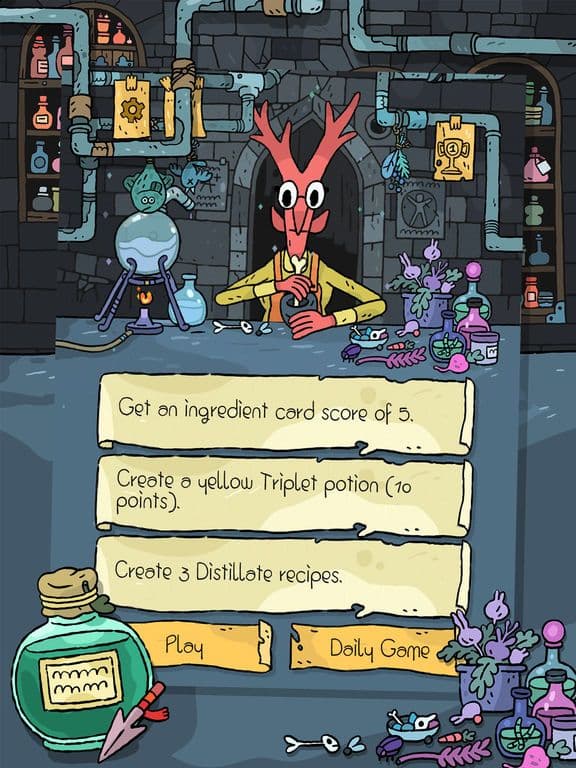
Miracle Merchant is a solitaire style potion brewing card game. In Miracle Merchant you become the apprentice of a master alchemist who creates potions for thirsty adventurers.