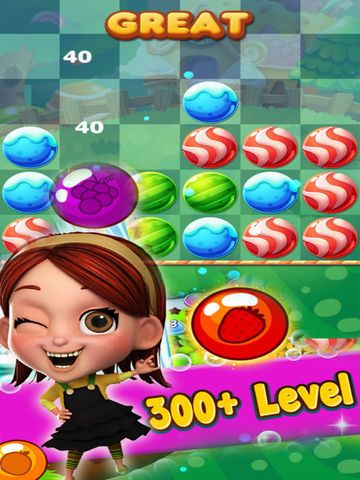
Review · Arcade · iOS
New Candy: Pop Blast Star
Reviewed: 15 Apr 2026
iOS
Nguyen Thi Thuy · 2016
Ludograph rating
D
Caution
32 /100
New Candy: Pop Blast Star is a puzzle game that develops problem solving and spatial awareness through its match-3 mechanics, with common mobile game monetization risks.
Growth (BDS)
21
Risk (RIS)
29
Daily limit
90min
Age guidance
10+
Developmental benefits
| B1 | Cognitive | 0.30 | |
| B2 | Social-emotional | 0.03 | |
| B3 | Motor | 0.25 | |
New Candy: Pop Blast Star offers moderate cognitive benefits through its match-3 puzzle mechanics. Players engage in basic problem-solving (3/5) as they identify candy patterns and plan moves to complete level objectives within time or move constraints. The game requires spatial awareness (2/5) to scan the board and recognize matching opportunities, plus strategic thinking (2/5) to prioritize moves and maximize points. Memory and attention (2/5) are exercised through tracking board state and remaining resources. The 100+ levels provide some adaptive challenge (2/5) as difficulty presumably increases, though the progression system is unclear. Motor skills are lightly engaged through hand-eye coordination and fine motor control (2/5 each) for touch-based candy matching. However, the game offers minimal creativity, no reading/language development, and limited learning transfer beyond basic pattern recognition.
Design risks
| R1 | Compulsion-loop pressure | 0.53 | |
| R2 | Monetization | 0.08 | |
| R3 | Social risk | 0.11 | |
The primary concerns with New Candy center on compulsion-loop design tactics common to casual mobile puzzle games. The game employs variable rewards (2/3) through star ratings and unpredictable level outcomes, combined with near-miss mechanics (2/3) inherent to match-3 games where desired matches almost appear. Loss aversion (2/3) is triggered through limited moves/time modes where players risk losing progress. Escalating commitment (2/3) builds as players advance through 100+ levels, and stopping barriers (2/3) exist through incomplete level attempts and star collection goals. The leaderboard feature creates social comparison (1/3) pressures. While no microtransactions are listed, the game likely includes ad pressure (2/3) as typical for free-to-play casual mobile games from small developers. The combination of these mechanics creates a moderate addiction risk profile, though less severe than synchronous multiplayer games. Content risks are negligible with E10+ rating and wholesome candy theme.
Content (not in risk score)
| R4.1 | Violence Level | 0.00 | |
| R4.2 | Sexual Content | 0.00 | |
| R4.3 | Language | 0.00 | |
| R4.4 | Substance References | 0.00 | |
| R4.5 | Fear / Horror | 0.00 | |
Content risk is displayed separately and does not affect the time recommendation.
Regulatory design checks · DSA — Assessed: meets criteria·GDPR-K — Not yet assessed·ODDS — Assessed: meets criteria
- DSA:What Ludograph checks: whether the game's design gives minors the transparency the EU Digital Services Act expects: plain terms, honest defaults, and clear reporting routes.: Estimated from review data. No dark pattern or child-targeting concerns found.
- GDPR-K:What Ludograph checks: whether age assurance and consent flows are designed for under-16s, in the spirit of GDPR Article 8.
- ODDS:What Ludograph checks: whether paid random-reward drop rates are disclosed, as required in China, Japan and South Korea.: Estimated from review data. No paid random-reward mechanics found, so drop-rate disclosure requirements do not apply.
These reflect Ludograph's assessment of the game's design practices against each framework's criteria, not a legal compliance determination.