Review · Simulation · Web
Pandemic Spread Simulation
Reviewed: 10 May 2026
Web
learningsim · 2020
Ludograph rating
C
Mixed
50 /100
Pandemic Spread Simulation is an educational tool that builds critical thinking and understanding of complex systems like exponential growth.
Growth (BDS)
33
Risk (RIS)
0
Daily limit
120min
Age guidance
–
Developmental benefits
| B1 | Cognitive | 0.58 | |
| B2 | Social-emotional | 0.07 | |
| B3 | Motor | 0.10 | |
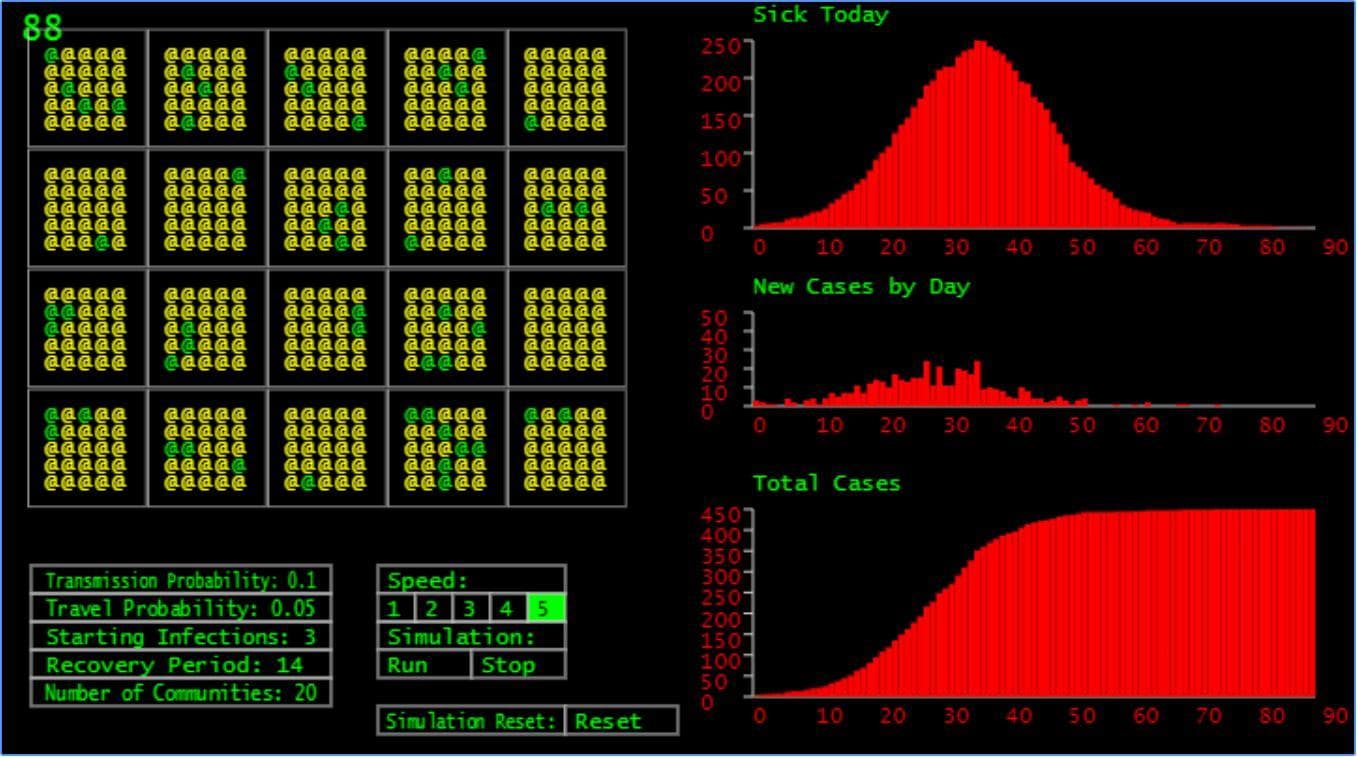
Pandemic Spread Simulation is an invaluable educational tool that demystifies the complex concept of exponential growth, particularly in the context of viral spread. It fosters critical thinking and problem-solving skills by allowing players to manipulate key variables like transmission and travel probability, directly observing their impact on 'flattening the curve.' The simulation provides a clear, interactive understanding of public health principles and the effectiveness of measures like social distancing, empowering players with knowledge to comprehend real-world events.
Design risks
| R1 | Compulsion-loop pressure | 0.00 | |
| R2 | Monetization | 0.00 | |
| R3 | Social risk | 0.00 | |
As a purely educational simulation, Pandemic Spread Simulation presents minimal risks. It lacks any manipulative design mechanics, monetization pressures, social interaction risks, or concerning content. The primary 'risk' is perhaps the serious nature of the topic itself, which could be unsettling for very young or sensitive individuals, though the presentation is scientific and not sensationalized.
Content (not in risk score)
| R4.1 | Violence Level | 0.00 | |
| R4.2 | Sexual Content | 0.00 | |
| R4.3 | Language | 0.00 | |
| R4.4 | Substance References | 0.00 | |
| R4.5 | Fear / Horror | 0.00 | |
Content risk is displayed separately and does not affect the time recommendation.
Regulatory design checks · DSA — Assessed: meets criteria·GDPR-K — Assessed: meets criteria·ODDS — Assessed: meets criteria
- DSA:What Ludograph checks: whether the game's design gives minors the transparency the EU Digital Services Act expects: plain terms, honest defaults, and clear reporting routes.: Estimated from review data. No dark pattern or child-targeting concerns found.
- GDPR-K:What Ludograph checks: whether age assurance and consent flows are designed for under-16s, in the spirit of GDPR Article 8.: Estimated from review data. No privacy or child-targeting concerns found.
- ODDS:What Ludograph checks: whether paid random-reward drop rates are disclosed, as required in China, Japan and South Korea.: Estimated from review data. No paid random-reward mechanics found, so drop-rate disclosure requirements do not apply.
These reflect Ludograph's assessment of the game's design practices against each framework's criteria, not a legal compliance determination.