Review · Adventure · PC · macOS
Puzzle Pirates
Reviewed: 20 May 2026
PC · macOS
Three Rings · 2011
Ludograph rating
Growth (BDS)
59
Risk (RIS)
40
Daily limit
60min
Age guidance
7+
Developmental benefits
| B1 | Cognitive | 0.72 | |
| B2 | Social-emotional | 0.47 | |
| B3 | Motor | 0.45 | |
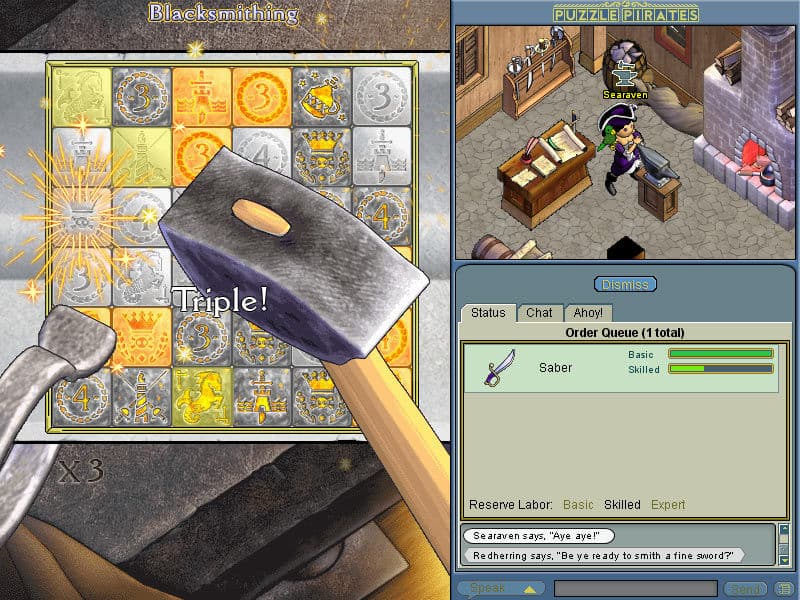
Puzzle Pirates offers a rich environment for developing problem-solving skills, strategic thinking, and adaptive challenge. Players must master various puzzle mini-games to succeed in different piratical activities, from sailing to swordfighting. The cooperative nature of the game encourages teamwork and communication as players join crews and work together to achieve common goals. The player-run economy also introduces elements of practical math and systems thinking. The game provides a good platform for creative expression through pirate customization and strategic planning in crew management.
Design risks
| R1 | Compulsion-loop pressure | 0.53 | |
| R2 | Monetization | 0.17 | |
| R3 | Social risk | 0.44 | |
The game employs variable rewards and frequent rewards to encourage continued play, which can contribute to compulsion-loop design. While there is no direct pay-to-win, microtransactions are present, and the game's social elements could subtly encourage spending. As an MMO, there is a risk of exposure to strangers, although direct stranger chat is not a feature. The competitive aspect of pirating and crew management could lead to mild social comparison. The cartoonish violence is minimal, and there is no explicit sexual content, harsh language, substance reference, or fear-inducing elements.
Content (not in risk score)
| R4.1 | Violence Level | 0.33 | |
| R4.2 | Sexual Content | 0.00 | |
| R4.3 | Language | 0.00 | |
| R4.4 | Substance References | 0.00 | |
| R4.5 | Fear / Horror | 0.00 | |
Content risk is displayed separately and does not affect the time recommendation.
Heads up
- Monthly spendTypical real-money spend by engaged players: $0 – $10/mo.
Regulatory design checks · DSA — Not yet assessed·GDPR-K — Assessed: concerns noted·ODDS — Assessed: meets criteria
- DSA:What Ludograph checks: whether the game's design gives minors the transparency the EU Digital Services Act expects: plain terms, honest defaults, and clear reporting routes.
- GDPR-K:What Ludograph checks: whether age assurance and consent flows are designed for under-16s, in the spirit of GDPR Article 8.: Estimated from review data. Likely violations: unmoderated stranger contact that likely exposes personal data.
- ODDS:What Ludograph checks: whether paid random-reward drop rates are disclosed, as required in China, Japan and South Korea.: Estimated from review data. No paid random-reward mechanics found, so drop-rate disclosure requirements do not apply.
These reflect Ludograph's assessment of the game's design practices against each framework's criteria, not a legal compliance determination.