Review · Strategy · PC · Nintendo Switch · macOS
RollerCoaster Tycoon 3: Complete Edition
Reviewed: 17 Apr 2026
PC · Nintendo Switch · macOS
Frontier Developments · 2020
Ludograph rating
B
Good
67 /100
RollerCoaster Tycoon 3: Complete Edition is a simulation game that fosters problem solving and spatial awareness while designing theme parks.
Growth (BDS)
54
Risk (RIS)
11
Daily limit
120min
Age guidance
–
Developmental benefits
| B1 | Cognitive | 0.82 | |
| B2 | Social-emotional | 0.20 | |
| B3 | Motor | 0.35 | |
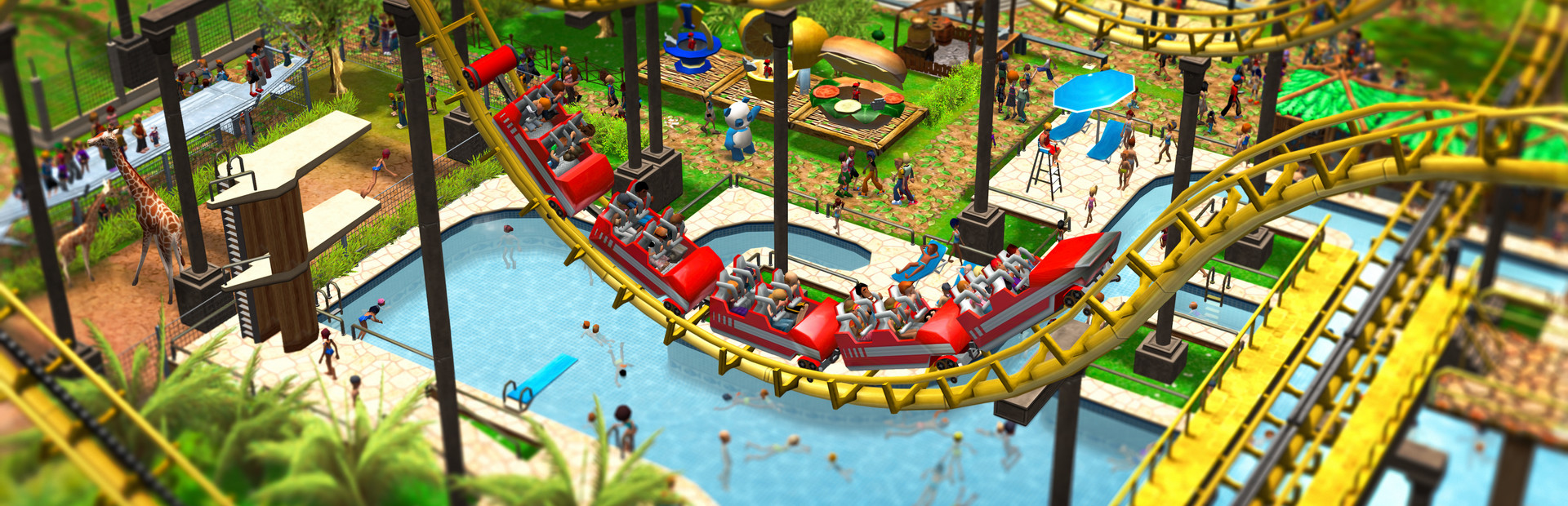
RollerCoaster Tycoon 3 is an exceptional cognitive development tool that excels in multiple domains. Its core gameplay demands sophisticated problem-solving as players must balance competing constraints like budget, space, guest satisfaction, and park efficiency. The spatial awareness demands are outstanding - players must visualize 3D roller coaster layouts, plan park flow, and optimize attraction placement. Strategic thinking is heavily exercised through financial management, long-term planning, and resource allocation across scenarios with varying objectives. The creative freedom is remarkable, with 300+ rides, 500 scenery pieces, and custom coaster design allowing near-limitless expression. Mathematical thinking emerges naturally through budget management, profit/loss calculations, pricing optimization, and statistical tracking of guest behavior. The game offers excellent learning transfer to real-world concepts like business management, customer service, logistics, and basic economics. Adaptive challenge is strong with dozens of scenarios progressing in difficulty, plus sandbox mode for open-ended exploration.
Design risks
| R1 | Compulsion-loop pressure | 0.23 | |
| R2 | Monetization | 0.00 | |
| R3 | Social risk | 0.00 | |
RollerCoaster Tycoon 3 presents minimal risks, making it one of the safest commercial games for children. As a complete edition with no microtransactions, DLC, or online features, monetization risk is zero. Social risks are entirely absent - it's a single-player experience with no chat, multiplayer, or social comparison mechanisms. Content is completely clean with no violence, inappropriate language, or mature themes. The primary risk is moderate infinite play potential - sandbox mode has no natural endpoint and the game's depth can encourage extended sessions. There are mild escalating commitment elements as players invest time building elaborate parks, and some loss aversion when parks face financial trouble. However, the game respects player time with autosave features and no penalties for taking breaks. The compulsion-loop design is significantly lower than modern free-to-play games, as progression is steady and predictable rather than variable and addictive.
Content (not in risk score)
| R4.1 | Violence Level | 0.00 | |
| R4.2 | Sexual Content | 0.00 | |
| R4.3 | Language | 0.00 | |
| R4.4 | Substance References | 0.00 | |
| R4.5 | Fear / Horror | 0.00 | |
Content risk is displayed separately and does not affect the time recommendation.
Regulatory design checks · DSA — Assessed: meets criteria·GDPR-K — Assessed: meets criteria·ODDS — Assessed: meets criteria
- DSA:What Ludograph checks: whether the game's design gives minors the transparency the EU Digital Services Act expects: plain terms, honest defaults, and clear reporting routes.: Estimated from review data. No dark pattern or child-targeting concerns found.
- GDPR-K:What Ludograph checks: whether age assurance and consent flows are designed for under-16s, in the spirit of GDPR Article 8.: Estimated from review data. No privacy or child-targeting concerns found.
- ODDS:What Ludograph checks: whether paid random-reward drop rates are disclosed, as required in China, Japan and South Korea.: Estimated from review data. No paid random-reward mechanics found, so drop-rate disclosure requirements do not apply.
These reflect Ludograph's assessment of the game's design practices against each framework's criteria, not a legal compliance determination.