Review · Family · iOS
Shell Shatter
Reviewed: 16 Apr 2026
iOS
Scott Cawthon · 2014
Ludograph rating
D
Caution
41 /100
Shell Shatter is a fast-paced puzzle game that develops problem solving, spatial awareness, and hand-eye coordination with minimal risk.
Growth (BDS)
27
Risk (RIS)
12
Daily limit
120min
Age guidance
10+
Developmental benefits
| B1 | Cognitive | 0.34 | |
| B2 | Social-emotional | 0.03 | |
| B3 | Motor | 0.45 | |
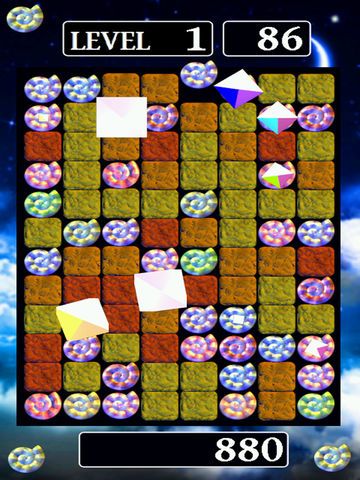
Shell Shatter is a fast-paced puzzle game that exercises spatial reasoning and problem-solving skills. Players must quickly identify which dirt tiles to clear to allow shells to fall into horizontal rows, requiring spatial awareness (3) and real-time problem-solving (3). The game demands moderate strategic thinking (2) in deciding when to use power-ups (B and C icons) versus manual clearing. The time pressure element builds reaction time (3) and hand-eye coordination (3) as players must rapidly drag across tiles. Fine motor control (3) is essential for precise touch inputs. The game provides adaptive challenge (2) through increasing difficulty and time constraints, while memory and attention (2) are engaged in tracking shell positions and colors.
Design risks
| R1 | Compulsion-loop pressure | 0.27 | |
| R2 | Monetization | 0.00 | |
| R3 | Social risk | 0.00 | |
Shell Shatter presents minimal risk overall with a total R-score of only 8. As a premium game with no microtransactions, it avoids all monetization risks (R2=0). The single-player nature eliminates social risks (R3=0), and the abstract puzzle content has no concerning material (R4=0). The primary risk comes from moderate compulsion-loop design (R1=8), particularly through infinite play mechanics (2) that allow continuous sessions without mandatory breaks. The time-based scoring creates mild loss aversion (1) and stopping barriers (1), as players may feel compelled to finish rounds. Variable rewards (1) come from unpredictable tile configurations and scoring opportunities, while near-miss experiences (1) occur when shells almost complete rows. However, the absence of streak mechanics, FOMO events, and notifications keeps manipulation modest.
Content (not in risk score)
| R4.1 | Violence Level | 0.00 | |
| R4.2 | Sexual Content | 0.00 | |
| R4.3 | Language | 0.00 | |
| R4.4 | Substance References | 0.00 | |
| R4.5 | Fear / Horror | 0.00 | |
Content risk is displayed separately and does not affect the time recommendation.
Regulatory design checks · DSA — Assessed: meets criteria·GDPR-K — Assessed: meets criteria·ODDS — Assessed: meets criteria
- DSA:What Ludograph checks: whether the game's design gives minors the transparency the EU Digital Services Act expects: plain terms, honest defaults, and clear reporting routes.: Estimated from review data. No dark pattern or child-targeting concerns found.
- GDPR-K:What Ludograph checks: whether age assurance and consent flows are designed for under-16s, in the spirit of GDPR Article 8.: Estimated from review data. No privacy or child-targeting concerns found.
- ODDS:What Ludograph checks: whether paid random-reward drop rates are disclosed, as required in China, Japan and South Korea.: Estimated from review data. No paid random-reward mechanics found, so drop-rate disclosure requirements do not apply.
These reflect Ludograph's assessment of the game's design practices against each framework's criteria, not a legal compliance determination.