Review · Strategy · PC
SimIsle: Missions in the Rainforest
Reviewed: 11 May 2026
PC
Intelligent Games · 1995
Ludograph rating
A
Recommended
74 /100
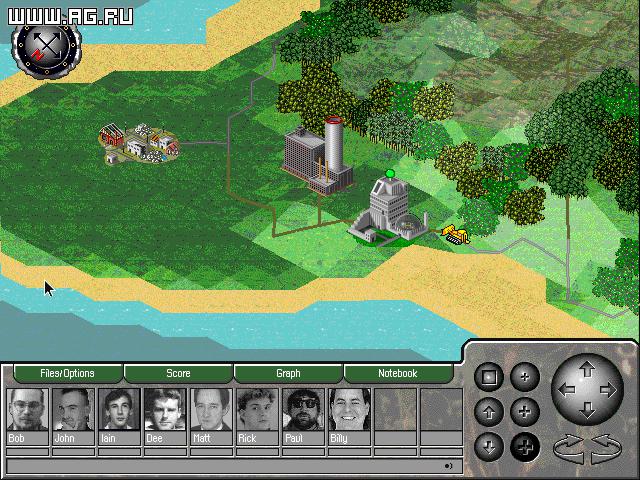
SimIsle: Missions in the Rainforest is a strategy game that builds problem solving and strategic thinking through complex environmental and economic decisions.
Growth (BDS)
59
Risk (RIS)
0
Daily limit
120min
Age guidance
–
Developmental benefits
| B1 | Cognitive | 0.80 | |
| B2 | Social-emotional | 0.53 | |
| B3 | Motor | 0.15 | |
SimIsle: Missions in the Rainforest is a highly educational strategy game that challenges players with complex environmental and economic decisions. It fosters critical thinking, problem-solving, and strategic planning through its intricate simulation mechanics. Players learn about ecosystem management, resource allocation, and the consequences of their choices on both the environment and the local population. The game encourages empathy and ethical reasoning by presenting scenarios where players must balance competing interests and consider the long-term impact of their actions. Its open-ended nature and adaptive challenges provide a rich learning environment for understanding complex systems.
Design risks
| R1 | Compulsion-loop pressure | 0.00 | |
| R2 | Monetization | 0.00 | |
| R3 | Social risk | 0.00 | |
SimIsle: Missions in the Rainforest presents minimal risks. There are no elements of compulsion-loop design, monetization pressures, or social risks. The content is educational and non-violent. The primary 'risk' could be the game's complexity, which might be challenging for younger players without guidance, potentially leading to frustration rather than engagement if not appropriately supported.
Content (not in risk score)
| R4.1 | Violence Level | 0.00 | |
| R4.2 | Sexual Content | 0.00 | |
| R4.3 | Language | 0.00 | |
| R4.4 | Substance References | 0.00 | |
| R4.5 | Fear / Horror | 0.00 | |
Content risk is displayed separately and does not affect the time recommendation.
Regulatory design checks · DSA — Assessed: meets criteria·GDPR-K — Assessed: meets criteria·ODDS — Assessed: meets criteria
- DSA:What Ludograph checks: whether the game's design gives minors the transparency the EU Digital Services Act expects: plain terms, honest defaults, and clear reporting routes.: Estimated from review data. No dark pattern or child-targeting concerns found.
- GDPR-K:What Ludograph checks: whether age assurance and consent flows are designed for under-16s, in the spirit of GDPR Article 8.: Estimated from review data. No privacy or child-targeting concerns found.
- ODDS:What Ludograph checks: whether paid random-reward drop rates are disclosed, as required in China, Japan and South Korea.: Estimated from review data. No paid random-reward mechanics found, so drop-rate disclosure requirements do not apply.
These reflect Ludograph's assessment of the game's design practices against each framework's criteria, not a legal compliance determination.