Review · Adventure · iOS
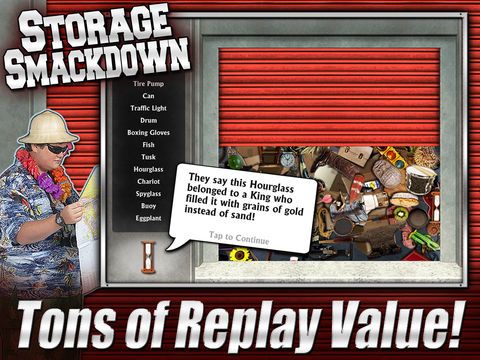
Storage Smackdown: Hidden Object Adventures FREE
Reviewed: 16 Apr 2026
iOS
Anarchy Enterprises · 2014
Ludograph rating
D
Caution
39 /100
Storage Smackdown is a hidden object game that helps kids develop memory and attention skills, but has monetization risks.
Growth (BDS)
25
Risk (RIS)
10
Daily limit
120min
Age guidance
–
Developmental benefits
| B1 | Cognitive | 0.32 | |
| B2 | Social-emotional | 0.03 | |
| B3 | Motor | 0.40 | |
Storage Smackdown offers modest cognitive benefits centered on visual search and attention skills. The core hidden object gameplay requires sustained focus and pattern recognition as players scan cluttered scenes to locate specific items (memoryAttention=4). The gravity-based physics that reshuffles objects adds a light problem-solving element (problemSolving=3), requiring players to adapt their search strategies as items move. Basic spatial awareness develops as players track objects across the locker space (spatialAwareness=2). The game requires hand-eye coordination and fine motor control for precise tapping (handEyeCoord=3, fineMotor=3), with moderate reaction time demands as objects shift (reactionTime=2). Reading object names and humorous descriptions provides minimal literacy engagement (readingLanguage=2). The randomized levels offer some adaptive challenge (adaptiveChallenge=2), though the core mechanics remain straightforward. However, the game offers virtually no social-emotional development opportunities as a single-player experience, and minimal creativity or strategic thinking beyond the basic search task.
Design risks
| R1 | Compulsion-loop pressure | 0.17 | |
| R2 | Monetization | 0.08 | |
| R3 | Social risk | 0.00 | |
Storage Smackdown presents low-to-moderate risks, primarily centered on its free-to-play monetization model. As a free mobile game, it likely contains advertisements (adPressure=2), which can interrupt gameplay and potentially expose children to age-inappropriate marketing. The randomized, replayable nature of levels creates some infinite play potential (infinitePlay=1), though the finite 36-level structure provides natural boundaries. Variable rewards from finding objects and completing levels may provide mild dopamine stimulation (variableRewards=1, variableRewardFreq=1), and progression mechanics can encourage escalating commitment (escalatingCommitment=1). The 'one more level' design creates minor stopping barriers (stoppingBarriers=1). However, the game avoids predatory monetization tactics—no microtransactions, loot boxes, or pay-to-win mechanics are present. Social risks are absent due to the single-player nature with no chat or online interaction. Content is clean with no violence, sexual content, or inappropriate language, making it suitable for all ages from a content perspective.
Content (not in risk score)
| R4.1 | Violence Level | 0.00 | |
| R4.2 | Sexual Content | 0.00 | |
| R4.3 | Language | 0.00 | |
| R4.4 | Substance References | 0.00 | |
| R4.5 | Fear / Horror | 0.00 | |
Content risk is displayed separately and does not affect the time recommendation.
Regulatory design checks · DSA — Assessed: meets criteria·GDPR-K — Assessed: meets criteria·ODDS — Assessed: meets criteria
- DSA:What Ludograph checks: whether the game's design gives minors the transparency the EU Digital Services Act expects: plain terms, honest defaults, and clear reporting routes.: Estimated from review data. No dark pattern or child-targeting concerns found.
- GDPR-K:What Ludograph checks: whether age assurance and consent flows are designed for under-16s, in the spirit of GDPR Article 8.: Estimated from review data. No privacy or child-targeting concerns found.
- ODDS:What Ludograph checks: whether paid random-reward drop rates are disclosed, as required in China, Japan and South Korea.: Estimated from review data. No paid random-reward mechanics found, so drop-rate disclosure requirements do not apply.
These reflect Ludograph's assessment of the game's design practices against each framework's criteria, not a legal compliance determination.