Review · Adventure · iOS
The Lion Guard
Reviewed: 06 May 2026
iOS
Disney · 2016
Ludograph rating
C
Mixed
46 /100
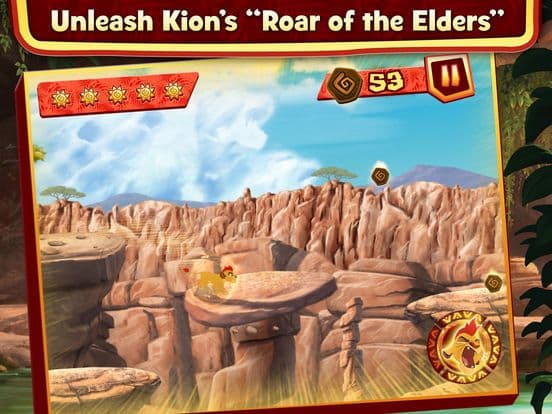
The Lion Guard is an adventure game that builds problem solving, spatial awareness, and strategic thinking as players navigate environments and choose characters.
Growth (BDS)
30
Risk (RIS)
4
Daily limit
120min
Age guidance
7+
Developmental benefits
| B1 | Cognitive | 0.34 | |
| B2 | Social-emotional | 0.13 | |
| B3 | Motor | 0.45 | |
The Lion Guard game offers moderate cognitive benefits through problem-solving, spatial awareness, and strategic thinking as players navigate diverse environments and choose appropriate guard members to overcome obstacles. It also provides opportunities for memory and attention development. Motor skills like hand-eye coordination, fine motor control, and reaction time are engaged through gameplay. The game encourages empathy and emotional regulation through its narrative themes of protecting the Pride Lands.
Design risks
| R1 | Compulsion-loop pressure | 0.07 | |
| R2 | Monetization | 0.00 | |
| R3 | Social risk | 0.06 | |
The primary risks in The Lion Guard game are minimal. There's a low level of compulsion-loop design through variable rewards (collecting tokens) and a soft stopping barrier with the 'sun sets' mission timer. Content-wise, there's mild, cartoonish violence against animal antagonists. Privacy risk is present due to data collection typical of mobile games, but there are no direct monetization pressures, social comparison, or stranger interaction risks. The game might encourage some mild loss aversion due to the mission timer. There are no social risks as the game is single-player.
Content (not in risk score)
| R4.1 | Violence Level | 0.33 | |
| R4.2 | Sexual Content | 0.00 | |
| R4.3 | Language | 0.00 | |
| R4.4 | Substance References | 0.00 | |
| R4.5 | Fear / Horror | 0.00 | |
Content risk is displayed separately and does not affect the time recommendation.
Regulatory design checks · DSA — Assessed: meets criteria·GDPR-K — Not yet assessed·ODDS — Assessed: meets criteria
- DSA:What Ludograph checks: whether the game's design gives minors the transparency the EU Digital Services Act expects: plain terms, honest defaults, and clear reporting routes.: Estimated from review data. No dark pattern or child-targeting concerns found.
- GDPR-K:What Ludograph checks: whether age assurance and consent flows are designed for under-16s, in the spirit of GDPR Article 8.
- ODDS:What Ludograph checks: whether paid random-reward drop rates are disclosed, as required in China, Japan and South Korea.: Estimated from review data. No paid random-reward mechanics found, so drop-rate disclosure requirements do not apply.
These reflect Ludograph's assessment of the game's design practices against each framework's criteria, not a legal compliance determination.