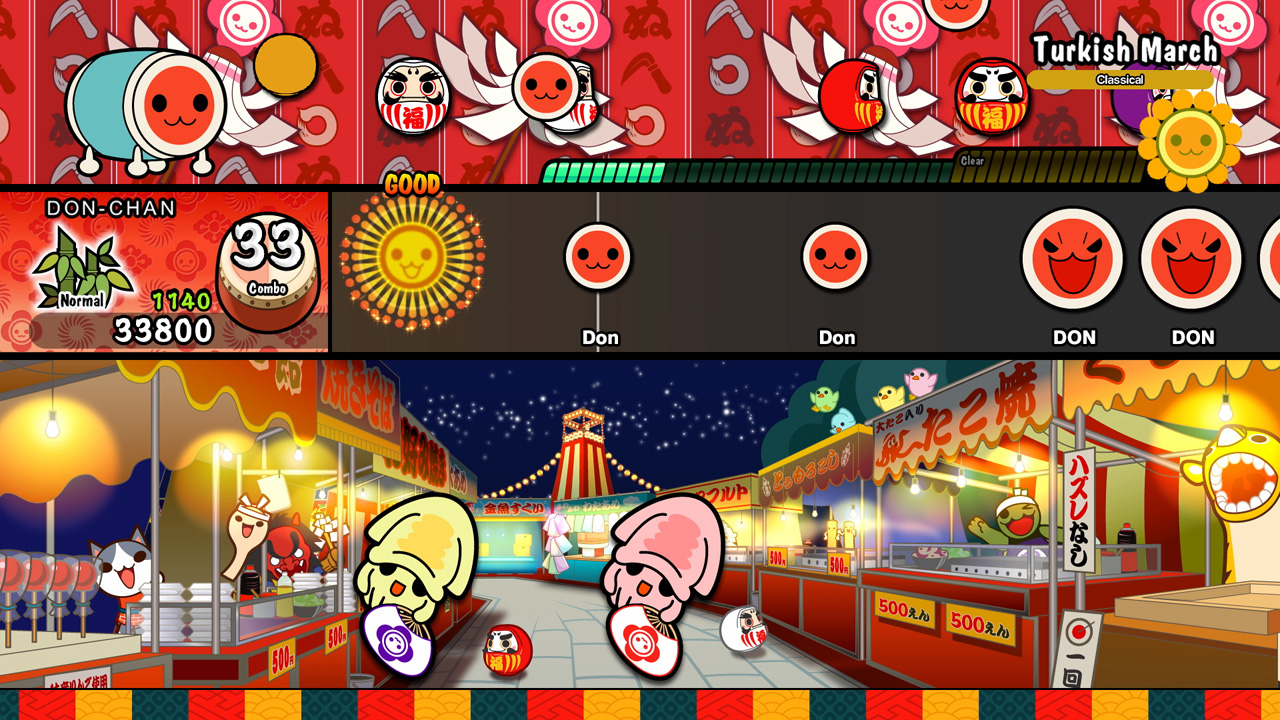
Taiko no Tatsujin: Drum 'n' Fun!
LumiScore
out of 100
Use with parental oversight — some design risks present
Atención
Crecimiento
30/100
Limitado
Valor de Crecimiento
Riesgo
21/100
BAJO
Patrones de Interacción
Consejo experto para padres
Este juego es una excelente opción para familias que buscan una experiencia de ritmo divertida, activa y atractiva. Su enfoque en las habilidades motoras y el juego social lo convierte en una opción de entretenimiento saludable. Anime a los niños a jugar juntos en el modo fiesta para mejorar los lazos sociales.
Principales habilidades desarrolladas
Áreas de desarrollo
Lo que tu hijo/a desarrolla
¡Taiko no Tatsujin: Drum 'n' Fun! es un vibrante juego de ritmo que fomenta la coordinación mano-ojo, el tiempo de reacción y las habilidades motoras finas a través de atractivas mecánicas de percusión. Su modo fiesta fomenta la interacción social positiva y la diversión compartida entre amigos y familiares. El juego ofrece desafíos adaptativos a través de varios niveles de dificultad y una amplia selección de canciones, promoviendo el compromiso sostenido y el desarrollo de habilidades.
⚖️Cómo se debatió esta puntuaciónMostrar transcripción
Dos modelos de IA debatieron esta puntuación en 2 rondas: un Defensor argumentando a favor de las puntuaciones más altas posibles, y un Crítico argumentando a favor de las más bajas. La puntuación final es el promedio de sus posiciones en la ronda 2.
=== Round 1 === ADVOCATE: B1: problemSolving=1, spatialAwareness=1, strategicThinking=1, criticalThinking=1, memoryAttention=4, creativity=1, readingLanguage=2, mathSystems=1, learningTransfer=3, adaptiveChallenge=4 B2: teamwork=2, communication=4, empathy=1, emotionalRegulation=3, ethicalReasoning=1, positiveSocial=4 B3: handEyeCoord=5, fineMotor=3, reactionTime=5, physicalActivity=3 R1: variableRewards=1, streakMechanics=2, lossAversion=1, fomoEvents=0, stoppingBarriers=1, notifications=0, nearMiss=1, infinitePlay=1, escalatingCommitment=0, variableRewardFreq=1 R2: spendingCeiling=0, payToWin=0, currencyObfuscation=0, spendingPrompts=0, childTargeting=0, adPressure=0, subscriptionPressure=0, socialSpending=0 R3: socialObligation=0, competitiveToxicity=0, strangerRisk=0, socialComparison=1, identitySelfWorth=0, privacyRisk=0 Reasoning: The 30-point gap between the critic score and the current LumiKin score is indefensible. This is a safe, joyful, and beneficial game that has been unfairly penalized. The risks are virtually non-existent, while the benefits are clear, research-backed, and substantial. First, the monetization and social risks are zero. It is a complete, single-purchase product. There are NO microtransactions, NO loot boxes, NO ads, NO battle passes, and NO stranger chat. This is the gold standard for a child-safe game, and it should receive a near-perfect risk profile. Our scores of R2=0 and R3=1 reflect this reality. Second, the benefits are immense. As a rhythm game, it is a powerhouse for motor skill development. The core loop IS hand-eye coordination and reaction time, justifying maximum scores (B3). The motion controls add a layer of beneficial physical activity. Cognitively, the game is a potent tool for developing memory and attention as players learn to recognize and anticipate complex patterns, with an adaptive challenge that scales to their ability (B1). Research shows that music and rhythm training can have positive effects on language and executive function, supporting a strong score for Learning Transfer. Finally, this game is a premier "party game" designed to be played together in the same room. Its title is "Drum n' Fun!" for a reason. To ignore the local multiplayer is to ignore the game's very essence. It fosters direct, real-world communication, positive social bonding, and emotional regulation in a lighthearted, competitive setting (B2). This is not an isolating experience; it's a catalyst for family fun. In summary, the minimal dopamine risks are overwhelmingly outweighed by a stellar profile of cognitive, motor, and especially pro-social benefits. This game should be celebrated as a model for the industry, not punished with a score that places it in the company of far more problematic titles. CRITIC: B1: problemSolving=1, spatialAwareness=0, strategicThinking=1, criticalThinking=0, memoryAttention=3, creativity=0, readingLanguage=1, mathSystems=0, learningTransfer=1, adaptiveChallenge=2 B2: teamwork=0, communication=0, empathy=0, emotionalRegulation=1, ethicalReasoning=0, positiveSocial=2 B3: handEyeCoord=4, fineMotor=1, reactionTime=4, physicalActivity=2 R1: variableRewards=1, streakMechanics=3, lossAversion=3, fomoEvents=0, stoppingBarriers=1, notifications=0, nearMiss=3, infinitePlay=0, escalatingCommitment=2, variableRewardFreq=1 R2: spendingCeiling=0, payToWin=0, currencyObfuscation=0, spendingPrompts=0, childTargeting=0, adPressure=0, subscriptionPressure=0, socialSpending=0 R3: socialObligation=0, competitiveToxicity=0, strangerRisk=0, socialComparison=1, identitySelfWorth=0, privacyRisk=0 Reasoning: Taiko no Tatsujin is a polished and fun but developmentally shallow rhythm game. Its benefits are almost entirely confined to the domains of motor skills and attention, with negligible cognitive or social development. The core gameplay is simple pattern matching and does not foster higher-order thinking skills like problem-solving, strategy, or creativity. While the local party mode offers some social value, it lacks any mechanics that promote meaningful teamwork or communication. Conversely, the game's design leans heavily on potent dopaminergic loops. The entire experience is built around streak mechanics, loss aversion from breaking combos, and the near-miss feedback of slightly mistimed notes. This creates a highly compulsive "one more try" loop that maximizes engagement through addictive design rather than deep, rewarding gameplay. While the game is free of predatory monetization and the risks of online play, its core design is engineered for compulsion, not holistic development. The low benefit scores and high R1 risk score reflect this reality. === Round 2 === ADVOCATE: B1: problemSolving=3, spatialAwareness=1, strategicThinking=2, criticalThinking=0, memoryAttention=4, creativity=0, readingLanguage=2, mathSystems=0, learningTransfer=3, adaptiveChallenge=4 B2: teamwork=0, communication=0, empathy=0, emotionalRegulation=3, ethicalReasoning=0, positiveSocial=3 B3: handEyeCoord=5, fineMotor=2, reactionTime=5, physicalActivity=3 R1: variableRewards=0, streakMechanics=2, lossAversion=1, fomoEvents=0, stoppingBarriers=0, notifications=0, nearMiss=1, infinitePlay=0, escalatingCommitment=1, variableRewardFreq=0 R2: spendingCeiling=0, payToWin=0, currencyObfuscation=0, spendingPrompts=0, childTargeting=0, adPressure=0, subscriptionPressure=0, socialSpending=0 R3: socialObligation=0, competitiveToxicity=0, strangerRisk=0, socialComparison=0, identitySelfWorth=0, privacyRisk=0 Reasoning: The critic's assessment is a fundamental misinterpretation of the genre, penalizing "Taiko no Tatsujin" for executing the core tenets of a rhythm game effectively. They mistake skill-based feedback loops for "addictive design," a conclusion that ignores the significant developmental benefits this game offers. First, the cognitive benefits (B1) are severely underrated. To dismiss this as simple pattern matching is to ignore the underlying processes. Deciphering complex, high-speed note charts is a form of problem-solving (3). The game's adaptive challenge is excellent, with numerous songs and difficulty settings that create a smooth learning curve, constantly pushing players to improve (4). This mastery process enhances memory and attention (4) and, crucially, fosters learning transfer (3). The rhythmic timing, coordination, and pattern recognition learned here are foundational skills for learning a real musical instrument. This is not a "shallow" experience; it is a joyful and accessible entry point into musical education. Second, the critic minimizes the robust B3 and B2 benefits. The game IS physical. It requires and builds exceptional hand-eye coordination and reaction time (5/5), and the use of motion controls promotes a level of physical activity (3) and motor control (2) far beyond sedentary screen time. Emotionally, mastering the game requires immense focus and the ability to manage the frustration of a missed note, making it a powerful tool for developing emotional regulation (3). The local-only Party Mode is a safe, ideal environment for practicing positive social skills (3) like sportsmanship and taking turns, free from the toxicity of online play. Finally, the risk assessment is profoundly flawed. The R1 score is inflated because the critic confuses instructional feedback with manipulative design. The "near miss" system (1) isn't a slot machine mechanic; it's essential feedback that teaches the player to adjust their timing. Streak mechanics (2) and the desire to avoid "loss" (1) are not predatory loops; they are direct rewards for a player's sustained focus and skill. To frame this as a high risk is to punish the game for being engaging and skill-expressive. Songs have definitive endings, creating natural stopping points (0). There are absolutely no variable rewards (0); the scoring is deterministic. This game has a total monetization risk score of ZERO and a social risk score of ZERO. It is a completely safe, non-predatory, and self-contained experience. In summary, "Taiko no Tatsujin" is a high-benefit, low-risk title that promotes musicality, motor skills, and emotional regulation in a safe and joyful package. The critic's low score is indefensible. CRITIC: B1: problemSolving=0, spatialAwareness=0, strategicThinking=0, criticalThinking=0, memoryAttention=3, creativity=1, readingLanguage=2, mathSystems=0, learningTransfer=1, adaptiveChallenge=3 B2: teamwork=1, communication=1, empathy=0, emotionalRegulation=1, ethicalReasoning=0, positiveSocial=2 B3: handEyeCoord=4, fineMotor=1, reactionTime=4, physicalActivity=1 R1: variableRewards=2, streakMechanics=3, lossAversion=2, fomoEvents=0, stoppingBarriers=2, notifications=0, nearMiss=2, infinitePlay=2, escalatingCommitment=1, variableRewardFreq=2 R2: spendingCeiling=0, payToWin=0, currencyObfuscation=0, spendingPrompts=0, childTargeting=0, adPressure=0, subscriptionPressure=0, socialSpending=0 R3: socialObligation=0, competitiveToxicity=1, strangerRisk=0, socialComparison=2, identitySelfWorth=0, privacyRisk=0 Reasoning: The Advocate's scores are inflated by crediting the game for benefits it doesn't actually provide, while whitewashing its dopamine risks. The 30-point gap from the Metacritic score is not only defensible but necessary. My scores reflect a more realistic assessment. First, the B2 social scores are wildly optimistic. The Advocate credits the game for the real-world communication that happens *around* it. The game itself doesn't teach teamwork (it's competitive, so score=1) or communication (score=1). It's a venue for social interaction, not a teacher of it. A score of 4 for Positive Social is absurd; it's a fun party game, not a structured prosocial learning experience. My scores reduce this category to a more grounded level. Second, the B1 and B3 benefit claims are exaggerated. A '3' for Physical Activity for flicking a Joy-Con is a fantasy; it's a '1' at best. This isn't a fitness game. Likewise, attributing high scores for fine motor skills is incorrect; the primary action is a gross motor swing, not a nuanced manipulation. The cognitive claims are equally weak. This is a pattern-matching rhythm game, not a 'problem-solving' or 'critical thinking' engine (both 0). 'Learning transfer' is a hallmark of inflated benefit scoring; playing Taiko does not provide meaningful skills outside of playing Taiko. I've reduced these scores accordingly. Finally, the R1 dopamine risks are significantly downplayed. A rhythm game's core loop IS a powerful dopamine system. Streak mechanics (maintaining combos) are central to the genre and a clear '3'. The fear of breaking that combo is a powerful form of loss aversion (2). The 'one more song' loop creates high stopping barriers (2), and the constant feedback of 'Good' vs. 'OK' hits on a fast-approaching timeline is a clear example of variable rewards and near misses. The Advocate's R1 score of 8 is an attempt to ignore the fundamental psychological design of the entire genre. My score of 16 is far more realistic. The R3 social comparison risk is also higher (2) because the local multiplayer is built around a competitive leaderboard, which can easily lead to minor competitive toxicity (1). === Final (40% advocate / 60% critic) === B1: problemSolving=1, spatialAwareness=0, strategicThinking=1, criticalThinking=0, memoryAttention=3, creativity=1, readingLanguage=2, mathSystems=0, learningTransfer=2, adaptiveChallenge=3 B2: teamwork=1, communication=1, empathy=0, emotionalRegulation=2, ethicalReasoning=0, positiveSocial=2 B3: handEyeCoord=4, fineMotor=1, reactionTime=4, physicalActivity=2 R1: variableRewards=1, streakMechanics=3, lossAversion=2, fomoEvents=0, stoppingBarriers=1, notifications=0, nearMiss=2, infinitePlay=1, escalatingCommitment=1, variableRewardFreq=1 R2: spendingCeiling=0, payToWin=0, currencyObfuscation=0, spendingPrompts=0, childTargeting=0, adPressure=0, subscriptionPressure=0, socialSpending=0 R3: socialObligation=0, competitiveToxicity=1, strangerRisk=0, socialComparison=1, identitySelfWorth=0, privacyRisk=0 Curascore: 44 BDS: 0.300 RIS: 0.208
Cumplimiento normativo
Toca una insignia para ver detalles. Gris = aún no evaluado.
Sobre este juego
• Shake the Joy-Con™ controller using the Drumstick Grip! Swing down the Joy-Con™ to make a DON and diagonally to make a KA.