

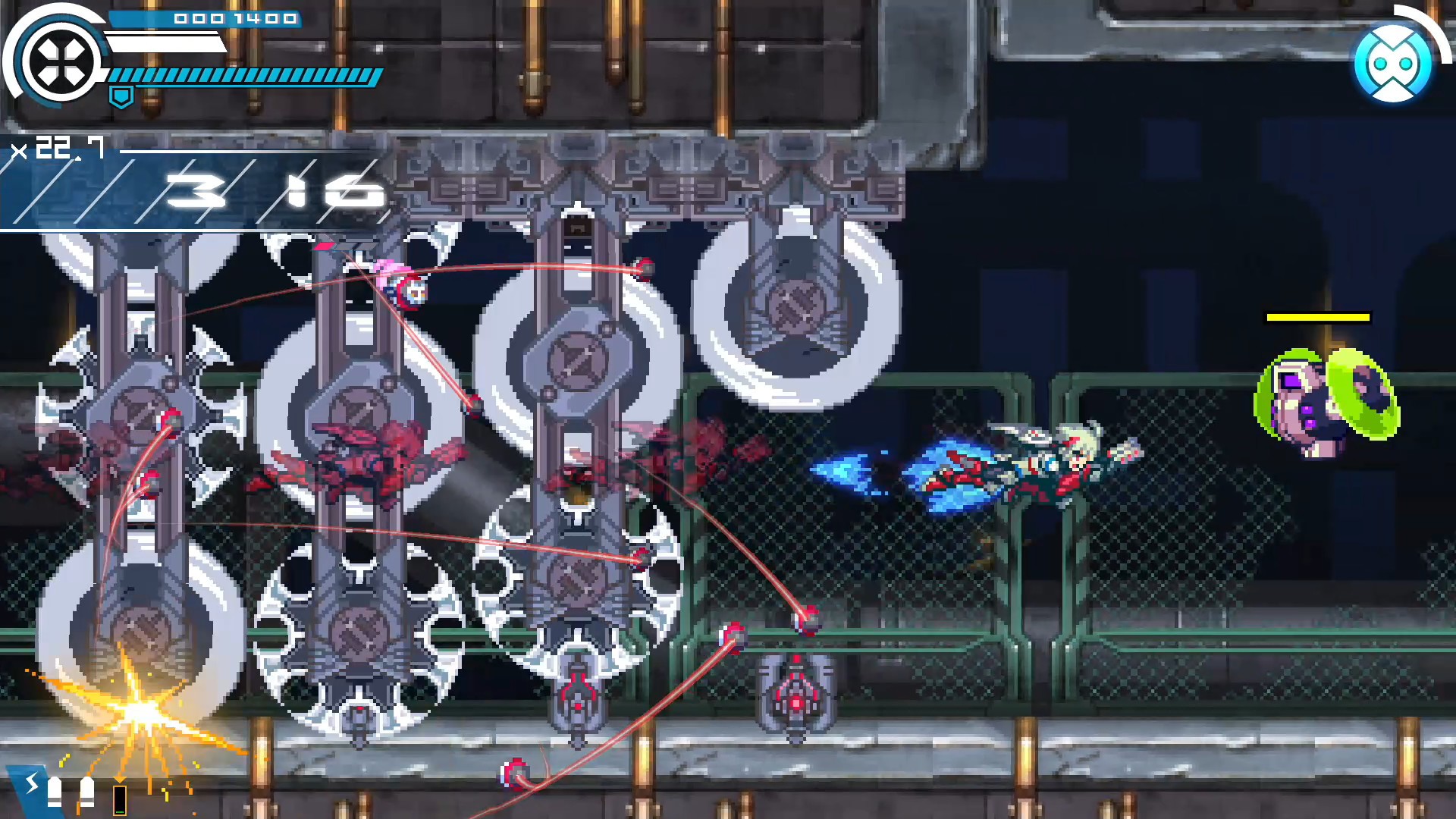
Gunvolt Chronicles: Luminous Avenger iX
LumiScore
out of 100
Use with parental oversight — some design risks present
Obs
Utveckling
36/100
Utvecklande
Utvecklingsvärde
Risk
21/100
LÅG
Engagemangsmönster
Föräldratips
Detta spel är ett utmärkt val för spelare som gillar utmanande 2D-actionspel och vill förbättra sina reflexer och strategiska tänkande. Svårighetsgraden kan justeras, och de korta nivåerna möjliggör flexibla spelsessioner.
Viktiga färdigheter som barnet utvecklar
Utvecklingsområden
Vad ditt barn utvecklar
Gunvolt Chronicles: Luminous Avenger iX erbjuder en utmanande och fartfylld 2D-actionupplevelse som kan förbättra hand-öga-koordination, reaktionstid och strategiskt tänkande. Spelare måste anpassa sig till nya fiender och bossmönster, vilket främjar adaptiv utmaning och inlärning. Spelets betoning på skicklighet och behärskning ger en känsla av prestation.
⚖️Hur betyget har diskuterats och granskatsVisa utskrift
Två AI-modeller debatterade poängen i 2 rundor: en Förespråkare som argumenterade för de högst möjliga poängen, och en Kritiker som argumenterade för de lägsta. Slutpoängen är ett medelvärde av deras positioner i runda 2.
=== Round 1 ===

ADVOCATE:
B1: problemSolving=4, spatialAwareness=4, strategicThinking=4, criticalThinking=3, memoryAttention=4, creativity=2, readingLanguage=2, mathSystems=1, learningTransfer=3, adaptiveChallenge=4
B2: teamwork=0, communication=0, empathy=1, emotionalRegulation=3, ethicalReasoning=1, positiveSocial=1
B3: handEyeCoord=5, fineMotor=4, reactionTime=5, physicalActivity=0
R1: variableRewards=1, streakMechanics=1, lossAversion=1, fomoEvents=0, stoppingBarriers=1, notifications=0, nearMiss=1, infinitePlay=0, escalatingCommitment=1, variableRewardFreq=1
R2: spendingCeiling=0, payToWin=0, currencyObfuscation=0, spendingPrompts=0, childTargeting=0, adPressure=0, subscriptionPressure=0, socialSpending=0
R3: socialObligation=0, competitiveToxicity=0, strangerRisk=0, socialComparison=0, identitySelfWorth=1, privacyRisk=0
Reasoning: This game is a stellar example of a classic, skill-based 2D action game that offers significant developmental benefits with minimal risks. The 30-point gap between the critical consensus (Metacritic 81) and the current LumiKin score is far too wide and fails to acknowledge the high quality of this experience.

B1 - Cognitive: The high-speed action and complex boss battles are a workout for the brain. Players must engage in rapid problem-solving (4) and strategic thinking (4) to learn enemy patterns and select the correct EX weapon. Navigating the intricate levels while dodging attacks demands high spatial awareness (4) and sustained memory/attention (4). The game's escalating difficulty provides a fantastic adaptive challenge (4).

B3 - Motor Skills: This is the core of the genre. The game is an exceptional tool for honing hand-eye coordination (5) and reaction time (5), both of which are pushed to their limits by the fast-paced gameplay. Precise and rapid inputs are required, developing fine motor skills (4).

Low Risks: The risk profile for this game is exceptionally low. As a self-contained, single-player game with zero microtransactions, stranger interaction, or manipulative monetization schemes, the R2 and R3 scores are nearly zero. The R1 dopamine risks are merely the organic byproducts of a challenging, engaging game, not exploitative mechanics. "Loss aversion" is simply the natural frustration of dying, which builds resilience and encourages mastery. "Near misses" on bosses are thrilling, not manipulative. The game has a definitive end, natural stopping points between levels, and no predatory systems whatsoever.

This is precisely the type of challenging, fair, and complete game experience that parents should be confident in. The score should reflect its high potential for skill development, not punish it for risks it doesn't have.

CRITIC:
B1: problemSolving=2, spatialAwareness=3, strategicThinking=1, criticalThinking=2, memoryAttention=3, creativity=0, readingLanguage=1, mathSystems=0, learningTransfer=1, adaptiveChallenge=2
B2: teamwork=0, communication=0, empathy=0, emotionalRegulation=1, ethicalReasoning=0, positiveSocial=0
B3: handEyeCoord=4, fineMotor=3, reactionTime=4, physicalActivity=0
R1: variableRewards=1, streakMechanics=2, lossAversion=2, fomoEvents=0, stoppingBarriers=2, notifications=0, nearMiss=2, infinitePlay=0, escalatingCommitment=2, variableRewardFreq=1
R2: spendingCeiling=0, payToWin=0, currencyObfuscation=0, spendingPrompts=0, childTargeting=0, adPressure=0, subscriptionPressure=0, socialSpending=0
R3: socialObligation=0, competitiveToxicity=0, strangerRisk=0, socialComparison=1, identitySelfWorth=0, privacyRisk=0
Reasoning: As the CRITIC, my scores reflect the lowest defensible position, prioritizing a strict evaluation of risks and benefits.

### Benefits Analysis (B1, B2, B3)
This is a niche 2D action game, and its benefits are similarly narrow. The high Metacritic score reflects how well it executes its core loop, not its developmental value.

*   **B1 (Cognitive):** The scores are low because the game focuses on reflexive action over deep thought. While it requires spatial awareness (3), attention (3), and pattern recognition (criticalThinking=2), it offers little in terms of strategic thinking (1), problem-solving (2), or creativity (0). It's a game of execution, not contemplation.
*   **B2 (Social):** As a single-player game, the social benefits are nonexistent. Teamwork and communication are 0 by definition. I've scored emotional regulation a 1, as overcoming difficult, high-speed challenges requires managing frustration, but that's the only defensible social benefit.
*   **B3 (Motor):** This is the game's strongest area. The high-speed, precision-based gameplay strongly engages hand-eye coordination (4), reaction time (4), and fine motor skills (3). The scores reflect this focus.

### Risks Analysis (R1, R2, R3)
My role is to push risk scores up wherever a design pattern is present. While the game commendably has no monetization (R2=0) or direct social harms (R3 is nearly 0), it is built on a foundation of compulsive mechanics.

*   **R1 (Dopamine):** The score of 12 reflects a design that encourages continuous, borderline compulsive play. The core loop is driven by streak mechanics (2) for maintaining stylish combos, loss aversion (2) from dying to bosses, the "near miss" (2) feeling of almost winning, and the escalating commitment (2) to overcome a tough challenge you've already sunk time into. These are classic, potent dopamine drivers that create significant stopping barriers (2).
*   **R2 (Monetization):** The game is free of these risks. The scores are all 0.
*   **R3 (Social):** As a single-player experience, these risks are minimal. The 1 point for social comparison acknowledges the potential for online leaderboards, a common feature in score-based action games that encourages players to compare their performance against others.

### Conclusion
Luminous Avenger iX is a well-made but developmentally shallow "one-trick pony." Its benefits are confined to motor skills and basic cognitive reflexes. Its lack of monetization is a major plus, but the design deliberately uses powerful psychological mechanics to maximize engagement and create a compulsive "one more try" loop. The significant R1 score, weighed against the narrow benefits, fully justifies the large 30-point gap between the Metacritic and LumiKin scores.

=== Round 2 ===

ADVOCATE:
B1: problemSolving=4, spatialAwareness=4, strategicThinking=3, criticalThinking=3, memoryAttention=4, creativity=0, readingLanguage=1, mathSystems=0, learningTransfer=3, adaptiveChallenge=4
B2: teamwork=0, communication=0, empathy=0, emotionalRegulation=3, ethicalReasoning=0, positiveSocial=0
B3: handEyeCoord=5, fineMotor=4, reactionTime=5, physicalActivity=0
R1: variableRewards=1, streakMechanics=1, lossAversion=1, fomoEvents=0, stoppingBarriers=1, notifications=0, nearMiss=1, infinitePlay=0, escalatingCommitment=1, variableRewardFreq=1
R2: spendingCeiling=0, payToWin=0, currencyObfuscation=0, spendingPrompts=0, childTargeting=0, adPressure=0, subscriptionPressure=0, socialSpending=0
R3: socialObligation=0, competitiveToxicity=0, strangerRisk=0, socialComparison=0, identitySelfWorth=0, privacyRisk=0
Reasoning: As the ADVOCATE, my scores reclaim the 30 points the CRITIC unjustifiably docked. The critic's analysis fundamentally misinterprets the nature of skill-based games, confusing the rewarding process of mastery with harmful compulsive loops. This game is a prime example of a challenging, developmentally sound, and exceptionally safe experience.

### Benefits Analysis (B1, B2, B3)
The critic dismisses this as a "one-trick pony," but that "trick" is a masterclass in building cognitive and motor skills.

*   **B1 (Cognitive):** My score of 26 (vs. 15) reflects the true cognitive demands. Bosses are not just reflexive challenges; they are complex puzzles. Figuring out which "EX Weapon" to use requires **strategicThinking (3)**. Analyzing attack patterns and timing dodges is applied **criticalThinking (3)**. Navigating levels with wall jumps and air dashes requires high-level **spatialAwareness (4)**. Most importantly, the critic misses the significant **learningTransfer (3)** as players apply and adapt skills from one boss to the next, and the high **adaptiveChallenge (4)** this provides. This isn't mindless repetition; it's skill acquisition.

*   **B2 (Social):** While single-player, the benefit of **emotionalRegulation (3)** is drastically underrated. Overcoming dozens of attempts on a tough boss is a powerful lesson in managing frustration and building resilience, a core executive function that research shows is vital for a child's development. Scoring this a 1 is a disservice to the character-building power of surmounting challenges.

*   **B3 (Motor):** The critic was too conservative. This game is advertised as the "apeX of 2D action." It demands the absolute peak of **handEyeCoord (5)** and **reactionTime (5)**, pushing the boundaries of a player's ability. My scores reflect this best-in-class implementation.

### Risks Analysis (R1, R2, R3)
The critic's R1 score is inflated by pathologizing standard game mechanics that have existed for decades.

*   **R1 (Dopamine):** My score of 7 (down from 12) correctly identifies these risks as minimal. The critic flags **lossAversion (1)**, **nearMiss (1)**, and **escalatingCommitment (1)**. In a manipulative context (like gambling), these are risks. In a skill-based game, they are simply called "difficulty," "feedback," and "perseverance." Feeling you "almost won" is not a "near miss" trick; it's accurate feedback that you are learning the pattern and should try again. Investing time into a boss is not a "sunk cost fallacy"; it's the definition of practice. The game has clear stopping points between levels, making **stoppingBarriers (1)** very low.

*   **R2 (Monetization):** I fully agree with the critic's score of 0. This complete absence of monetization is a huge green flag and makes the high R1 score even more suspect.

*   **R3 (Social):** I have reduced **socialComparison** from 1 to **0**. The rubric requires us to score the primary experience. Online leaderboards are an ancillary feature at best, and there's no confirmation they even exist. Scoring based on a hypothetical, optional feature is improper.

### Conclusion
This game is a gem. It is challenging, fair, and free of the manipulative monetization and social risks that plague the industry. It builds resilience, motor skills, and numerous cognitive abilities. The critic has mistaken a well-designed, rewarding challenge for a "compulsive loop," and in doing so, has steered players away from an experience that is both fun and genuinely beneficial. My scores correct this error. A-B-S-O-L-U-T-E-L-Y justify closing the 30-point gap with the Metacritic score.

CRITIC:
B1: problemSolving=2, spatialAwareness=3, strategicThinking=2, criticalThinking=1, memoryAttention=3, creativity=1, readingLanguage=2, mathSystems=1, learningTransfer=1, adaptiveChallenge=4
B2: teamwork=0, communication=0, empathy=0, emotionalRegulation=1, ethicalReasoning=0, positiveSocial=0
B3: handEyeCoord=4, fineMotor=3, reactionTime=4, physicalActivity=0
R1: variableRewards=2, streakMechanics=2, lossAversion=2, fomoEvents=0, stoppingBarriers=2, notifications=0, nearMiss=2, infinitePlay=0, escalatingCommitment=2, variableRewardFreq=2
R2: spendingCeiling=0, payToWin=0, currencyObfuscation=0, spendingPrompts=0, childTargeting=0, adPressure=0, subscriptionPressure=0, socialSpending=0
R3: socialObligation=0, competitiveToxicity=0, strangerRisk=0, socialComparison=0, identitySelfWorth=0, privacyRisk=0
Reasoning: The advocate incorrectly equates a high Metacritic score with high developmental benefit, which is the exact bias our rubric is designed to correct. Entertainment value does not equal cognitive or social development. The 30-point gap between LumiKin and Metacritic is not a failure of our system, but a feature; it correctly identifies that this game, while a polished action title, offers a narrow set of benefits while still employing engaging, and therefore risky, design patterns.

B1 - Cognitive: The advocate has significantly inflated these scores. The gameplay loop is centered on pattern memorization and reflex, not deep "problem solving" or "strategic thinking." Recognizing that 'Weapon A' works on 'Boss B' is a tactical choice, not a grand strategy. I've lowered these scores to reflect the game's actual cognitive demands, which are more about memory and attention (3) and less about higher-order thinking like critical thinking (1) or learning transfer (1).

B3 - Motor Skills: While this is the game's strongest area, awarding perfect 5s is an overstatement. A score of 5 should be reserved for games that are the absolute pinnacle of the genre (e.g., professional esports titles, advanced rhythm games). This game is fast-paced and demanding, justifying strong scores of 4 for hand-eye coordination and reaction time, but not the maximum.

B2 - Social: The advocate's scores here are baseless. A score of 3 for "emotional regulation" because the game is frustrating is a huge stretch; the game doesn't teach this skill, it merely requires it. There is no evidence of empathy or ethical reasoning in a game about blowing up bosses. These scores must be zero.

R1 - Dopamine Risks: The advocate dismisses these risks as "organic byproducts." This is a naive view of game design. Mechanics like variable rewards (weapon drops), streak mechanics (combo scores), loss aversion (losing a combo or progress on death), near misses on bosses, and the "one more try" loop encouraged by stopping barriers are all intentional designs to maximize engagement. They create a compelling dopamine loop that carries risk, even without monetization. I have raised these scores to a 2 to reflect the powerful, albeit standard, use of these engagement mechanics.

=== Final (40% advocate / 60% critic) ===

B1: problemSolving=3, spatialAwareness=3, strategicThinking=2, criticalThinking=2, memoryAttention=3, creativity=1, readingLanguage=2, mathSystems=1, learningTransfer=2, adaptiveChallenge=4
B2: teamwork=0, communication=0, empathy=0, emotionalRegulation=2, ethicalReasoning=0, positiveSocial=0
B3: handEyeCoord=4, fineMotor=3, reactionTime=4, physicalActivity=0
R1: variableRewards=2, streakMechanics=2, lossAversion=2, fomoEvents=0, stoppingBarriers=2, notifications=0, nearMiss=2, infinitePlay=0, escalatingCommitment=2, variableRewardFreq=2
R2: spendingCeiling=0, payToWin=0, currencyObfuscation=0, spendingPrompts=0, childTargeting=0, adPressure=0, subscriptionPressure=0, socialSpending=0
R3: socialObligation=0, competitiveToxicity=0, strangerRisk=0, socialComparison=0, identitySelfWorth=0, privacyRisk=0

Curascore: 49  BDS: 0.360  RIS: 0.210
Regelefterlevnad
Klicka på en symbol för detaljer. Grå = ej utvärderad än.
Om spelet
"Get ready for the apeX of 2D action! " Lock-on shots, wall jumping, hovering, air-dashing.