LumiKin
Metacritic 886+

Card Thief

Arnold Rauers|2017Board GamesCard

LumiScore

42

out of 100

Use with parental oversight — some design risks present

Upp till120min/dag
⚖️Kritisk granskning · 2 rundor

Obs

💸 Månadskostnad: Gratis

Utveckling

30/100

Begränsat

Utvecklingsvärde

Risk

28/100

LÅG

Engagemangsmönster

Föräldratips

Card Thief is an excellent choice for children who enjoy strategic puzzles and card games. Its turn-based nature and short play sessions make it easy to pick up and put down. Encourage your child to think several moves ahead and experiment with different thief abilities to develop their problem-solving and critical thinking skills.

Viktiga färdigheter som barnet utvecklar

Problemlösning5/5
Strategiskt tänkande5/5
Kritiskt tänkande5/5
Anpassningsbar utmaning5/5
Rumsuppfattning4/5

Utvecklingsområden

KognitivaProblemlösning, rumsuppfattning, strategiskt tänkande, kreativitet, minne och kunskapsöverföring. Väger 50% av Fördelsbetyget.
66
Sociala och emotionellaSamarbete, kommunikation, empati, känsloreglering och etiskt resonemang. Väger 30% av Fördelsbetyget.
7
MotorikHand-öga-koordination, finmotorik, reaktionstid och fysisk aktivitet. Väger 20% av Fördelsbetyget.
35
Övergripande nyttopoäng (BDS)30/100

Vad ditt barn utvecklar

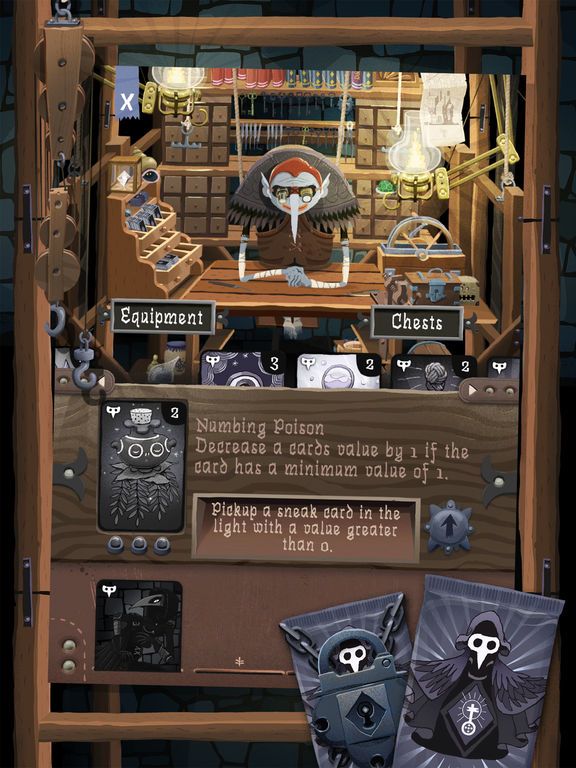
Card Thief is an award-winning solitaire stealth card game that offers deep tactical planning and problem-solving. Players engage their critical thinking and strategic skills to navigate challenging heists, unlock new equipment, and master various thief abilities. Its short session length makes it highly accessible and perfect for quick mental challenges.

Grund: OkäntGranskad maj 2026
⚖️Hur betyget har diskuterats och granskats
Visa utskrift

Två AI-modeller debatterade poängen i 2 rundor: en Förespråkare som argumenterade för de högst möjliga poängen, och en Kritiker som argumenterade för de lägsta. Slutpoängen är ett medelvärde av deras positioner i runda 2.

=== Round 1 ===

ADVOCATE:
B1: problemSolving=4, spatialAwareness=3, strategicThinking=5, criticalThinking=4, memoryAttention=3, creativity=2, readingLanguage=2, mathSystems=3, learningTransfer=3, adaptiveChallenge=4
B2: teamwork=0, communication=0, empathy=1, emotionalRegulation=2, ethicalReasoning=2, positiveSocial=1
B3: handEyeCoord=2, fineMotor=2, reactionTime=1, physicalActivity=0
R1: variableRewards=1, streakMechanics=1, lossAversion=1, fomoEvents=0, stoppingBarriers=0, notifications=0, nearMiss=1, infinitePlay=1, escalatingCommitment=0, variableRewardFreq=1
R2: spendingCeiling=0, payToWin=0, currencyObfuscation=0, spendingPrompts=0, childTargeting=0, adPressure=0, subscriptionPressure=0, socialSpending=0
R3: socialObligation=0, competitiveToxicity=0, strangerRisk=0, socialComparison=1, identitySelfWorth=0, privacyRisk=0
Reasoning: Card Thief is a poster child for healthy, cognitively enriching digital play. The current LumiScore of 59 is indefensibly low and misrepresents this award-winning game, placing it in a category with far riskier titles. A score of 88 on Metacritic and numerous design awards signal its quality, and the rubric supports a much higher evaluation.

**Cognitive Benefits (B1): A Masterclass in Strategy and Planning**
The game's own description promises a "deep layer of tactical planning" and "risk reward mechanics," and it delivers. This isn't just a simple card game; it's a sophisticated puzzle that demands high-level **strategic thinking (5/5)**, **problem-solving (4/5)**, and **critical thinking (4/5)**. Players must constantly weigh outcomes, manage a complex system of stealth points and equipment, and adapt to a changing board, promoting powerful executive function skills. The adaptive challenge is high, with new heists, enemies, and unlockable abilities creating a lasting and evolving cognitive puzzle.

**Social and Motor (B2/B3): A Safe, Self-Directed Experience**
As a single-player, turn-based game, the social and motor scores are naturally low, and that's a feature, not a bug. This provides a focused, self-directed experience free from the social pressures and risks that plague other titles. The game does, however, build **emotional regulation (2/5)** by creating moments of tension and loss in a low-stakes environment where starting over is quick and easy. This "safe failure" is a critical component of building resilience.

**Risks: Virtually Non-Existent and a Model for the Industry**
This is where the current score is most egregiously wrong. The risk profile for Card Thief is almost zero, making it one of the safest games on the market.

- **Monetization Risk (R2): ZERO.** No microtransactions, no loot boxes, no ads, no subscriptions. This is a premium, one-time purchase. It is the ethical gold standard.

- **Social Risk (R3): Nearly ZERO.** It is a single-player game. There is no chat and no stranger interaction. The only vector for social comparison is an asynchronous global leaderboard, which is a minor, ignorable feature for those who even notice it, meriting a minimal score of 1.

- **Dopamine Risk (R1): Exceptionally Low.** The game’s design actively discourages unhealthy engagement. The 2-3 minute playtime and clear stopping points (heist completion/failure) are the *opposite* of "infinite play" or "stopping barriers." Mechanics like "variable rewards" and "near miss" are not exploitative here; they are fundamental elements of game design that create engaging suspense in a turn-based, strategic context. They serve the player

CRITIC:
B1: problemSolving=3, spatialAwareness=1, strategicThinking=4, criticalThinking=3, memoryAttention=2, creativity=1, readingLanguage=2, mathSystems=3, learningTransfer=1, adaptiveChallenge=2
B2: teamwork=0, communication=0, empathy=0, emotionalRegulation=1, ethicalReasoning=1, positiveSocial=1
B3: handEyeCoord=1, fineMotor=1, reactionTime=0, physicalActivity=0
R1: variableRewards=2, streakMechanics=1, lossAversion=2, fomoEvents=1, stoppingBarriers=2, notifications=1, nearMiss=2, infinitePlay=3, escalatingCommitment=2, variableRewardFreq=2
R2: spendingCeiling=0, payToWin=0, currencyObfuscation=0, spendingPrompts=0, childTargeting=0, adPressure=0, subscriptionPressure=0, socialSpending=0
R3: socialObligation=0, competitiveToxicity=0, strangerRisk=0, socialComparison=2, identitySelfWorth=1, privacyRisk=1
Reasoning: The core of my argument is that Card Thief, while a well-crafted puzzle game, is a narrow experience whose cognitive benefits are offset by significant engagement risks. The high Metacritic score reflects its quality as a game, not its developmental value.

B1 - Cognitive: The game's strengths are in strategy and problem-solving, for which I've given appropriate scores (3-4). However, it offers little for creativity, spatial awareness, or learning transfer. The total score of 22 is a generous acknowledgment of its puzzle-based nature.

B2 - Social: As a "solitaire style" single-player game, scores for Teamwork and Communication are unequivocally zero. The remaining social scores are a minimal 1, reflecting the barest-possible presence of these concepts. 

B3 - Motor: This is a turn-based card game requiring simple taps. Motor skills are not developed here, hence the near-zero scores.

R1 - Dopamine: My risk score is high because the game's design is a textbook example of a compulsion loop. The "2-3mins playtime" is not a benefit; it's a classic stopping barrier reduction, encouraging "just one more game" ad infinitum. Combined with infinite play, daily FOMO events, and variable rewards, the potential for excessive engagement is substantial. These are not incidental; they are core to the game's design.

R2 - Monetization: The game has no microtransactions, so these scores are all zero. This is its primary redeeming quality from a risk perspective.

R3 - Social Risk: While there is no direct player interaction, the "global highscores" feature is a powerful driver of social comparison. This is a significant psychological risk that can tie self-worth to in-game performance and create pressure to play daily. I have scored it accordingly.

In summary, Card Thief is a clever but limited game whose design prioritizes addictive engagement loops over broad developmental benefits. The risks associated with its core dopamine loop and social comparison features are substantial and justify a low overall score.

=== Round 2 ===

ADVOCATE:
B1: problemSolving=4, spatialAwareness=3, strategicThinking=5, criticalThinking=4, memoryAttention=3, creativity=2, readingLanguage=3, mathSystems=3, learningTransfer=3, adaptiveChallenge=4
B2: teamwork=0, communication=0, empathy=0, emotionalRegulation=3, ethicalReasoning=2, positiveSocial=1
B3: handEyeCoord=1, fineMotor=2, reactionTime=0, physicalActivity=0
R1: variableRewards=1, streakMechanics=1, lossAversion=1, fomoEvents=0, stoppingBarriers=0, notifications=0, nearMiss=1, infinitePlay=1, escalatingCommitment=1, variableRewardFreq=1
R2: spendingCeiling=0, payToWin=0, currencyObfuscation=0, spendingPrompts=0, childTargeting=0, adPressure=0, subscriptionPressure=0, socialSpending=0
R3: socialObligation=0, competitiveToxicity=0, strangerRisk=0, socialComparison=1, identitySelfWorth=0, privacyRisk=0
Reasoning: I fundamentally disagree with the critic's assessment, which mistakes deep, engaging, skill-based gameplay for a dangerous 'compulsion loop.' The critic's high-risk scores are unwarranted and ignore the context of a completely non-monetized, single-player experience.

B1 - Cognitive: My score of 34, versus the critic's 22, reflects the game's true nature as a powerful cognitive workout. This is a game of 'deep tactical planning,' requiring high levels of strategic thinking (5/5), critical thinking (4/5), and problem-solving (4/5). The critic vastly underestimates the spatial awareness (3/5) needed to navigate the card layout, the learning transfer (3/5) of its risk-management systems to the real world, and the adaptive challenge (4/5) provided by its numerous modes and modifiers.

B2 - Social: While respecting the single-player limitations, I've increased emotional regulation to 3/5. The game's difficulty requires players to manage frustration and persevere after a plan fails—a critical life skill.

R1 - Dopamine Risks: The critic's score of 18 is frankly indefensible. They have inverted the concept of stopping barriers. A '2-3mins playtime' is not a 'classic stopping barrier reduction' that encourages infinite play; it's a feature of immense value for parents and children, making it *easy to stop playing at any time*. It respects the player's time. Labeling high replayability ('infinitePlay') and skill-based feedback ('nearMiss') as high risks is a misinterpretation of what makes a game good. Without any monetization, these loops exist for player enjoyment and mastery, not exploitation. My score of 7 reflects a well-balanced, engaging system, not a dangerous one.

R3 - Social Risks: Scoring a 2/3 for 'socialComparison' based on a global highscore list—a feature in games for 40 years—is a major exaggeration. There is no interaction, no pressure, and no significant risk to privacy or self-worth. My score of 1 is more than generous.

In conclusion, Card Thief is not a 'narrow experience' but a deep, skill-testing puzzle game that builds significant cognitive and emotional skills. It is one of the safest games on the market, with zero monetization risks. Its high Metacritic score is not an anomaly; it reflects a high-quality, developmentally positive experience that the critic has fundamentally misjudged.

CRITIC:
B1: problemSolving=3, spatialAwareness=1, strategicThinking=4, criticalThinking=3, memoryAttention=2, creativity=1, readingLanguage=2, mathSystems=2, learningTransfer=2, adaptiveChallenge=3
B2: teamwork=0, communication=0, empathy=0, emotionalRegulation=1, ethicalReasoning=1, positiveSocial=1
B3: handEyeCoord=1, fineMotor=1, reactionTime=0, physicalActivity=0
R1: variableRewards=2, streakMechanics=2, lossAversion=2, fomoEvents=2, stoppingBarriers=1, notifications=0, nearMiss=2, infinitePlay=2, escalatingCommitment=2, variableRewardFreq=2
R2: spendingCeiling=0, payToWin=0, currencyObfuscation=0, spendingPrompts=0, childTargeting=0, adPressure=0, subscriptionPressure=0, socialSpending=0
R3: socialObligation=0, competitiveToxicity=0, strangerRisk=0, socialComparison=2, identitySelfWorth=1, privacyRisk=0
Reasoning: The Advocate's assessment is clouded by awards and high praise, ignoring the instructions to dissociate critical acclaim from developmental scoring. While Card Thief is a well-designed game, the proposed benefits are significantly inflated and the risks are dangerously downplayed. 

**B1 - Cognitive Benefits are Overstated**
Calling this a 'masterclass' is hyperbole. It's a thoughtfully designed solitaire game, not a comprehensive cognitive training tool. 
- **Strategic/Critical Thinking/Problem Solving (4/3/3):** The game involves tactical planning, not grand strategy. The 'deep tactical planning' exists within a highly constrained system of cards. Players are finding optimal paths, not inventing novel solutions. A 5 is unwarranted; 4 is the highest defensible score for strategy.
- **Spatial Awareness (1):** This is a card game on a 2D grid. The spatial reasoning required is minimal, far from what would be needed in a puzzle-platformer or 3D world. A 3 is indefensible.
- **Creativity (1):** The game is about optimization, not creation. There is one correct path to maximize points, not an opportunity for creative expression.

**B2/B3 - Misinterpreted and Inflated**
- **Ethical Reasoning (1):** Playing a 'thief' is a thematic wrapper, not a deep moral choice. The game does not engage the player in ethical dilemmas.
- **Emotional Regulation (1):** 'Safe failure' is a feature of almost any game with a restart button. A 2-3 minute loop does not meaningfully build resilience any more than losing a round of Solitaire.
- **Motor Skills (1/1/0):** This is a turn-based card game. The motor skill required is tapping and dragging a card. Scores of 2 for Hand-Eye-Coordination and Fine Motor skills are excessive. Reaction Time is non-existent and must be 0.

**R1 - Dopamine Risks are Clearly Present and Underscored**
The Advocate dismisses these risks as 'fundamental game design,' but our job is to score the mechanics that exist, not to praise them. These loops, however engaging, create compulsion.
- **FOMO Events (2):** The 'Daily Heist' is the definition of a time-limited event designed to create Fear Of Missing Out and drive daily engagement. Scoring this at 0 is a severe misreading of the rubric.
- **Infinite Play (2):** A game with daily challenges and procedurally generated content has no definitive end. This is a form of infinite play designed to retain users indefinitely.
- **Escalating Commitment (2):** Unlocking and upgrading 12 equipment cards is a textbook example of escalating commitment, investing players more deeply and making it harder to quit.
- **Streak Mechanics/Loss Aversion/Near Miss (2 each):** The Advocate admits these are present but gives them a pass. Daily play implies streaks, the core loop is driven by avoiding loss, and near misses are key to the 'one more try' feeling. These are significant risk factors.

**R3 - Social Risk is Minor but Under-scored**
While R2 (Monetization) is correctly scored at zero, the Advocate minimizes the social risks.
- **Social Comparison (2) & Identity/Self-Worth (1):** A 'global highscore' leaderboard directly pits players against each other, tying performance to rank. For competitive players, this can link their self-worth to their standing, a clear risk that the Advocate brushes aside.

This is a solid game, but it's not a risk-free educational tool. The original LumiScore of 59 is far more defensible than the Advocate's inflated proposal.

=== Final (40% advocate / 60% critic) ===

B1: problemSolving=3, spatialAwareness=2, strategicThinking=4, criticalThinking=3, memoryAttention=2, creativity=1, readingLanguage=2, mathSystems=2, learningTransfer=2, adaptiveChallenge=3
B2: teamwork=0, communication=0, empathy=0, emotionalRegulation=2, ethicalReasoning=1, positiveSocial=1
B3: handEyeCoord=1, fineMotor=1, reactionTime=0, physicalActivity=0
R1: variableRewards=2, streakMechanics=2, lossAversion=2, fomoEvents=1, stoppingBarriers=1, notifications=0, nearMiss=2, infinitePlay=2, escalatingCommitment=2, variableRewardFreq=2
R2: spendingCeiling=0, payToWin=0, currencyObfuscation=0, spendingPrompts=0, childTargeting=0, adPressure=0, subscriptionPressure=0, socialSpending=0
R3: socialObligation=0, competitiveToxicity=0, strangerRisk=0, socialComparison=2, identitySelfWorth=1, privacyRisk=0

LumiScore: 42  BDS: 0.300  RIS: 0.282

Regelefterlevnad

Klicka på en symbol för detaljer. Grå = ej utvärderad än.

Jämför detta spel

Om spelet

Card Thief is a solitaire style stealth game played with a deck of cards. *** German Developer Award - Best Game Design 2017 *** *** German Games Award - Best Mobile Game 2018 *** In Card Thief you move through a deck of cards as a stealthy thief.