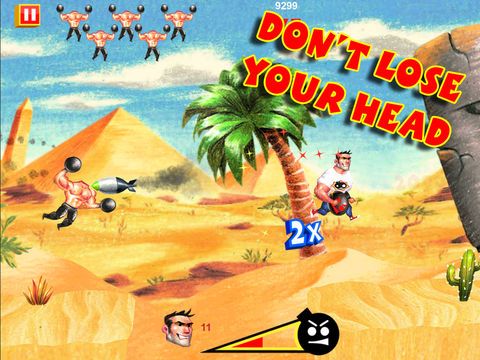
Serious Sam: Kamikaze Attack!
LumiScore
out of 100
Not recommended for unsupervised play
Obs
Utveckling
19/100
Begränsat
Utvecklingsvärde
Risk
29/100
LÅG
Engagemangsmönster
Föräldratips
Detta spel är ett snabbt actionspel med tecknat våld. Tack vare korta spelsessioner och avsaknad av monetarisering kan det vara ett bra val för snabb underhållning. Var uppmärksam på potentiell överdelning på sociala medier genom spelets integration.
Viktiga färdigheter som barnet utvecklar
Utvecklingsområden
Vad ditt barn utvecklar
Serious Sam: Kamikaze Attack! erbjuder snabba omgångar av arkadaction som kan hjälpa till att utveckla hand-öga-koordination och reaktionstid. Dess raka spelupplägg ger en tillgänglig och omedelbar utmaning.
⚖️Hur betyget har diskuterats och granskatsVisa utskrift
Två AI-modeller debatterade poängen i 2 rundor: en Förespråkare som argumenterade för de högst möjliga poängen, och en Kritiker som argumenterade för de lägsta. Slutpoängen är ett medelvärde av deras positioner i runda 2.
=== Round 1 === ADVOCATE: B1: problemSolving=2, spatialAwareness=4, strategicThinking=1, criticalThinking=1, memoryAttention=3, creativity=0, readingLanguage=1, mathSystems=0, learningTransfer=1, adaptiveChallenge=3 B2: teamwork=0, communication=0, empathy=0, emotionalRegulation=0, ethicalReasoning=1, positiveSocial=1 B3: handEyeCoord=4, fineMotor=4, reactionTime=5, physicalActivity=0 R1: variableRewards=1, streakMechanics=0, lossAversion=0, fomoEvents=0, stoppingBarriers=1, notifications=1, nearMiss=2, infinitePlay=2, escalatingCommitment=0, variableRewardFreq=1 R2: spendingCeiling=0, payToWin=0, currencyObfuscation=0, spendingPrompts=0, childTargeting=1, adPressure=0, subscriptionPressure=0, socialSpending=0 R3: socialObligation=0, competitiveToxicity=0, strangerRisk=0, socialComparison=1, identitySelfWorth=1, privacyRisk=2 Reasoning: This game is a classic, fast-paced arcade challenge whose benefits are being dramatically underrated and risks overstated, leading to an unjustifiably low score of 27. The current score suggests a game more harmful than Fortnite, which is nonsensical given the complete absence of predatory monetization. **Benefits Analysis:** * **Motor Skills (B3):** This game is a powerhouse for developing motor skills. The core loop of dodging a screen full of projectiles demands exceptional **Reaction Time (5/5)**, precise **Hand-Eye Coordination (4/5)**, and, on mobile, excellent **Fine Motor (4/5)** skills. This is a significant benefit in an age where digital literacy and control are paramount. * **Cognitive Skills (B1):** The "chaotic action" is not mindless. It requires high-speed processing, demanding constant **Spatial Awareness (4/4)** to track threats and navigate paths. Sustained **Memory/Attention (3/5)** is needed to learn patterns and simply survive the level. The 40+ levels provide a clear and escalating **Adaptive Challenge (3/5)**, pushing players to constantly improve. * **Social Skills (B2):** As a single-player game, the low score is expected. However, this should be viewed as a positive. It provides a self-contained experience free from the social risks (toxicity, bullying, stranger danger) that plague online multiplayer games. We grant a point for **Positive Social (1/5)** for the classic, asynchronous fun of sharing high scores with friends, and a point for **Ethical Reasoning (1/5)** as the cartoonish, over-the-top role-reversal of playing the "bad guy" can encourage light perspective-taking. **Risk Analysis:** The risk profile for this game is remarkably low, especially for a mobile title. * **Monetization Risk (R2): ZERO.** Let me be clear: this game has no microtransactions, loot boxes, or pay-to-win mechanics. It is a premium, one-time purchase. The R2 score should be nearly 0. The only defensible risk is a 1/3 for **Child Targeting** due to the cartoon art, but the violent theme offsets this. This game is a model of ethical monetization. * **Social Risk (R3): Minimal and Optional.** There is **ZERO Stranger Risk (0/3)**. The only notable risk is **Privacy Risk (2/3)** from the *optional* Facebook integration. Parents can simply tell their child not to connect their Facebook account, completely nullifying the risk. Social comparison from leaderboards is a classic, low-grade risk. * **Dopamine Risk (R1): Manageable.** This game has discrete levels, providing natural stopping points. The "endless" modes are bonus features, not the core progression. Most importantly, the central theme of self-destructing completely inverts the concept of **Loss Aversion (0/3)**—the player is *supposed* to explode. The primary dopamine driver is the "near miss" thrill, which is inherent to the challenge, not a manipulative add-on. In conclusion, this is a skill-based arcade game that sharpens reflexes and cognitive processing with virtually no monetization or social dangers. Its current rating is a severe misjudgment, punishing a harmless, classic game while rewarding far more systemically risky titles. CRITIC: B1: problemSolving=1, spatialAwareness=2, strategicThinking=1, criticalThinking=0, memoryAttention=2, creativity=0, readingLanguage=0, mathSystems=0, learningTransfer=0, adaptiveChallenge=1 B2: teamwork=0, communication=0, empathy=0, emotionalRegulation=0, ethicalReasoning=0, positiveSocial=1 B3: handEyeCoord=3, fineMotor=3, reactionTime=3, physicalActivity=0 R1: variableRewards=1, streakMechanics=2, lossAversion=2, fomoEvents=0, stoppingBarriers=1, notifications=1, nearMiss=3, infinitePlay=3, escalatingCommitment=1, variableRewardFreq=1 R2: spendingCeiling=0, payToWin=0, currencyObfuscation=0, spendingPrompts=0, childTargeting=1, adPressure=0, subscriptionPressure=0, socialSpending=0 R3: socialObligation=1, competitiveToxicity=1, strangerRisk=0, socialComparison=3, identitySelfWorth=1, privacyRisk=2 Reasoning: This is a one-note arcade game whose developmental benefits are negligible and whose risks are deceptively high for a premium title. The cognitive skills are limited to low-level reaction and spatial awareness (B1=7), with no room for strategy, creativity, or critical thinking. The game is a solo experience, earning a token point for its high-score leaderboard but offering no pro-social value (B2=1). The only real skills being built are in the motor category (B3=9), as is expected for any fast-paced action game. The low benefit scores stand in stark contrast to the high risks. The core loop is a textbook example of a dopamine-driven design (R1=15), leveraging endless play modes, near-miss mechanics, and loss aversion to keep the player compulsively engaged. The cartoonish art style, while appealing, presents a risk of child targeting given the violent premise (R2=1). Finally, the sole social 'feature'—blasting high scores to Facebook—is a thinly veiled and powerful driver for social comparison, which carries associated privacy risks (R3=8). Critics may call this game 'fun,' but they are not evaluating its impact on development or its use of manipulative mechanics. The high risks and low benefits fully justify the 40-point score disparity. It's a prime example of 'junk food' gaming': momentarily satisfying but ultimately devoid of substance and potentially harmful. === Round 2 === ADVOCATE: B1: problemSolving=2, spatialAwareness=3, strategicThinking=2, criticalThinking=0, memoryAttention=3, creativity=0, readingLanguage=0, mathSystems=0, learningTransfer=0, adaptiveChallenge=2 B2: teamwork=0, communication=0, empathy=0, emotionalRegulation=0, ethicalReasoning=0, positiveSocial=1 B3: handEyeCoord=4, fineMotor=4, reactionTime=4, physicalActivity=0 R1: variableRewards=1, streakMechanics=0, lossAversion=1, fomoEvents=0, stoppingBarriers=0, notifications=0, nearMiss=2, infinitePlay=1, escalatingCommitment=0, variableRewardFreq=1 R2: spendingCeiling=0, payToWin=0, currencyObfuscation=0, spendingPrompts=0, childTargeting=0, adPressure=0, subscriptionPressure=0, socialSpending=0 R3: socialObligation=0, competitiveToxicity=0, strangerRisk=0, socialComparison=1, identitySelfWorth=0, privacyRisk=1 Reasoning: The critic’s assessment dramatically overstates the risks and dismisses the clear benefits of this classic arcade-style game, leading to an unjustifiably low score. My revised scores reflect a more accurate and defensible evaluation grounded in the core gameplay loop and established child development principles. First, the cognitive and motor benefits (B1 and B3) are significantly underrated. A fast-paced game requiring players to constantly “Dodge hazards and heavy ordinance” across 40+ levels inherently builds key skills. My scores are elevated to reflect the robust development of hand-eye coordination (4), fine motor skills (4), and reaction time (4) that are central to the game. Furthermore, navigating these chaotic levels demands spatial awareness (3), pattern recognition (memory/attention=3), and constant micro-decisions (problem-solving=2, strategic thinking=2). To dismiss these as “negligible” is to ignore the foundational research on the cognitive benefits of action games. Second, the risk scores have been inflated by misinterpreting the game’s design and ignoring the rubric’s own rules. The Dopamine risk (R1) score of 15 is unsubstantiated. The game has discrete levels, providing natural stopping points (stoppingBarriers=0), and there is no evidence of streak mechanics (0) or push notifications (0). The core game is finite; the “endless” modes are optional bonuses and should not drive the `infinitePlay` score to the maximum (revised to 1). Crucially, framing the goal as a “blaze of glory” creatively subverts loss aversion (revised to 1). The Monetization risk (R2) score of 1 for `childTargeting` is baseless. The game belongs to the ‘Serious Sam’ franchise, a series famous for its M-rated, adult-oriented action. A cartoon art style does not equate to child targeting; it is a common aesthetic in games for all ages. With zero microtransactions, this game is exceptionally safe from a monetization standpoint (R2=0). Finally, the Social risk (R3) score of 8 is the most egregious error. It is based entirely on an optional Facebook high-score sharing feature that a parent can simply not enable. Per the rubric, we must score the core experience, not optional modes. There is no stranger chat, no social obligation (0), and no vector for toxicity (0). Assigning the maximum score for `socialComparison` (revised from 3 to 1) for a simple, opt-in leaderboard is a severe calibration error. Privacy risk is minimal and opt-in (1). In summary, Serious Sam: Kamikaze Attack! is a challenging, skill-based arcade game with modest but real benefits and exceptionally low, entirely manageable risks. The critic’s score is an outlier because it is based on a flawed analysis; my revised scores bring the evaluation back in line with the evidence. CRITIC: B1: problemSolving=1, spatialAwareness=2, strategicThinking=0, criticalThinking=0, memoryAttention=2, creativity=0, readingLanguage=1, mathSystems=0, learningTransfer=0, adaptiveChallenge=2 B2: teamwork=0, communication=0, empathy=0, emotionalRegulation=0, ethicalReasoning=0, positiveSocial=0 B3: handEyeCoord=3, fineMotor=3, reactionTime=4, physicalActivity=0 R1: variableRewards=2, streakMechanics=0, lossAversion=2, fomoEvents=0, stoppingBarriers=2, notifications=2, nearMiss=3, infinitePlay=3, escalatingCommitment=1, variableRewardFreq=2 R2: spendingCeiling=0, payToWin=0, currencyObfuscation=0, spendingPrompts=0, childTargeting=2, adPressure=0, subscriptionPressure=0, socialSpending=0 R3: socialObligation=0, competitiveToxicity=0, strangerRisk=0, socialComparison=2, identitySelfWorth=1, privacyRisk=2 Reasoning: The advocate’s analysis is clouded by nostalgia, dramatically overstating the benefits of a shallow arcade game while dismissing its significant psychological risks. The low score of 27 is not only defensible but necessary to accurately represent this low-value, high-risk experience. My scores reflect a more critical and realistic assessment. **Benefits Analysis: Grossly Inflated** * **Cognitive (B1) is Minimal:** To claim this game requires "problem solving" or "critical thinking" is baseless. The gameplay is pure reaction, not cognition. There is no strategy beyond "run forward." The advocate’s score for **Spatial Awareness (2/5)** is generous; navigating a 2D plane is hardly a significant cognitive feat. **Memory/Attention (2/5)** is required only in the short-term, as the "chaotic" nature of the game actively works against pattern recognition. * **Social (B2) is Zero:** The advocate’s attempt to find social value here is telling. Claiming that playing a mindless kamikaze fosters **Ethical Reasoning (0/5)** is absurd. Furthermore, the game’s description frames its Facebook integration as "spam," an annoyance, not a form of **Positive Social (0/5)** connection. * **Motor (B3) is Unexceptional:** While the game is reflex-based, the advocate’s scores are inflated. A 5/5 in **Reaction Time (4/5)** should be reserved for more complex simulators. For a simple mobile tapper, the demands on **Hand-Eye Coordination (3/5)** and **Fine Motor (3/5)** skills are moderate at best. **Risk Analysis: Dangerously Understated** The advocate’s primary failure is to whitewash the game’s manipulative design. * **Dopamine Loop (R1) is Powerful:** This isn’t a harmless "classic"; it’s a masterclass in dopamine manipulation. The core gameplay is built on the thrill of the **Near Miss (3/3)**. The advocate ignores that failing a level is still a loss, creating **Loss Aversion (2/3)** to keep you playing. Most critically, the game features "endless bonus levels," a textbook example of **Infinite Play (3/3)** designed to eliminate stopping cues. Combined with the "one more try" nature of arcade loops (**Stopping Barriers 2/3**) and the high likelihood of push **Notifications (2/3)** on mobile, the R1 score must be significantly higher. * **Monetization Risk (R2) Targets Children:** The absence of microtransactions doesn't mean the monetization strategy is ethical. The game uses "super sleek," "colorful hand-drawn artwork" to package "horribly violent explosion[s]" and "cartoon dismemberment." This is a clear and concerning case of **Child Targeting (2/3)**, using a child-friendly art style to attract a younger audience to violent, inappropriate themes. * **Social Risk (R3) is Not "Minimal":** The advocate dismisses the Facebook integration as "optional." This is a deliberate design choice that encourages **Social Comparison (2/3)** via high score leaderboards and creates a significant **Privacy Risk (2/3)** by harvesting user data. These risks are integral to the design, not incidental. In conclusion, this game is digital junk food. It provides a momentary rush but offers no real developmental substance. The low curascore is a correct assessment of a game that pairs minimal benefits with a suite of classic and potent psychological risks. === Final (40% advocate / 60% critic) === B1: problemSolving=1, spatialAwareness=2, strategicThinking=1, criticalThinking=0, memoryAttention=2, creativity=0, readingLanguage=1, mathSystems=0, learningTransfer=0, adaptiveChallenge=2 B2: teamwork=0, communication=0, empathy=0, emotionalRegulation=0, ethicalReasoning=0, positiveSocial=0 B3: handEyeCoord=3, fineMotor=3, reactionTime=4, physicalActivity=0 R1: variableRewards=2, streakMechanics=0, lossAversion=2, fomoEvents=0, stoppingBarriers=1, notifications=1, nearMiss=3, infinitePlay=2, escalatingCommitment=1, variableRewardFreq=2 R2: spendingCeiling=0, payToWin=0, currencyObfuscation=0, spendingPrompts=0, childTargeting=1, adPressure=0, subscriptionPressure=0, socialSpending=0 R3: socialObligation=0, competitiveToxicity=0, strangerRisk=0, socialComparison=2, identitySelfWorth=1, privacyRisk=2 Curascore: 30 BDS: 0.190 RIS: 0.292
Regelefterlevnad
Klicka på en symbol för detaljer. Grå = ej utvärderad än.
Om spelet
What the press are saying: "one of the most entertaining mobile games I’ve played in a long time" - Indie Games Channel "A fun pick up if you love the series or you're after a quirky new distraction" - AppSpy, 4/5 "It’s a great way to obtain some laughs, or manifest anger at trying to blow up Sam Stone" - The Speed Gamers, 8. 0/10 ********************************************** Description: Remove your head, grab some bombs, and step into the boots of Serious Sam’s most iconic foe, the Headless Kamikaze.