Sandbox vs. on-rails: what open-ended games do that guided ones don't
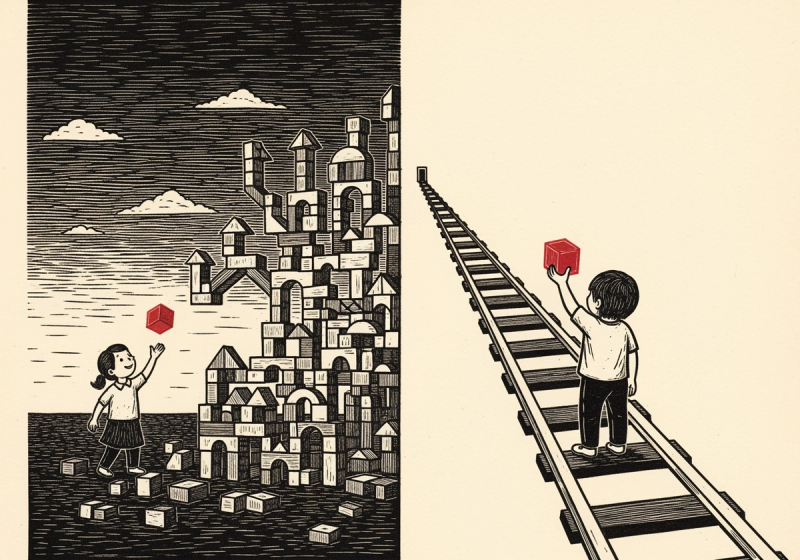
From the doorway, two children look like they're doing the same thing. Both are staring at a screen, both are building something, both are absorbed. Look closer and one of them is assembling a structure that exists nowhere else — choosing the problem, inventing the solution, deciding when it's finished. The other is being walked through a sequence of pre-built steps that produce a pre-determined result, dressed up as creation. One is creative play. The other is creative theatre. The developmental difference between them is large, and it's worth being able to spot.
The technical names are sandbox (open-ended, player-authored) and on-rails (guided, designer-authored). Most games sit somewhere on the spectrum between. Where a game falls is one of the better predictors of whether it's building anything in your child — and it's a distinction Ludograph's benefit score is designed to catch.
What "open-ended" actually means
A genuinely open-ended game hands the player three things a guided game keeps for itself: the goal, the method, and the stopping point. In Minecraft, nobody tells you to build a castle, how to build it, or when it's done — you decide all three. In Mario Maker, you don't just play levels, you author them. In a creative-mode building game, the screen is closer to a blank page than a worksheet.
This matters because the cognitive work of open-ended play is qualitatively different. Deciding what to make is a creative act. Figuring out how with an open toolset is problem-solving. Judging when it's good enough is self-direction. None of those muscles get exercised when the game supplies the goal, scripts the method, and signals completion with a victory jingle. A guided game can still be excellent — it can train reaction time, pattern recognition, persistence — but it is doing different work, and "creative-looking" is not the same as "creative."
The rubric encodes this directly. Creativity and expression (B1.6) asks specifically whether the game "provides open-ended tools for building, designing, composing, or storytelling" — Minecraft Creative and Mario Maker score the maximum; a linear shooter scores near zero, however polished. It's a measure of authorship, not of how much stuff is on screen.
What the evidence supports — and where it thins out
Here's where honesty matters, because this is a topic where enthusiasm tends to outrun the data.
Well-supported: that open-ended construction play exercises spatial reasoning and planning. The spatial-cognition link is one of the more robust findings in the whole "games and development" literature — spatial skills are trainable and the gains transfer (Uttal et al., 2013, Psychological Bulletin), and 3D building games lean on exactly those skills. That problem-solving and systems-thinking are genuinely engaged by open toolsets is also well grounded.
Intuitive but thinner: the leap from "sandbox games involve creativity" to "sandbox games make children more creative in general." That's the same overreach as brain-training transfer claims, and the controlled evidence is modest. Watching a child invent in Minecraft, it feels self-evident that creativity is being built; the rigorous causal demonstration that it generalises beyond the game is weaker than the spatial-reasoning evidence. So we score creativity as a real, present developmental dimension — because the activity unmistakably is creative — without claiming it manufactures a more creative adult. Under-claiming keeps the score trustworthy.
The practical upshot for parents is the same either way: open-ended play is at minimum a richer cognitive activity than guided play, and at best a genuine creativity builder. Either reading favours the sandbox.
The user-generated wrinkle
The cleanest sandbox games are now platforms — Roblox, Fortnite Creative, Minecraft with its marketplace — where the "game" is millions of player-made experiences. This is the purest form of open-endedness and the messiest to score, because a single platform contains a creative-coding tutorial and a casino-styled simulator under the same logo. The authorship that makes sandboxes valuable is exactly what makes them impossible to rate with one number.
That's why Ludograph scores these platforms differently — per-experience where it can, with score floors that stop a thin, title-only listing from inheriting an inflated benefit number. The full reasoning is in How we score Roblox and Fortnite Creative. The relevant point here: the creation tools on these platforms are about as open-ended as games get, but "my kid plays Roblox" tells you almost nothing until you know which Roblox — building a world and grinding a pay-to-win simulator are opposite activities wearing the same brand.
How the rubric scores it
Open-endedness shows up most clearly in the cognitive half of the benefit score. Real catalogue numbers:
- Minecraft (console, no marketplace) — benefit 0.60, risk 0.14, up to 120 min/day. The rubric's reference sandbox: maximum creativity and spatial scores, minimal manipulation. About as good as the benefit side gets.
- Red Dead Redemption 2 — benefit 0.56, risk 0.00, up to 120 min/day (17+). Mostly on-rails — a tightly authored story — and still scores high, because guided design done superbly is still rich. On-rails isn't an insult; it's a different shape of value.
The contrast to hold onto: a high benefit score can come from open-ended authorship (Minecraft) or from a masterfully guided experience (a great story game). What pulls the benefit score down is shallow guided design — a game that walks the player through empty motions and calls it play. The rubric isn't biased toward sandboxes for their own sake; it's biased toward depth, and open-ended play is simply one of the most reliable routes to it.
What to do with this
- Ask "who's deciding what to make?" If the answer is the child, you're looking at sandbox value. If it's the game, you're looking at guided value — still potentially great, but a different thing. Match it to what your child gets less of elsewhere.
- Steer younger children toward open tools for at least some of their screen time. Creative-mode building, level-making, music or drawing games — the authorship is where the richest cognitive work lives.
- On platforms, name the specific experience, not the app. "Roblox" and "Fortnite" are storefronts. Find out which world your child actually plays in, and check that one — the spread within a single platform is enormous.
- Don't dismiss on-rails games. A beautifully guided game builds persistence, timing and pattern recognition that a sandbox may not. The goal is a balanced diet, not sandbox purism.
The honest summary
Open-ended and guided games can look identical from across the room and do quite different things up close. Sandbox play hands your child the goal, the method, and the finish line — and in claiming those decisions, exercises creativity, spatial reasoning and self-direction in a way guided play structurally can't. The evidence is strongest for the spatial and problem-solving gains and more modest for "makes kids more creative," and we score it accordingly rather than overselling. But the practical rule is simple: when you can, make sure some of your child's screen time is spent authoring rather than just completing. The blank page is doing more than the worksheet.
Read next
- What 'good for kids' actually means — the science behind the benefit score — how creativity and spatial reasoning roll into the benefit number.
- How we score Roblox and Fortnite Creative — why "my kid plays Roblox" needs a follow-up question.
- The best games for an 8-year-old — open-ended picks that score well on both profiles.