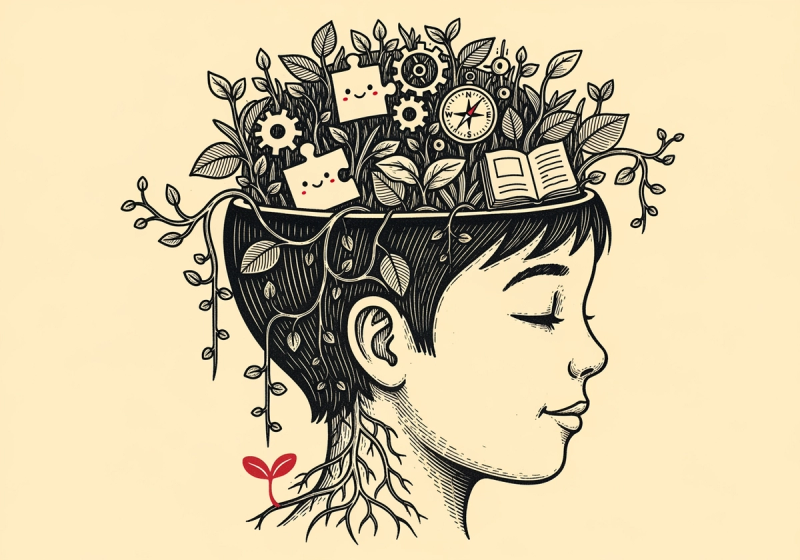
What 'good for kids' actually means — the science behind the benefit score
"Educational" is the most overused word in the children's games aisle, and one of the least examined. A game that drills multiplication tables behind a cartoon mascot calls itself educational. So does an open-world building game that never mentions school once. They are not the same thing, and lumping them together helps no parent decide anything.
Ludograph tries to be precise instead. Every game in the catalogue gets a Benefit Density Score — a number from 0 to 1 that estimates how much genuine developmental value the design offers — and that number is built on a specific, citable view of what childhood development actually involves. This post explains that view: what we measure, why, what the research supports, and — just as important — what it doesn't.
Two profiles, not one verdict
The first thing to understand is that the benefit score is deliberately kept separate from the risk score. A game is not "good" or "bad" on a single axis. It has a Benefit Profile (what your child develops) and a Risk Profile (what to watch out for), and the two are independent — a game can score high on both at once. That independence is the whole design. It lets us say something honest and uncomfortable: a genuinely enriching game can also be genuinely manipulative, and a parent deserves to see both facts side by side rather than have them averaged into mush.
So when we talk about "good for kids," we mean only the benefit side — and we mean it in the developmental sense, grounded in three families of skill.
The three things we actually measure
The benefit score draws on the same structure developmental psychologists use when they talk about what childhood play builds. We group it into three categories and weight them.
Cognitive development (the largest weight, 50%). This is the heart of the case for games. It covers problem-solving, spatial reasoning, strategic and critical thinking, working memory and attention, creativity, language, systems thinking, and whether difficulty adapts to the player. The reason it carries the most weight is that this is where the evidence is strongest. The landmark synthesis is Granic, Lobel and Engels' The Benefits of Playing Video Games (2014, American Psychologist), which pulled together the cognitive, motivational, emotional and social upsides of play that the moral-panic literature had been ignoring. On the cognitive side specifically, the evidence is unusually concrete: action games measurably sharpen aspects of visual attention (Green & Bavelier's Action video game modifies visual selective attention, 2003, Nature), and spatial skills — which games train heavily — are among the few cognitive abilities a meta-analysis has shown to be reliably trainable and transferable (Uttal et al., 2013, Psychological Bulletin).
Social and emotional development (30%). Teamwork, communication, empathy and perspective-taking, emotional regulation, ethical reasoning, and whether the multiplayer environment is actually prosocial. Cooperative play is the clearest case here — a game that requires genuine collaboration, where players depend on each other's contributions, is doing real social work. The flip side matters too: "social" features that are really just unmoderated open chat with strangers score nothing on this axis, because exposure is not the same as development.
Physical and motor development (20%). Hand-eye coordination, fine motor control, reaction time, and — weighted deliberately — whole-body physical activity. The smallest category, but the one that quietly distinguishes a motion or VR title that gets a child moving from a sedentary one. (We think this dimension deserves to count for more than it currently does, and it's on the rubric roadmap.)
Each of these rolls up into the Benefit Density Score via a fixed formula — cognitive at half the weight, social-emotional at thirty percent, physical at twenty. The weighting isn't arbitrary; it tracks where the developmental evidence is strongest.
What the research supports — and what it doesn't
Here is where most "games are good for you" writing goes wrong, and where we try not to.
What's well-supported: that specific cognitive skills — spatial reasoning, certain kinds of attention, problem-solving under uncertainty — are exercised and in some cases improved by games that demand them. That cooperative play can build real social coordination. That games are a legitimate venue for practising persistence and frustration tolerance when the difficulty is honest rather than monetised.
What's weaker than the marketing claims: "brain training" transfer. The popular idea that a memory mini-game makes your child smarter in general is largely unsupported — most cognitive gains are narrow and specific to the trained task. Creativity benefits from open-ended sandbox tools are intuitively obvious to anyone who's watched a child build, but the controlled evidence is thinner than the cognitive evidence, and we score it accordingly rather than overclaiming. And "educational" branding is no guarantee of anything: a game can wear the label and still score low because the learning is bolted on rather than built in.
We'd rather under-claim and be trusted than over-claim and be marketing. The benefit score is an estimate of developmental density, not a promise of outcomes.
Why a high benefit score doesn't automatically mean "play more"
This is the part parents find counterintuitive, so it's worth seeing in real numbers from the catalogue.
- Red Dead Redemption 2 — benefit 0.56, risk 0.00, up to 120 min/day (17+). High benefit, almost no manipulation design — so the recommendation is generous. This is what "good for kids" looks like when nothing is working against the player. (The 17+ is a content matter, handled entirely separately — see Does violent content actually predict harm?.)
- Minecraft (console, no marketplace) — benefit 0.60, risk 0.14, up to 120 min/day. The rubric's model citizen: exceptional cognitive and creative density, minimal manipulation.
- Clash of Clans — benefit 0.75, risk 0.79, 15 min/day, not recommended. The highest benefit score of its studio's catalogue — and still one of the shortest recommendations we give.
Look at that last one. Clash of Clans has more measured developmental value than many games we recommend warmly. Real strategy, resource management, planning. And it still lands at fifteen minutes, because the benefit score is only an input — it cannot buy back a high-risk design. The formula is deliberately asymmetric: substantial benefits (a Benefit Density Score of 0.60 or above) can extend a time recommendation by one tier, but they can't rescue a game whose risk intensity is very high. Benefits earn a longer leash, not immunity.
That asymmetry is the honest answer to "but it's educational!" Sometimes a game really is — and the design around the educational core is still built to keep your child playing past the point of benefit. Both things are true. The two-number system exists so you can see both.
What to do with the benefit score
- Read it as a reason, not a permission slip. A high benefit number tells you what your child is getting — spatial reasoning, teamwork, creative expression. Use it to choose between games, not to set the timer. The time recommendation already factors benefits in.
- Look at which category is driving it. A benefit score built on cognitive density (problem-solving, building) is a different proposition from one built on physical activity. The per-game page breaks it down — match it to what your child actually needs more of.
- Distrust the word "educational" on the box; trust the breakdown. If a game markets itself as educational but scores low on benefit, the learning is probably decoration. If a game never mentions learning and scores high, the development is real.
- Pair a high-benefit, low-risk game with co-play when your child is younger. The developmental upside is largest when an adult is occasionally in the loop — see The case for co-play.
The honest summary
"Good for kids" is not a vibe and it's not a marketing claim — it's a measurable estimate of developmental density across cognition, social-emotional skill, and physical movement, grounded in the strongest research available and weighted toward where that research is strongest. Ludograph's benefit score is our best attempt to make the word mean something. But it is deliberately only half the instrument. The other half — the risk score — is what stops a genuinely enriching game from getting a free pass it hasn't earned. Read them together, and "is this good for my kid?" becomes a question you can actually answer.
Read next
- Flow, not just fun: why some games leave kids calmer and others wired — the difference between earned challenge and engineered arousal.
- How much game time is healthy, by age — how benefit and risk combine into the headline number.
- ESRB, PEGI, and the Ludograph rating: what each one actually tells you — why a content rating and a developmental score answer different questions.