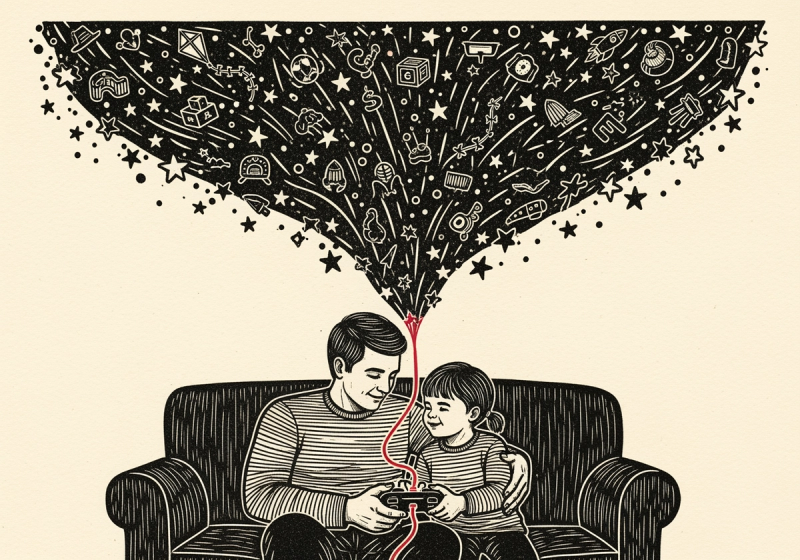
The case for co-play: the most-studied parenting move in gaming
Parents tend to reach for one of two instruments when it comes to gaming: the ban or the blind eye. Either you restrict it — hours, ratings, hard nos — or you treat the console as a babysitter and stay out of it. Both feel like responsible positions. Both are, according to a surprisingly deep body of research, less effective than a third option that almost nobody reaches for first: playing with your child.
Researchers call it co-play, or co-use, and it sits inside a well-studied framework called parental mediation — the same framework media scholars built decades ago to study how parents handle television. The short version of what the research found is genuinely useful, and this post is about that finding: what co-play is, why it outperforms the alternatives, and how to do it without faking enthusiasm for a game you find baffling.
Three styles, and what the research says about each
Media-mediation research generally sorts parental approaches into three buckets. They map almost perfectly onto gaming.
Restrictive mediation — rules, limits, bans, ratings enforcement. This is the most common instinct and it does real work: restriction reliably reduces exposure, especially to age-inappropriate content. But restriction alone has a known ceiling. It doesn't teach a child to evaluate anything; it just moves the boundary. And as children get older it tends to backfire, breeding secrecy and reactance rather than judgement — the teenager who games at a friend's house precisely because it's forbidden at home.
Active mediation — talking about games: discussing content, asking questions, explaining your reasoning. This is where the developmental payoff starts. Children whose parents talk with them about media tend to develop better critical filters, and the effect shows up across the mediation literature (the foundational synthesis is Valkenburg and colleagues' work on parental mediation styles, later extended to interactive media by Nikken and Jansz).
Co-use / co-play — actually being present in the activity, ideally playing alongside. This is the strongest form, because it folds active mediation into the experience itself. You're not lecturing about the game from the kitchen; you're in it, reacting in real time, modelling how you think. Coyne and colleagues' research on parent–child gaming found measurable relationship benefits, particularly the much-cited finding that co-playing with daughters was associated with better behaviour and stronger parent–child connection (Game on… girls, 2011).
The headline, across study after study: restriction controls exposure, but active and co-play mediation are what actually build judgement — and judgement is the thing your child takes with them when you're not in the room.
Why co-play works when lectures don't
Three reasons, all of them ordinary.
It turns the game from a wall into a window. A child playing alone behind a closed door is a black box. A child playing next to you is narrating their world — who their friends are, what they find exciting, what frustrates them, what they're being sold. You learn more about your ten-year-old's social life from twenty minutes of Roblox on the couch than from a week of "how was school."
It moves you from referee to ally. When the only times you engage with gaming are to set limits and shut it down, you become the opposition. When you also show up to play, you earn standing — and the limits you do set land as guidance from someone who gets it rather than edicts from someone who doesn't. This is the difference between "you don't even know what this game is" (true, and fatal to your authority) and "I've played it, and here's what I think."
It makes the teaching moments real. When a "limited-time offer" pops up and you're right there, you can name it in the moment — "see how it's counting down? that timer is there to make you buy now." That lands a hundred times harder than a dinner-table speech, because it's attached to the actual feeling the design just produced. Co-play is active mediation with perfect timing.
How Ludograph is built to support co-play
This is partly why the catalogue gives you two numbers and a breakdown rather than a verdict. A simple "banned / allowed" label tells a referee what to enforce. A benefit profile, a risk profile, and a per-game parent tip tell a co-player what to look for once they sit down.
- The benefit breakdown tells you what's worth pointing out — "this part is real problem-solving, watch how you're planning ahead."
- The risk breakdown tells you what to name when it appears — the specific currency, the specific timer, the specific social-pressure mechanic.
- The time recommendation gives you a shared, external reference point, so the limit is "what the guide says" rather than "because I said so."
Some games make co-play easy and rewarding in itself. The rubric's social-emotional axis rewards genuine cooperation, and a game built for two — Minecraft in co-op, the gentler farming and building titles — is one where sitting down together is a pleasure rather than a chore. Others (a solitary gacha grind, an open lobby full of strangers) are ones you'll co-play more as an observer than a participant — and that's fine too. The point isn't to love the game. It's to be in the room.
How to actually do it (without faking it)
- Ask to be taught, not to play well. "Show me how this works — I'm terrible at it" is the single best opener. It flips the hierarchy: your child becomes the expert, which they love, and you get a guided tour of their world. You do not need to be good.
- Start with twenty minutes, not a commitment. Co-play doesn't mean joining a guild. It means being present and engaged for one short session, occasionally. Frequency beats duration.
- Narrate your thinking, lightly. Not a lecture — just thinking out loud. "Huh, it really wants me to buy that now." "That was a clever puzzle." You're modelling how a person evaluates a game, in real time.
- Save the verdict for later. Co-play is for connection and observation, not enforcement. If something concerns you, note it and raise it afterwards — ideally using the approach for talking about a game you don't like. Don't turn the couch into a courtroom.
- Use it most where the stakes are highest. Younger children and games with real social or monetisation pressure are where your presence does the most. A self-contained single-player puzzle game needs you less than a stranger-facing multiplayer world does.
The honest summary
The most effective thing the research points to is also the least convenient: not banning, not ignoring, but being there. Restriction controls what your child is exposed to; co-play and conversation build the judgement that outlasts any rule you'll ever set. You don't have to enjoy the game, win at the game, or even fully understand the game. You have to sit down next to it occasionally and pay attention — and let your child teach you. That's the move with the most evidence behind it, and it costs nothing but twenty minutes on the couch.
Read next
- What 'good for kids' actually means — the science behind the benefit score — what to point out and praise while you're playing along.
- How to talk about a game you don't like — raising concerns without ending the conversation.
- Voice chat, party chat, and stranger contact — the part of your child's gaming where being present matters most.