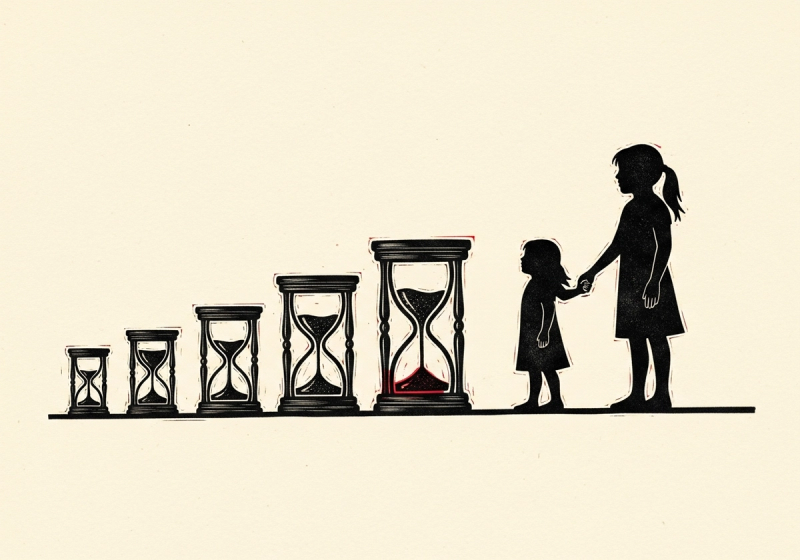
How much game time is actually healthy, by age
If you have ever tried to find a clean number from a credible source for "how much gaming is okay for a nine-year-old", you have probably noticed something: nobody will give you one. The World Health Organization doesn't, the American Academy of Pediatrics doesn't, no Nordic public-health authority does. They all converge on a single answer that is correct but very annoying: it depends on the game.
So we built a number, and we built it so that it does depend on the game. This is how it works.
What the public-health guidance actually says
The two most-cited sources are unambiguous in the early years and deliberately fuzzy after that.
- The World Health Organization (2019 guidelines) recommends no sedentary screen time for children under 2, and no more than 1 hour of sedentary screen time per day for ages 2–4, less being better.
- The American Academy of Pediatrics (Media and Young Minds, 2016 and the Center of Excellence FAQ) recommends the same hour cap for ages 2–5, and from 6 onward stops giving an hourly cap entirely. The recommendation becomes: keep sleep, physical activity, and family time intact, and make a written family media plan.
That second move — from hard cap to "make a plan" — is the gap Ludograph is built to fill. From age 6 onward, the only honest answer is it depends on the game, but most parents need something more actionable than that to settle the question on a Wednesday evening.
Why a generic cap is wrong
Here is the case for refusing to give you a one-size number. Two games, same hour:
- An hour of Minecraft in a single-player world. Spatial planning, resource management, building, problem-solving. No notifications, no streaks, no monetisation in the base game. Our rubric scores this BDS 0.60, RIS 0.14 — high benefit, near-zero manipulation. The recommended cap is up to 2 hours per day.
- An hour of a free-to-play mobile match-three with a daily streak, an energy system, and a battle pass. The same hour, maybe even the same kid. Monopoly GO! is the canonical example — BDS 0.14, RIS 0.73, Ludograph rating 18, recommended not for children.
The hour is identical on the clock. The hour is not identical in the brain. Any framework that puts both into the same bucket is doing your kid a disservice in opposite directions: it under-rates the good game and over-rates the bad one.
The Ludograph time-recommendation formula
We calculate two numbers per game from a public rubric — the Benefit Density Score (BDS, 0–1) and the Risk Intensity Score (RIS, 0–1). The base session length is read off the RIS:
- RIS 0.00 – 0.15 — up to 120 min/day.
- RIS 0.16 – 0.30 — up to 90 min/day.
- RIS 0.31 – 0.50 — up to 60 min/day.
- RIS 0.51 – 0.70 — up to 30 min/day.
- RIS 0.71 + — 15 min, or not recommended.
Then two adjustments are applied:
- BDS ≥ 0.60 (substantial developmental value) extends the recommendation by one tier — unless RIS is above 0.70, in which case high risk overrides the bonus.
- BDS < 0.20 and RIS > 0.30 (low value, moderate risk) drops the recommendation by one tier.
The asymmetry is deliberate: real developmental benefit earns more time, but it never overrides a very high-risk design.
Age adjustments, applied last
The numbers above are calibrated for ages 6–12. We then adjust:
- Under 6. Recommendation is halved and capped at 30 min/day, regardless of the game. This aligns with the WHO/AAP one-hour total-screen ceiling.
- 6–9. Applied as-is.
- 10–12. Applied as-is, with notes on co-play where the game's social risk is elevated.
- 13–17. Extended one tier for age-appropriate content. Teens benefit from autonomy with guardrails more than from arbitrary limits.
So a teen playing Red Dead Redemption 2 (BDS 0.56, RIS 0.00, content-rated 17+) gets a 2-hour-tier recommendation — not because the game is short, but because the design isn't trying to pull them back in. A teen playing a game with the same content rating but a high RIS would get half that, for the opposite reason.
What to do with the number
Three rules of thumb after the formula does its work:
- Don't budget time across games. "He had 20 minutes of Brawl Stars, so he gets 100 of Minecraft" is not how this works. Each game's recommendation is its own thing, because the design pressures are different. Allow the high-benefit, low-risk games more space and the others less.
- Watch the stopping points, not the clock. Games with no natural breaks (endless runners, daily timers, infinite-scroll level lists) are harder to leave than games with chapter beats. Time limits feel like punishment in the first kind and like normal endings in the second.
- Look at the week, not the day. Public-health guidance is much more comfortable with a few high-quality hours on a Saturday than with a stressed-out daily check-in on a school night. The Ludograph rating time recommendation is a daily ceiling, not a daily target.
Read next
- Bundled online modes: why GTA V, RDR2, and Minecraft score the way they do — what happens when a great single-player game ships with a not-great online one.
- Voice chat, party chat, and stranger contact — the social-risk dimension that drives a lot of online-multiplayer RIS.
- How the Ludograph rating is calculated — the full rubric behind every number above.