Flow, not just fun: why some games leave kids calmer and others wired
Every parent has run this experiment without meaning to. Your child plays one game for an hour and switches it off looking content, a little tired, ready for dinner. They play a different game for the same hour and come off it jangled — irritable, twitchy, unable to settle, melting down when you ask them to stop. Both games were "fun." Both held their attention. So why do they leave such different children in their wake?
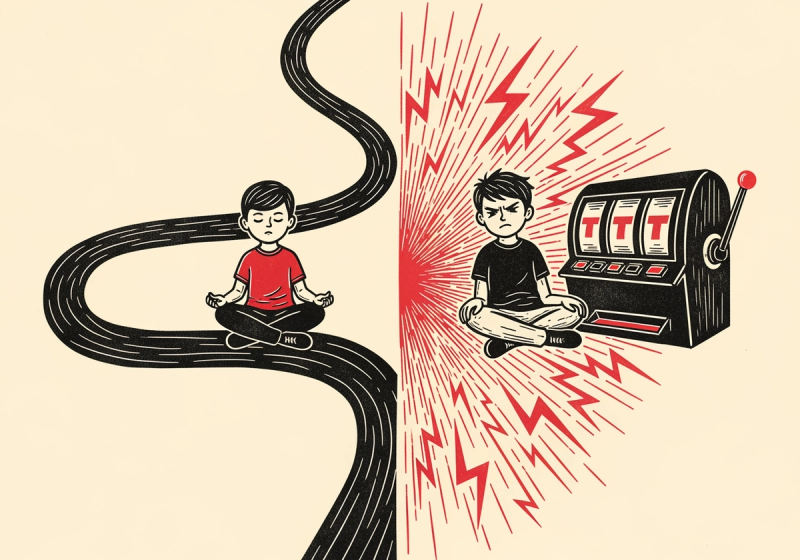
The answer is that "fun" is too coarse a word. Underneath it are two very different psychological states a game can produce, and they have almost opposite effects on a developing nervous system. One is flow. The other is engineered arousal. Telling them apart is one of the most useful things a parent can learn to do — and it's a large part of what Ludograph's risk score is actually measuring.
Flow: the good kind of absorption
The concept comes from the psychologist Mihály Csikszentmihalyi, who spent decades studying the state of complete, energised absorption in a challenging task — the feeling artists, athletes and, yes, gamers describe as being "in the zone." Flow has well-defined conditions: a clear goal, immediate feedback, and — crucially — a challenge that sits right at the edge of the player's ability. Too easy and you get bored; too hard and you get anxious. Flow lives in the narrow band between.
A game built for flow keeps a child in that band by scaling challenge to skill. As the player gets better, the game gets harder, honestly, through design rather than spending. The reward for mastering a hard section is a harder section. This is genuinely good for children: it builds persistence, frustration tolerance, and the deeply useful experience of getting better at something through effort. The rubric scores this directly under adaptive challenge (B1.10) — "Does difficulty scale with the player's skill, keeping them in a flow state? Or is difficulty used to push spending?" Games like Celeste or Hades are textbook flow machines: brutally hard, scrupulously fair, and weirdly calming to play despite the difficulty, because the player is in control of their own progress.
And here's the part parents notice: flow tends to resolve. There's a natural arc to mastering a level and then stopping. The nervous system was working hard, but it was the child's work, self-directed, and it winds down the way effort does.
Engineered arousal: the kind that's hard to come down from
Now the other state. A game can hold attention not by putting a child in flow but by repeatedly spiking their reward system on a schedule the designer controls, not the player. The mechanism is the variable-ratio reward — unpredictable payoffs delivered at calibrated intervals — which behavioural psychology has known for the better part of a century is the single most powerful way to keep a behaviour going. It's the engine of the slot machine, and it produces arousal, not absorption.
The difference matters physiologically. Flow is sustained effort that resolves. Engineered arousal is a series of dopamine spikes with no natural endpoint, layered with mechanics specifically designed to prevent the wind-down: the next chest is almost ready, the event ends tonight, the streak will break if you stop. The rubric tracks this whole family under R1 (dopamine manipulation design) — variable-ratio rewards, streak mechanics, loss-aversion triggers, time-limited FOMO, near-miss feedback, infinite-scroll design with no natural endpoint, and notifications engineered to restart the loop. A game loaded with these doesn't leave a child satisfied. It leaves them in a state of low-grade activation that has nowhere to go — which is exactly the irritable, can't-settle child you're trying to get to the dinner table.
This is why "but they were having fun" and "but they're impossible afterwards" are not a contradiction. Engineered arousal is a kind of fun. It's just fun that runs the nervous system rather than serving it.
Why the after-play mood is the tell
If you want a fast read on which state a game produces, watch the ten minutes after it goes off, not the hour during. Flow-type games tend to produce a tired, content, regulated child. Arousal-type games tend to produce activation that spills into the rest of the evening — the meltdown at the off-switch, the inability to transition, the immediate "can I play again." The transition difficulty is itself diagnostic: a game that's genuinely hard to stop is usually one engineered to be hard to stop.
None of this requires you to ban anything. It just reframes the meltdown. When a child can't come off a game, that's not necessarily defiance or addiction — it's frequently the predictable output of a design built to keep the reward system spiking. Naming it ("that wired feeling is the game working on you, not you being bad") is more useful than punishing it.
How the rubric tells them apart
The cleanest way to see flow-vs-arousal in the numbers is to look at the risk score, which is driven heavily by exactly the R1 manipulation family. Real catalogue examples:
- Minecraft (console, no marketplace) — risk 0.14, up to 120 min/day. A sandbox of self-directed challenge — close to pure flow. Low manipulation, generous recommendation.
- Red Dead Redemption 2 — risk 0.00, up to 120 min/day. A finite, finished story with nothing to run against the player. The arc resolves; the game wants to end.
- Genshin Impact — risk 0.64, up to 30 min/day (13+). A genuinely beautiful world wrapped around a gacha loop, daily-reset chores, and time-limited banners — the arousal machinery is dense, and the recommendation drops sharply to match.
- Clash Royale — risk 0.74, 15 min/day, not recommended. Timed chests with randomised contents: the variable-ratio schedule made literal. Among the highest-arousal designs in the catalogue.
Notice that this axis is independent of how good a game looks or how skilled it seems. Genshin Impact demands real coordination; that's not the question here. The question the risk score answers is whether the game keeps your child by serving their absorption or by spiking their arousal — and the recommendation tightens as the second one takes over.
What to do about it
- Use the after-play mood as your gauge. Calm and tired points to flow. Wired and dysregulated points to engineered arousal. Trust what you observe over what the game calls itself.
- For arousal-heavy games, externalise the stopping point. Flow games end themselves; arousal games don't. Set the timer before play starts, because the design is specifically built to erase the natural "okay, that's enough" moment. See How to enforce a time limit without a fight.
- Favour adaptive-challenge games for younger children. Games that scale difficulty honestly build persistence and tend to self-regulate. The benefit side of the rubric rewards exactly this.
- Name the wired feeling out loud. "That jittery feeling when you stop is the game's design, not you." Children who can name engineered arousal are better at noticing it — a skill worth far more than any single ban.
The honest summary
"Fun" hides a fork in the road. One path is flow: absorbed, self-paced, effortful in a way that resolves and builds real skill — and is, not coincidentally, satisfying to stop. The other is engineered arousal: a calibrated drip of reward spikes with the off-ramps deliberately removed, which is fun in the moment and hard to come down from. Ludograph's risk score is, in large part, a measure of how far a game leans toward the second. You don't need it to know which kind your child just played — you only need to watch the ten minutes after the screen goes dark.
Read next
- What 'good for kids' actually means — the science behind the benefit score — how the upside is measured, including adaptive challenge.
- How much game time is healthy, by age — how arousal design pulls the recommended time down.
- How to enforce a time limit without a fight — practical stopping strategies for games that won't stop themselves.