Review · Action · Nintendo 3DS · Wii U · Wii
Castlevania II: Simon's Quest (1987)
Reviewed: 18 May 2026
Nintendo 3DS · Wii U · Wii · NES
Konami Digital Entertainment · 1987
Ludograph rating
Growth (BDS)
38
Risk (RIS)
3
Daily limit
120min
Age guidance
13+
Developmental benefits
| B1 | Cognitive | 0.50 | |
| B2 | Social-emotional | 0.00 | |
| B3 | Motor | 0.65 | |
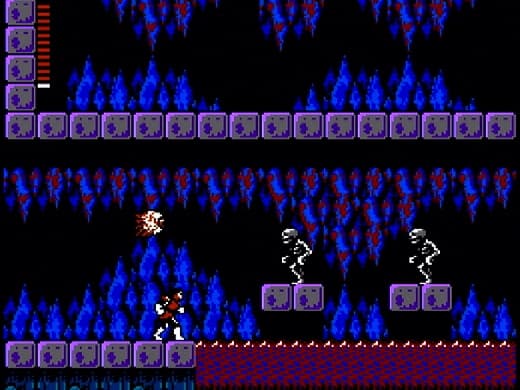
Castlevania II: Simon's Quest offers a challenging platforming adventure that encourages problem-solving, critical thinking, and spatial awareness through its exploration and puzzle elements. Players must strategically navigate environments, manage resources, and learn enemy patterns to progress, fostering cognitive development. The game's reliance on reading clues also enhances language skills.
Design risks
| R1 | Compulsion-loop pressure | 0.07 | |
| R2 | Monetization | 0.00 | |
| R3 | Social risk | 0.00 | |
While an older title, Castlevania II does contain moderate fantasy violence against monsters. Its design does not incorporate modern manipulative mechanics like excessive compulsion loops or monetization pressures, making it a relatively low-risk game in those categories. However, the lack of social interaction means it offers no social-emotional benefits.
Content (not in risk score)
| R4.1 | Violence Level | 0.67 | |
| R4.2 | Sexual Content | 0.00 | |
| R4.3 | Language | 0.00 | |
| R4.4 | Substance References | 0.00 | |
| R4.5 | Fear / Horror | 0.67 | |
Content risk is displayed separately and does not affect the time recommendation.
Regulatory design checks · DSA — Assessed: meets criteria·GDPR-K — Assessed: meets criteria·ODDS — Assessed: meets criteria
- DSA:What Ludograph checks: whether the game's design gives minors the transparency the EU Digital Services Act expects: plain terms, honest defaults, and clear reporting routes.: Estimated from review data. No dark pattern or child-targeting concerns found.
- GDPR-K:What Ludograph checks: whether age assurance and consent flows are designed for under-16s, in the spirit of GDPR Article 8.: Estimated from review data. No privacy or child-targeting concerns found.
- ODDS:What Ludograph checks: whether paid random-reward drop rates are disclosed, as required in China, Japan and South Korea.: Estimated from review data. No paid random-reward mechanics found, so drop-rate disclosure requirements do not apply.
These reflect Ludograph's assessment of the game's design practices against each framework's criteria, not a legal compliance determination.