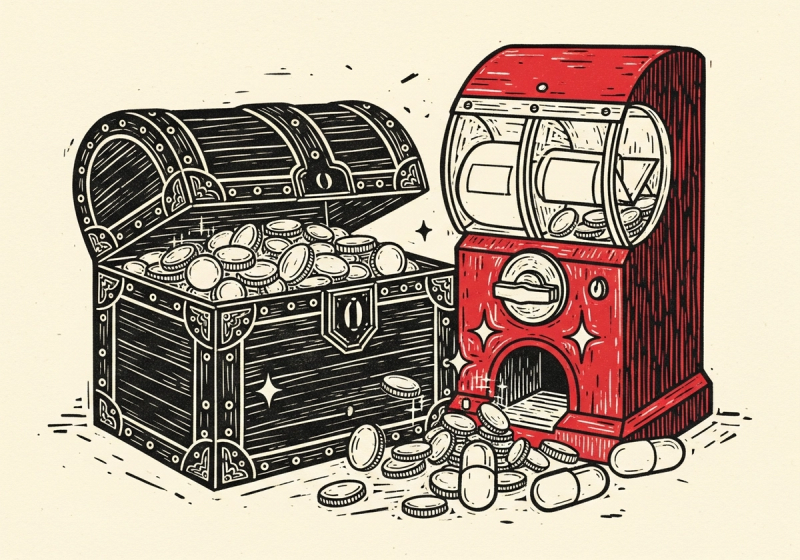
Loot boxes, battle passes, and what the law says
If you have ever tried to find a definitive answer on whether loot boxes are "really" gambling, you have probably noticed that the answer depends on which country your kid is sitting in. Belgium says yes. The UK says no. The Netherlands tried to say yes and then a court said no. Most of the rest of the world has not said anything at all. This is a guide to the current state of play — legal, empirical, and practical — and to how Ludograph handles games that use the mechanics.
What a loot box actually is
A loot box (or gacha pull, or card pack, or supply drop) is a randomised reward purchased with in-game currency that is itself purchased with real money. The defining property is that the player knows roughly what kind of thing they will get, but not what specifically — exactly the structure of a slot machine.
A battle pass is the cousin mechanic: not randomised, but time-gated. The player pays once and then has a fixed window to unlock the rewards by playing — converting time pressure into spending pressure.
Both target the same underlying behaviour (sustained engagement and follow-on spending), through different routes. The rubric treats them as related but distinct: loot boxes hit the R1 family (dopamine manipulation design) and the R2 family (monetisation pressure); battle passes hit primarily R2 plus the R3 family (social/temporal obligation).
The legal landscape, briefly
The honest version: every jurisdiction is doing something different and most are doing nothing.
- Belgium is the clearest case. In April 2018 the Belgian Gambling Commission classified four games' loot-box mechanics as illegal gambling. Publishers responded by removing the mechanics from Belgian-region versions of those games. Belgium remains the cleanest "loot boxes are gambling" jurisdiction in Europe.
- The Netherlands initially fined EA over FIFA's Ultimate Team packs in 2018; the fine was upheld in lower courts and then overturned on appeal in 2022 — the Dutch Council of State held that the packs weren't covered by the existing Gambling Act because the items weren't directly exchangeable for money.
- The United Kingdom ran a long government consultation that concluded in July 2022 with the DCMS response paper declining to legislate, asking the industry to self-regulate instead. The resulting Industry Code of Conduct (2023, administered by Ukie) is voluntary.
- The United States has no federal regulation. The Federal Trade Commission held a workshop in 2019; no rule followed.
- The EU has a 2022 European Parliament resolution calling on the Commission to act, but no binding regulation has resulted.
The net effect for parents: in most places, loot-box design is fully legal, age ratings do not flag it directly (PEGI added an "in-game purchases / includes random items" descriptor in 2020, but it's a label, not a restriction), and the industry's own conduct code is voluntary.
What the research actually shows
Two things, both peer-reviewed, both robust:
- Loot-box spending is positively correlated with problem-gambling severity in adolescents. Zendle and colleagues have a series of papers establishing this — for example Loot boxes, gambling, and problem gambling among young people (2021) and the earlier Adolescents and loot boxes (2019, Royal Society Open Science). The relationship is consistent across studies and large enough to matter practically.
- Variable-ratio reward schedules are uniquely good at producing sustained engagement. This is older psychology, but the gaming-specific synthesis is well summarised in Newall et al. on engineered highs and behavioural addiction (2023). The mechanism is the same one slot machines use.
What the research does not show, despite popular framing, is that loot boxes cause gambling disorder. The correlation is real and robust; the causal story is harder to nail down and not the only thing parents need to worry about. The honest summary is: there is a meaningful overlap between loot-box engagement and later gambling-pattern behaviour, the design pressure is engineered, and the risk is concentrated in adolescents.
How Ludograph scores games that ship these mechanics
A few worked examples, pulled live from the catalogue:
- Genshin Impact — ESRB T, Ludograph rating 45, RIS 0.64, time rec up to 30 min/day, age 13+.
- Apex Legends — ESRB T, Ludograph rating 41, RIS 0.71, not recommended for children, age 17+.
- Arknights — ESRB T, Ludograph rating 42, RIS 0.65, time rec 30 min/day max, age 13+.
- Zenless Zone Zero — ESRB T, Ludograph rating 51, RIS 0.43, time rec up to 60 min/day, age 17+.
All four are ESRB T (Teen). The ESRB rating is not wrong about the content — these games are appropriate for teens in that sense — but the Ludograph rating reflects something the content rating does not: the design pressure. The recommended time drops sharply, the recommended age rises, and several end up in the "not recommended for children" bucket because the loot-box layer dominates the daily experience.
Note that high BDS doesn't rescue a high-loot-box-RIS game from a short time recommendation: Genshin Impact has real exploration value and a competent storyline (BDS 0.45), but the time recommendation stays at 30 minutes because the rubric's asymmetry refuses to let benefits override a high-RIS design. This is the same rule that produces the recommendation in How much game time is healthy, by age.
Practical steps
A short list, ordered by how much they actually do:
- Hard-set a no-spend rule on the kid's account. Console parental controls and platform store settings can lock down all purchases, including in-app purchases inside free-to-play games. This is the single biggest move. Most loot-box risk evaporates the moment Real Money cannot cross the line.
- Watch for the "first purchase only" trap. Most live-service games run a deeply discounted starter pack that anchors the price scale. Pre-empt the conversation before it happens, not after.
- Recognise the battle-pass clock. If your kid says "I have to play before the season ends", that is exactly the design pressure working. The recommended response is to let some pass tiers expire on purpose, once, to reset the expectation.
- Read the Ludograph per-game Parent Tip. Where loot-box pressure dominates, the Parent Tip on each scored game names the specific currency, the specific pack, and the specific store toggle to use.
What this means for the catalogue
A game with loot boxes is not automatically blacklisted on Ludograph — the rubric is honest about benefits that exist alongside extractive mechanics. But the time recommendation reflects the cost of those mechanics directly, and the per-game page surfaces the spending design where present. If a title you think we should be flagging isn't, the feedback link on its page goes to the re-scoring queue.
Read next
- ESRB, PEGI, and Ludograph rating — what each one actually measures — why a T rating and a 30-minute Ludograph recommendation are not contradictory.
- How much game time is healthy, by age — the asymmetric formula that produces the short recommendations above.
- Bundled online modes: GTA V, RDR2, and Minecraft — the closely related case where the loot mechanics hide inside a single-player launcher.