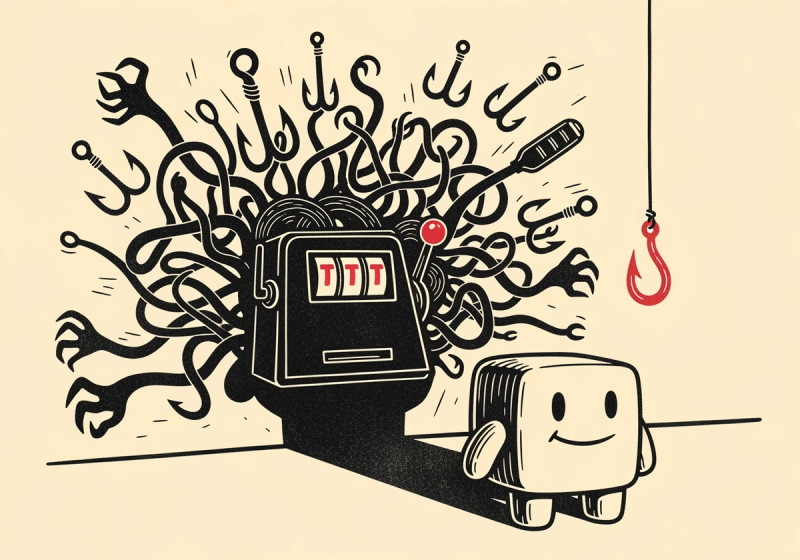
Dark patterns in kids' games: a field guide for parents
The phrase dark pattern was coined in 2010 by the designer Harry Brignull to name a specific thing: an interface deliberately built to trick users into doing something they didn't mean to — buying, subscribing, sharing, staying. It started as a critique of shopping sites and cookie banners. It applies, with a vengeance, to the games children play.
The reason dark patterns work is structural: the people designing the game are professionals with data, and the person being designed at is a nine-year-old whose impulse control and sense of future cost are years from finished. That's not a fair fight, and it isn't meant to be. The good news is that dark patterns are a finite, nameable set. Once you can see them, they lose most of their power. This is a field guide to the ones that show up most in kids' games — organised, named, and mapped to how Ludograph scores them.
Game researchers have built formal taxonomies of this — the foundational one is Zagal, Björk and Lewis's Dark Patterns in the Design of Games (2013), later extended by King, Delfabbro and others studying predatory monetisation. What follows borrows their structure and groups the patterns the way the Ludograph rubric does: by what they exploit — time, money, or social connection.
Temporal dark patterns (the rubric's R1 family)
These manipulate your child's relationship with time and the urge to keep playing.
- The appointment mechanic. Buildings, crops, chests, energy that refill on a real-world clock, training the child to return on the game's schedule. It manufactures a habit, then sells you the skip. (Rubric: R1.3 loss aversion, R1.5 artificial stopping barriers.)
- Grinding and the sunk-cost trap. Progress deliberately slowed so that quitting feels like wasting what you've already put in. "I've come too far to stop now" is an engineered feeling. (R1.9 escalating commitment.)
- Manufactured scarcity / FOMO. The limited-time event, the banner that ends tonight, the skin that's "leaving the shop." Urgency invented from nothing to override deliberation. (R1.4 FOMO.)
- The streak. A counter that punishes you for missing a day, converting a hobby into an obligation with a loss attached. (R1.2 streak mechanics.)
- The infinite loop. No natural endpoint — auto-advancing content, endless ladders, "next match starting" — so the off-ramp the child needs is simply never offered. (R1.8 infinite play.)
- The re-engagement notification. "Your village is under attack!" The game reaching out of the phone to restart the loop after your child managed to put it down. (R1.6 notifications.)
Monetary dark patterns (the R2 family)
These manipulate spending — and the ones aimed at children are the most cynical in the catalogue.
- Currency obfuscation. Real money buys gems, gems buy crystals, crystals buy the thing — each layer making the real cost harder to feel. Genshin Impact's chain (money → Genesis Crystals → Primogems → Wishes) is the textbook case, and it isn't an accident. (R2.3 currency obfuscation.)
- The premium-currency mismatch. Currency sold in bundles that never quite match item prices, so you're always left with a useless remainder that nudges the next purchase. (R2.1, R2.3.)
- Pay-to-skip and pay-to-win. The grind exists, in part, to make the purchase feel reasonable. When spending also buys power, the competition itself becomes a sales pitch. (R2.2 pay-to-win.)
- Spending prompts at frustration points. The "special offer" that appears right after a loss, when willpower is lowest. (R2.4 spending prompts.)
- Child-targeted purchase design. Bright, cartoonish buy buttons, reward animations for spending, confirmation flows a six-year-old can sail through. This is the one the rubric weights most heavily, because it's aimed squarely at the user least able to resist it. (R2.5 child-targeting.)
Social dark patterns (the R3 family)
These weaponise your child's relationships — often the most powerful lever of the three.
- Social obligation. Guilds, clans, teams whose other members are relying on your child to show up. Missing the clan war doesn't just cost progress; it lets real people down. Loss aversion pointed at a friendship. (R3.1 social obligation.)
- Conspicuous spending. Cosmetics and badges that publicly display what a player has bought, manufacturing envy and the pressure to keep up. (R3.4 social comparison.)
- Identity lock-in. Tying a child's sense of self to an account, a rank, a collection — so quitting feels like erasing themselves. (R3.5 identity and self-worth.)
Where it's heading worse, not better
Two trends are worth flagging. First, regulators are slowly noticing: the EU and several national consumer authorities have begun naming dark patterns explicitly, and there is movement toward requiring clearer disclosure of odds and real-money costs. Second, and against that, the patterns are getting subtler — personalised offers timed to individual behaviour, "free" rewards that seed a collection deliberately left incomplete. The arms race favours the side with the data. Which is exactly why a parent's defence has to be pattern-recognition, not vigilance against any single trick.
How the rubric turns this into a number
Ludograph's risk score is, in effect, a dark-pattern census. The three families above map directly onto the three risk dimensions, weighted into the Risk Intensity Score — R1 (dopamine/temporal) at 45%, R2 (monetary) at 30%, R3 (social) at 25%. The more dark patterns a game stacks, and the more central they are, the higher the score and the shorter the recommendation. Real examples:
- Clash Royale — risk 0.74, 15 min/day, not recommended. Timed chests with randomised contents, ladder grind, season pass: temporal and monetary patterns layered together.
- Genshin Impact — risk 0.64, up to 30 min/day (13+). The obfuscated-currency chain plus daily-reset chores plus limited-time banners — a clinic in all three families.
- Red Dead Redemption 2 — risk 0.00, up to 120 min/day (17+). A finished, finite, offline story: no clock to run against you, nothing to obfuscate, no lobby. The near-total absence of dark patterns is exactly why the number is what it is.
The contrast between the last one and the first two is the whole point. None of these is about whether the game is fun or well-made. It's about how many of the patterns above are quietly running while your child plays.
What to do
- Learn the names. A pattern you can name is a pattern you can point at. "That's a manufactured-scarcity countdown" is a thought your child can eventually have too — and that's the real defence.
- Lock purchases at the platform level. Most monetary dark patterns evaporate the instant gems and bundles require a parent's password. This single setting neutralises an entire family of tricks.
- Mute notifications and name the timers. Kill the re-engagement hook, and when a countdown appears, say out loud what it's for. The point isn't to ban the game; it's to make the manipulation visible.
- Read the risk breakdown before the review score. A glowing game with a high risk number is telling you the craft is real and the patterns are dense. Both facts matter.
The honest summary
Dark patterns aren't a vague unease about screens — they're a specific, catalogued set of design tricks built to outmanoeuvre a child's developing judgement, grouped by whether they exploit time, money, or friendship. They work because they're invisible to the person they target. Naming them is most of the cure, and turning that census into a single risk number is a large part of what Ludograph does. You don't have to ban the games. You have to be the one in the house who can see the hooks.
Read next
- Loot boxes, battle passes, and what the law says — the most-regulated, most-studied dark pattern, in depth.
- The attention economy comes for children — how the same playbook arrived from social media.
- Engagement vs. addiction: where the line actually is — what these patterns do and don't add up to.