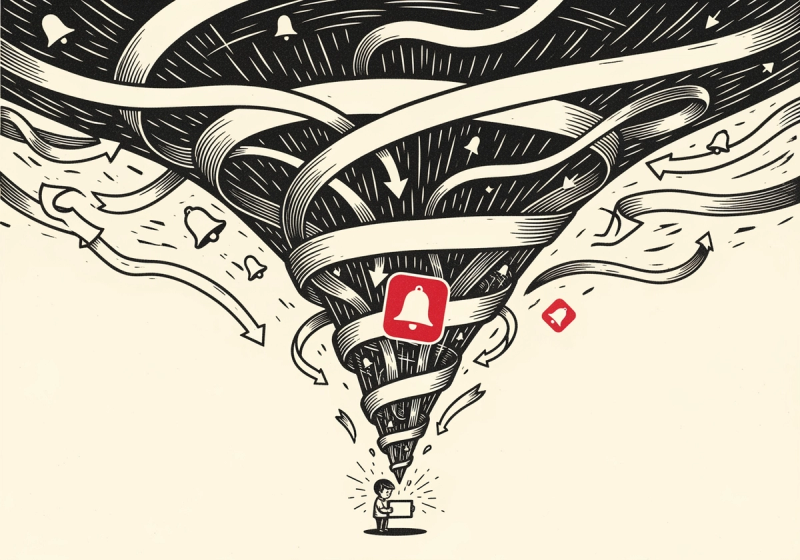
The attention economy comes for children
There's a line, usually attributed to the early web, that if you're not paying for the product, you are the product. It was coined about social media, where the business is selling your attention to advertisers. But the line has quietly become just as true of the games children play — and understanding that explains more about modern kids' gaming than any single mechanic does.
When a game is free, someone is still being paid. The currency is your child's time and attention — monetised directly through ads and in-app purchases, or indirectly by keeping engagement numbers high enough to justify the next round of either. Which means the design goal of a huge share of children's games is identical to the design goal of TikTok: maximise time on device. This post is about how the attention-economy playbook crossed from the feed into the game, and what changes when you realise the thing being optimised is your kid.
The playbook that crossed over
The tactics that made social media so sticky weren't invented for games, but they've been imported wholesale. The lineage is direct.
- The infinite feed → the infinite loop. Social media removed the bottom of the page so there was never a natural place to stop. Games removed the end of the session — auto-starting next matches, endless ladders, daily-refreshing content with no "you're done" screen. (Rubric: R1.8, infinite/endless play.)
- Pull-to-refresh → the variable reward. The slot-machine mechanic that makes a feed compelling — you never know what the next pull brings — is the same variable-ratio schedule that powers loot boxes and randomised drops. Same psychology, different wrapper. (R1.1, R1.10.)
- The notification → the notification. This one didn't even change names. The engineered push alert designed to reach out of the device and pull a user back — "someone tagged you," "your village is under attack" — is identical across both. (R1.6.)
- The streak → the streak. The headline borrowing. A daily counter that punishes you for missing a day turned casual use into daily obligation on social apps; the same mechanic now anchors countless games. (R1.2.)
- Social validation → conspicuous progress. Likes and follower counts became ranks, badges, and publicly displayed cosmetics — the same dopamine of being seen, ported into the game. (R3.4.)
None of this is coincidence. The talent, the data science, and in some cases the literal companies overlap. The attention economy is a single discipline now, and games are one of its most lucrative venues — aimed at users with the least-developed defences.
Why "free" is the tell
The single most useful habit a parent can build is to ask, of any game: how does this make money, and what does that incentivise?
- A paid, one-time game (a £40 console title, a premium app) has already been paid for. Its incentive is to be good enough that you recommend it. It generally has no reason to keep your child playing past satisfaction — which is why so many of the highest-scoring games in the catalogue are finite, paid, single-player experiences.
- A free-to-play game makes money only while your child is engaged — through purchases, ads, or both. Its incentive is, unavoidably, to maximise engagement. That doesn't make every free game predatory, but it does mean the business model is structurally pointed at your child's time.
This is why "it's free!" should raise an eyebrow rather than lower one. Free games can be wonderful. But free almost always means the design is optimising for the one resource you're trying to protect.
The part that isn't doom
It would be easy to read all this as "screens are poison," and that would be both wrong and unhelpful — Ludograph is gaming-positive for good reasons. The attention economy is a description of incentives, not a verdict on games. Plenty of genuinely enriching games exist inside it, and plenty of free games are made by people who care. The point isn't to retreat from the medium. It's to know which games are working for your child's development and which are working on your child's attention — and to spend accordingly.
And there's a real, hopeful asymmetry here: the defences are cheap and the off-switches are real. A notification toggle defeats an entire re-engagement strategy. A paid game sidesteps the whole engagement-maximising incentive. The attention economy is powerful, but it is not subtle once you know its moves.
How Ludograph scores it
The attention-economy mechanics are, almost one-for-one, the dopamine-design family the risk score is built from. So a game optimised for time-on-device tends to carry a high Risk Intensity Score, and the recommendation tightens to match. The business model shows up in the number:
- Red Dead Redemption 2 — risk 0.00, up to 120 min/day (17+). Paid, finite, offline. Nothing to optimise; the game wants to end. The attention economy has no foothold here.
- Hay Day — risk 0.52, up to 30 min/day. The gentler end of free-to-play — real appointment mechanics, but far less competitive and social pressure than its stablemates.
- Clash of Clans — risk 0.79, 15 min/day, not recommended (13+). Appointment clocks, streak-like obligations, re-engagement notifications, conspicuous progress — the attention-economy playbook, close to fully deployed.
Read those three as a gradient of how hard each business model leans on your child's attention. The paid game has no reason to; the gentle free game leans lightly; the engagement-maximised free game leans with everything it has.
What to do
- Ask "how does it make money?" first. Before age ratings, before reviews. The answer predicts the incentives, and the incentives predict the design. Free-to-play deserves a closer look, not a reflexive no.
- Turn off notifications across the board. This is the highest-leverage single setting in the whole attention economy. It severs the re-engagement loop that both social apps and games depend on.
- Buy the paid version when one exists. A one-time purchase removes the engagement-maximising incentive entirely. It's often the cheapest way to opt your child out of the attention economy for that title.
- Set the stopping point externally. Attention-economy design specifically deletes the natural "I'm done" moment, so it has to come from outside the game — a timer, a routine. See How to enforce a time limit without a fight.
The honest summary
The same machinery that made social media impossible to put down — infinite feeds, variable rewards, streaks, engineered notifications — now lives inside a large share of the games children play, because the business model is the same: when the game is free, the product is your child's attention. That's not a reason to fear games; it's a reason to read their incentives. Ask how a game makes money, mute the notifications, prefer the paid version, and set the stopping point yourself. The attention economy is built to be invisible. Your job is to be the person in the house who can see it.
Read next
- Dark patterns in kids' games: a field guide for parents — the specific tricks the attention economy deploys, named.
- Flow, not just fun: why some games leave kids calmer and others wired — why time-on-device design leaves children dysregulated.
- How to enforce a time limit without a fight — supplying the stopping point the design deliberately removes.