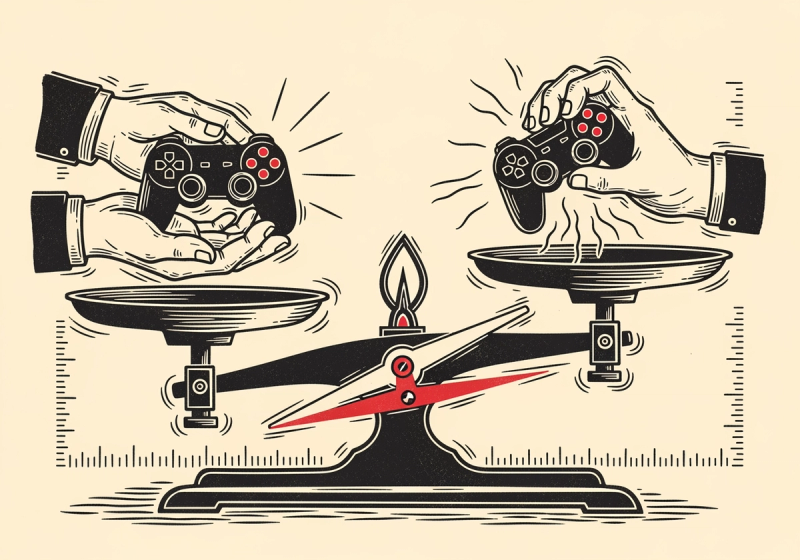
Engagement vs. addiction: where the line actually is
"He's literally addicted to that game." Almost every parent has said it, or thought it, usually around the third "five more minutes" of the evening. It's an understandable thing to feel and a slippery thing to claim, because addiction is a clinical word doing emotional work — and the gap between "plays a lot and hates stopping" and "has a diagnosable disorder" is enormous. Misjudging that gap in either direction does harm: panic where there's only a hobby, or complacency where there's a genuine problem.
This post is about that line — what the diagnostic literature actually says, how common the real thing is, why most heavy play isn't it, and why Ludograph deliberately measures the design rather than diagnosing the child.
What gaming disorder actually is
There is a real, recognised condition. In 2019 the World Health Organization added gaming disorder to the ICD-11, its international classification of diseases (in force from 2022). That recognition is genuine and worth taking seriously — but the criteria are far narrower than casual use of "addicted" implies. The WHO defines it as a pattern of gaming behaviour with three features, sustained over at least twelve months:
- Impaired control over gaming (when, how long, the inability to stop).
- Increasing priority given to gaming over other interests and daily activities — to the point gaming displaces them.
- Continuation or escalation despite negative consequences — falling grades, lost friendships, health effects — that the person can see and games through anyway.
The decisive word is impairment. It is not the number of hours. A child can play a great deal and have none of these features; another can play less and have all three. The diagnosis is about gaming damaging the rest of life and the child being unable to course-correct — not about a parent finding the quantity alarming.
Why most heavy play isn't addiction
Two things are true at once, and holding both is the whole skill.
First, the condition is real but rare. Careful prevalence estimates land well below the alarming figures that circulate online — most rigorous studies put genuine disordered gaming in the low single-digit percentages of players, and a notable chunk of children who screen positive at one point no longer do months later. The American Psychiatric Association pointedly listed "Internet Gaming Disorder" only as a condition for further study in the DSM-5, precisely because the evidence base wasn't settled. Researchers like Andrew Przybylski have repeatedly cautioned that loose measurement inflates apparent rates and pathologises ordinary enthusiasm.
Second — and this is the part that reframes most parental worry — intense engagement is not the same as addiction, and the difference often lies in the game's design, not the child's character. A child who can't stop playing a game engineered with appointment timers, streaks, loss-aversion penalties and re-engagement notifications is not necessarily showing a disorder. They are frequently showing the predictable, designed-for response to mechanics built to produce exactly that difficulty stopping. The "addictive" feeling can be manufactured by the product. That reframe matters: it moves the question from "what's wrong with my child?" to "what is this game doing, and what do we do about it?"
The honest middle ground
So when should a parent worry? Not at "plays a lot," and not at "melts down at the off-switch" on its own — that's usually engineered arousal, covered in Flow, not just fun. The genuine warning signs track the diagnostic criteria: gaming displacing things the child used to care about (friendships, sleep, food, school) over a sustained period; visible distress or deception around play; and continuing despite clear, child-acknowledged harm. One hard evening is a Tuesday. A months-long pattern of gaming crowding out the rest of a life is a reason to seek help — and that help is real, from a GP or a child psychologist, not a forum.
The reframe doesn't let games off the hook; it sharpens the question. If the design is doing the pulling, the lever is the design. If the displacement is severe and sustained, the lever is clinical support. Most families never need the second. Many benefit from understanding the first.
Why Ludograph scores the game, not the child
This is the philosophical core of the whole project: the rubric rates games, not gamers. We have no window into your child, and pathologising children at scale would be both unethical and useless. What we can assess is the thing that's the same for every player — what the designers built.
So instead of asking "is this child addicted?", the rubric asks "how much addiction-shaped pressure does this design exert?" That's the Risk Intensity Score, and it's built almost entirely from the mechanics that the addiction literature flags: variable-ratio rewards, streaks, loss aversion, FOMO, near-miss feedback, infinite-scroll design, and re-engagement notifications (the R1 family), plus monetisation pressure (R2) and social obligation (R3). A high risk score doesn't predict that your child will develop a problem. It tells you the design is leaning hard on the levers that make stopping difficult — so a child playing it needs more external structure than a child playing something gentle.
You can see the spread in the catalogue:
- Red Dead Redemption 2 — risk 0.00, up to 120 min/day (17+). A finite story with nothing engineered to keep you. Heavy play here is just absorption.
- Genshin Impact — risk 0.64, up to 30 min/day (13+). Dense engagement machinery wrapped around a real game. The risk score is high not because players are weak but because the design is strong.
- Clash of Clans — risk 0.79, 15 min/day, not recommended (13+). Appointment timers, clan obligation, randomised chests — close to a full house of the levers the literature names.
Same child, three very different amounts of design pressure to manage. That's the actionable information — far more useful than a label slapped on the kid.
What to do
- Drop "addicted" as a casual verb. It's clinically loaded and it points the finger at your child. "This game is built to be hard to put down" is both more accurate and more useful, because it identifies a fixable cause.
- Match your structure to the design pressure, not your alarm. A high-risk game needs external stopping points (timers, schedules) precisely because it removes the internal ones. A low-risk game often needs none. Let the risk score, not the hours, set your effort.
- Watch for displacement, not duration. The question isn't "how long?" but "is gaming pushing out the rest of his life — over months?" Sleep, friends, food, school. That's the line the diagnostic criteria draw.
- Know that real help exists and is rarely needed. If the displacement pattern is genuine and sustained, a GP or child psychologist is the right call — not a punishment, and not a forum thread.
The honest summary
Gaming disorder is real, recognised, and genuinely uncommon — defined by impairment and displacement sustained over a year, not by hours that worry a parent. Most of what gets called "addiction" is intense engagement, often produced by design built specifically to be hard to stop. That's why Ludograph measures the design and not your child: we can't tell you who's at risk, but we can tell you how hard a given game is pulling, so you can meet it with the right amount of structure. Reserve the clinical word for the clinical thing — and aim the rest of your attention at the machine, where it belongs.
Read next
- Loot boxes, battle passes, and what the law says — the most-studied of the engagement mechanics, and the research linking them to gambling patterns.
- Flow, not just fun: why some games leave kids calmer and others wired — why "can't stop playing" is usually about design, not character.
- How much game time is healthy, by age — how design pressure, not raw hours, sets the recommendation.