How games changed this century: the play stayed good, the hooks moved in
A parent who bought a game in 2002 and a parent who downloads one tonight are doing two genuinely different things, and most of the difference is invisible from the outside. The box art still promises adventure. The reviews still talk about worlds and stories. What changed sits underneath all of that, in the part of a game you can't see until your child is three weeks and forty dollars in.
We can put numbers on it. LumiKin has now scored 16,960 games with a known release date, going back to the turn of the century, each one rated on the developmental benefits it offers and the design risks it carries. Lined up by release year, that catalogue is a slow-motion x-ray of the medium. The headline is more reassuring than the usual moral panic suggests — and the part that should worry you is more specific.
The good news first: the benefits barely moved
Start with what a game does for a child — the problem-solving, the spatial reasoning, the cooperation and creativity that the benefit score measures. If you believe the common story that games have hollowed out into slot machines, you'd expect this line to fall off a cliff. It doesn't.
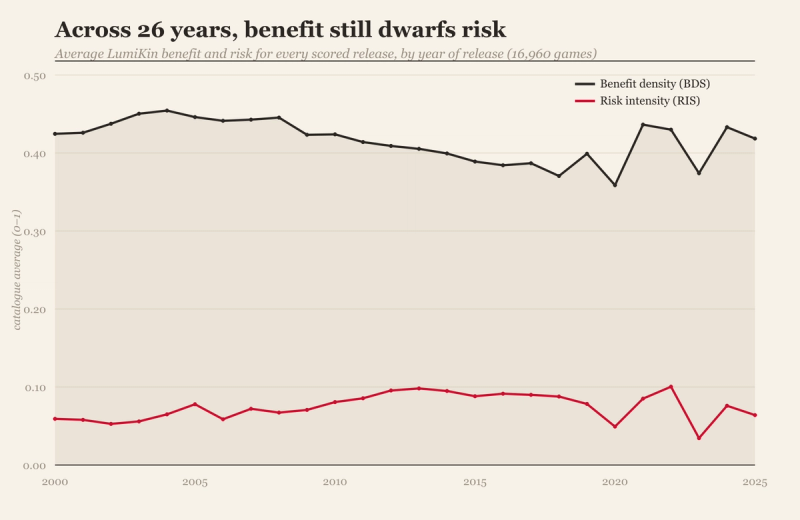
Averaged across the whole catalogue, benefit density runs around 0.44 for games released between 2000 and 2006, sags to 0.39 in the 2013–2018 stretch, then recovers to 0.39 and climbs back toward 0.42 in the most recent releases. That mid-century dip is real, and it lines up with the years the mobile storefront swallowed the charts. But it's a dip, not a collapse — and the recovery is just as real, carried by an indie renaissance that put thousands of small, well-made, sincerely designed games back into the world.
The risk line tells the same calming story at first glance. Across 26 years it never leaves the floor: catalogue-average risk intensity sits between 0.05 and 0.10 the entire time. For the typical game pulled at random from any year, the manipulation simply isn't there. Most games, most of the time, are still mostly fine. We lead with that because it's true, and because a parent who treats every game as a trap will lose the argument that actually matters.
So if the averages are flat, where's the problem? It's hiding inside the average. A mean can stay calm while its tails grow teeth.
The turn: a new category of game, arriving on a schedule
The risk score is built from named, measurable design tactics, and a handful of them weren't dormant before 2010 — they barely existed. Currency obfuscation, where real money is laundered through two or three layers of invented gems and tokens so the price stops feeling like money. Pay-to-win, where the wallet beats the skill. Manufactured urgency, the limited-time event that exists only to override a child's deliberation. Track those specific tactics across the catalogue and the flat line breaks.
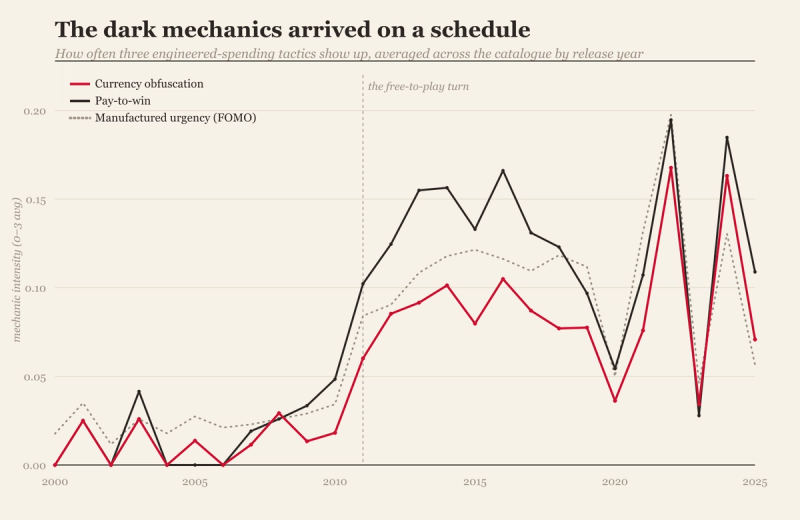
For the first decade of the century these tactics are statistical noise. Currency obfuscation averages essentially zero from 2000 through 2010. Then 2011 happens, and all three lines bend upward together: obfuscation triples, pay-to-win doubles, manufactured urgency jumps. By 2022 they sit five to eight times higher than their 2000s baseline. The share of games shipping with microtransactions tells the blunt version of the same story — under one percent in the early 2000s, 5.6% by 2012, 8.5% by 2016, and 13% of the 2024 releases in our catalogue.
The date isn't a coincidence; it's the calendar of the business model. The first paid microtransaction in a major game is usually traced to a single notorious moment in April 2006, when Bethesda sold a suit of cosmetic horse armour in The Elder Scrolls IV: Oblivion for a couple of dollars. Players howled. It sold anyway, and kept selling for years — and the industry learned the lesson it was always going to learn. The iPhone arrived in 2007 and the App Store in 2008; the free-to-play model that mobile made dominant needed the catalogue a few years to fill out. Our 2011 inflection is what that adoption looks like once it reaches enough titles to move an average.
The games that started it
Trends have patient zeros, and ours is older than the chart suggests. RuneScape launched in 2001 and sits alone in its decade: a browser MMO with a real-money membership and an economy our reviewers score at the very top of the monetisation scale, with risk intensity at 0.70 in a year when almost everything else we've scored is near zero. It was a decade early to the party it would later define.
The party itself shows up where the chart bends. Team Fortress 2 (2007) went free in 2011 and pioneered the cosmetic-crate economy that everyone copied — risk 0.66 in our catalogue. World of Tanks (2010) brought pay-for-power to the mainstream. Then the mobile wave: Clash of Clans (2012), an appointment-mechanic machine that scores risk 0.79 with a 15-minute recommendation despite genuinely high benefit, and Coin Master (2010), a literal slot machine wearing a mobile game's clothes, which posts one of the lowest LumiScores in our entire catalogue at 14. By the time Clash Royale arrived in 2016 — risk 0.74, also 15 minutes — the template was finished and the design patterns were industry-standard rather than industry-scandal.
What makes this more than mobile-bashing is where it went next. The tactics didn't stay in the free app store; they walked into the boxed franchises parents had trusted for a decade.
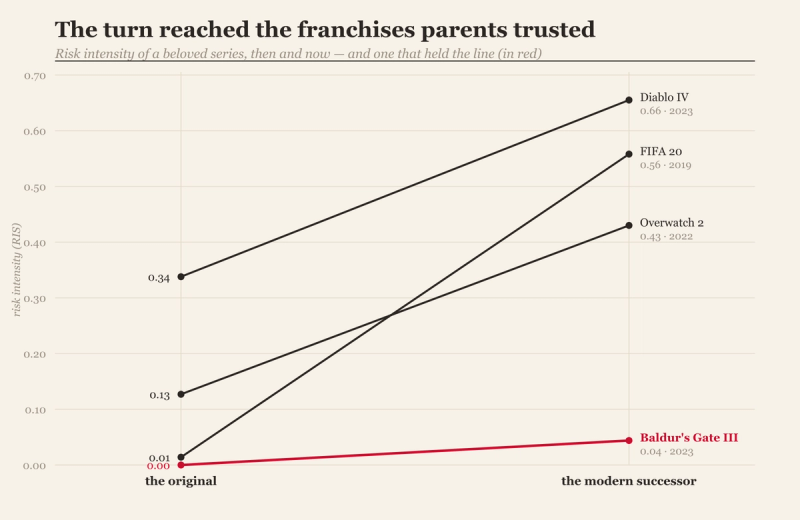
Diablo II (2000) was a finite action-RPG — risk 0.34, no microtransactions. Diablo IV (2023) is the same series rebuilt around a battle pass and a cash shop, and its risk lands at 0.66. Overwatch (2016) scored a clean 0.13 and a full two-hour recommendation; Overwatch 2 (2022) tripled that to 0.43. The sharpest jump belongs to football: a typical late-2000s FIFA release carried almost no design risk at all, while the Ultimate Team era pushed FIFA 20 to 0.56, its card-pack economy ruled a form of gambling by regulators in Belgium and the Netherlands in 2018. Same names on the box. Different machine inside.
It was never inevitable
Here is the line that keeps the whole story honest, and it's the red one on that last chart. The turn was a choice, not a law of physics, and plenty of studios declined to take it.
The benefit ceiling never moved: the highest-scoring games in our catalogue are spread clean across all 26 years. Baldur's Gate II posted a LumiScore of 90 with zero design risk in 2000. Half-Life 2 (2004) and Portal 2 (2011) sit near the top with risk of exactly 0.00. And the modern proof is the loudest of all: Baldur's Gate III (2023) scores 89 with a benefit density of 0.84 and a risk of 0.04 — a sprawling, hundred-hour, commercially gigantic 2023 release with no cash shop, no battle pass, and nothing to obfuscate. Elden Ring (2022) and Stardew Valley (2016) make the same point in different genres. The tools to build a clean, generous game never went away. Some studios just stopped reaching for them.
That's why the catalogue average held while specific games fell through the floor. The medium didn't degrade. It split. One branch kept making finished things you buy once and finish; the other built services engineered to be never finished and never quite paid off. The benefit score can't tell those branches apart — a live-service game and a masterpiece can both be brilliant fun. The risk score is the instrument that can.
What this means for a parent tonight
You don't need to relitigate 26 years of industry history at the dinner table. You need three habits the data points straight at.
- Read the risk number, not just the review. A game can be beautifully made and still be wired to extract — the two scores are independent on purpose. A high LumiScore with a high risk number is telling you the craft is real and the hooks are dense. Both facts are true at once.
- Lock purchases at the platform level. Almost the entire post-2011 trend — the obfuscated currencies, the pay-to-win, the frustration-timed offers — evaporates the moment gems and packs require your password. One setting neutralises a decade of design.
- Judge the game in front of you, not its name. Diablo, FIFA and Overwatch all crossed over; their earlier selves didn't. The franchise your child loves may have changed its machine since you last looked. Check the current entry, not your memory of the old one.
The honest summary
Games did not get worse this century. By the only measure that tracks what a child actually develops, they held remarkably steady, and the best of them are as good as anything the medium has ever produced — in 2000, in 2023, and most years in between. What changed is narrower and sharper than the headlines: somewhere around 2011, a new category of game learned to monetise attention through layered currencies, manufactured urgency, and pay-to-win, and over the following decade those tactics spread from free mobile apps into the boxed franchises parents grew up trusting. The averages stayed calm because most games never joined in. The job now isn't to fear games. It's to tell the two branches apart — which is the one number the box will never print, and the one LumiKin exists to give you.
Read next
- Loot boxes, battle passes, and what the law says — the single most-studied mechanic of the turn, in depth.
- Engagement vs. addiction: where the line actually is — what these mechanics do, and don't, add up to for a child.
- Dark patterns in kids' games: a field guide — the full named taxonomy behind the risk score.