Rockstar Games: the best storytellers in the medium, and the costliest lobby on the internet
There are two Rockstars, and your kid is almost certainly playing the second one.
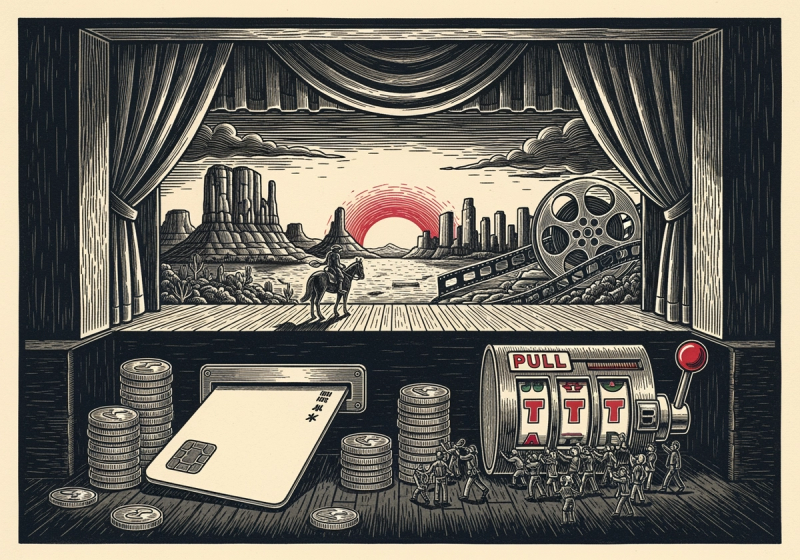
The first Rockstar makes some of the most accomplished single-player games the medium has produced — sprawling, hand-built worlds with the pacing of prestige television and a level of detail that has genuinely never been matched. The second Rockstar runs a pair of online economies that have extracted money from players for over a decade through grind, scarcity, and a real-money currency. Both ship on the same disc. This is a post about the gap between them, and what it means when you're deciding what your teenager plays.
A studio that releases when it's done
Rockstar Games was founded in 1998 under Take-Two Interactive, with the brothers Sam and Dan Houser at the creative core. Its flagship studio, Rockstar North in Edinburgh, was once DMA Design — the team that made the original Grand Theft Auto. Across its catalogue you find GTA, Red Dead Redemption, Bully, L.A. Noire, Max Payne 3, Manhunt, Midnight Club. A remarkably consistent house identity runs through all of it: satirical, cinematic, technically obsessive.
The defining trait is patience. Rockstar ships a major game roughly once every few years and lets each one cook for the better part of a decade. Red Dead Redemption 2 is the canonical example — a Western so densely simulated that NPCs remember you, snow deforms underfoot, and horses behave like animals rather than vehicles. That obsessiveness has a documented human cost: the studio has faced sustained criticism over crunch, including Dan Houser's 2018 remark about "100-hour weeks" during RDR2's final stretch. The craft is real, and so is the price of producing it.
What that patience buys, on the screen, is storytelling almost nobody else in games attempts at that scale. And the Ludograph rating rubric rewards exactly that.
The single-player craft, by the numbers
Pulled live from the catalogue — these are the offline games, scored on what a player gets if they never touch an online lobby:
- Red Dead Redemption 2 — Ludograph rating 72 · benefit 0.56 · risk 0.00 · up to 120 min/day (17+). Near the very top of our entire catalogue — by the rubric, an almost model example of well-built mature gaming.
- L.A. Noire — Ludograph rating 65 · benefit 0.49 · risk 0.015 · up to 120 min/day (17+). A detective game built on facial-capture interrogation — close to pure deduction.
- Grand Theft Auto V — Ludograph rating 63 · benefit 0.48 · risk 0.075 · up to 120 min/day (17+). The lower benefit score reflects adult-geared content density, not poor design; the near-zero risk confirms the story uses almost none of the manipulation patterns that drive screen-time concern.
- Bully — Ludograph rating 64 · benefit 0.47 · risk 0.01 · up to 120 min/day (13+). Rockstar's most teen-accessible game — a boarding-school story with real social-navigation themes under the mischief.
Notice the pattern: high benefit, near-zero risk intensity, a full two-hour recommendation. The risk intensity scores are low because a finished, finite, offline story has nothing to monetise and no clock to run against you. There is no Shark Card in the RDR2 campaign. There is no lobby. The game wants to tell you a story and then end.
The other Rockstar
Then there is what most players actually log into.
- Grand Theft Auto Online — Ludograph rating 37 · benefit 0.47 · risk 0.70 · 15 min/day, not recommended (17+).
- Grand Theft Auto V Enhanced — Ludograph rating 44 · benefit 0.46 · risk 0.58 · 30 min/day (17+). The re-release that pushes the online economy to the front.
Look at the benefit scores: GTA Online's BDS (0.47) is essentially the same as the GTA V story's (0.48). The fun is real; the worlds are the same. What changes is the risk intensity, which leaps from 0.075 to 0.70 — and drags the time recommendation from two hours down to fifteen minutes, into "not recommended." Same studio, same engine, same map. The number collapses because of what was bolted on top:
- Shark Cards. GTA Online's GTA$ is bought with real money. Over the years, in-game prices for the most desirable items have climbed in a way that makes the grind-it-out path punishingly slow and the buy-it-now path tempting — the textbook structure of a pay-to-skip economy. Red Dead Online runs the same play with Gold Bars.
- The grind treadmill. Content is drip-fed and priced so that "earning" a flashy vehicle can take many hours, precisely the friction a card removes.
- Toxicity and griefing. Open lobbies mean strangers with weaponised vehicles, modders and cheaters (especially on PC), scams aimed at newer players, and voice chat with no real floor. For a younger teen this is the actual social environment, not the cinematic story the box sells.
This is the same split we cover in detail in Bundled online modes: the single-player game is what gets reviewed and remembered; the online mode is what gets played. Ludograph's policy is to score the offline game and surface the online mode as a separate, prominent warning — because collapsing them into one number would be wrong for whichever one your kid is actually in.
Why the rubric splits them instead of averaging
It would be easy to blend GTA V's two halves into a single mediocre score. We deliberately don't, for the same reason we don't blend a film with its lobby's slot machines. A 17-year-old playing the GTA V campaign and a 17-year-old matched into a public GTA Online session are having two completely different experiences with two completely different risk profiles. One number can't be right for both. So the campaign keeps its honest, high score, and the online mode carries its own — and the per-game page tells you which is which.
It also keeps Ludograph honest in the gaming-positive direction: Red Dead Redemption 2 genuinely is one of the best things the medium has made, and burying that under its online economy would mislead a parent as badly as ignoring the economy would.
What parents can actually do
Most of the levers here are the same ones from the bundled-online guide, ordered by how much friction they remove:
- Don't pay for the platform subscription that gates online play — no PlayStation Plus on the child's account, no Xbox Game Pass Core. Most bundled online modes need it to function.
- Use per-title online-play toggles. PS5 and Xbox Series let you block online play game-by-game in parental controls.
- Boot into Story Mode on purpose. RDR2 asks once per launch; GTA V defaults to story. The online mode is a choice, not the only door.
- Name the economy, not the game. With older teens, "I don't want you grinding a rigged in-game economy or sitting in a lobby full of scammers" lands far better than objecting to the game itself — which, in its single-player form, may be genuinely excellent.
- Remember these are 17+ regardless. Unlike a kid-facing mobile game, the issue here isn't only monetisation — the mature content is real. The online economy is a second problem stacked on a first.
The honest summary
Rockstar's reputation as a storyteller is fully earned; the rubric agrees, and Red Dead Redemption 2 sits near the top of our catalogue. But the studio also runs two of the most durable, most extractive online economies in gaming, attached to those same prestige titles — and for many kids the lobby, not the story, is the game. The good news is that the split is clean and the off-switch is real: the masterpiece and the cash machine ship together, but they don't have to be played together.
Read next
- Bundled online modes: GTA V, RDR2, and Minecraft — the full policy and the verbatim warnings Ludograph attaches to each title.
- Loot boxes, battle passes, and what the law says — what the online economies are actually monetising, and where the law stands.
- Voice chat, party chat, and stranger contact — the social-risk surface that an open GTA Online lobby opens up.