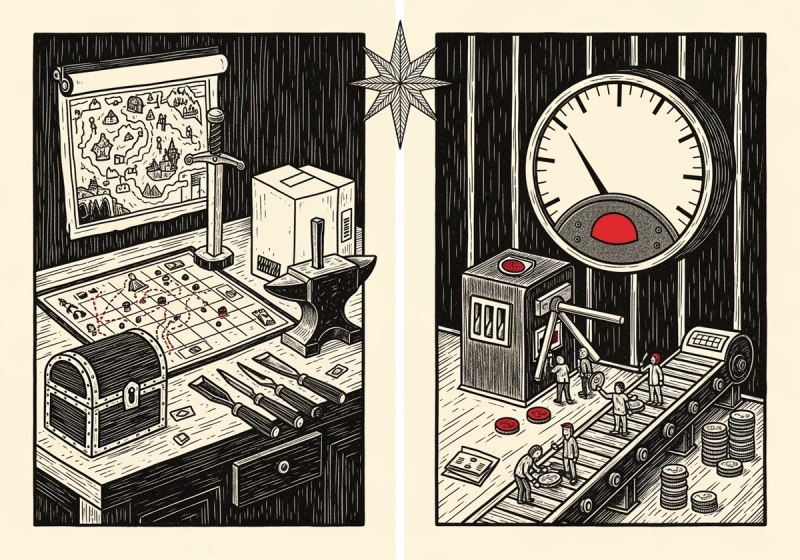
Blizzard Entertainment: the studio that perfected the game, then perfected the storefront
For a stretch of the late 1990s and 2000s, "Blizzard" was shorthand for finished. You bought the box, you got the whole game, and the game was extraordinary. There was no season to keep up with, no currency to top up, no clock counting down on a deal. The studio's unofficial motto — it's done when it's done — was a promise about craft.
That studio still exists, in pieces. But the business wrapped around it has changed completely — from selling games to renting access to them. And because Blizzard's catalogue spans both eras, we can do something unusual here: watch the change happen in the scores. The same engine, the same rubric, rating thirty years of one studio's output — and the numbers split almost perfectly down the middle.
Where Blizzard came from
The company was founded in February 1991 as Silicon & Synapse, taking the name Blizzard Entertainment in 1994. What followed is one of the strongest runs in the medium:
- Warcraft: Orcs & Humans (1994) and its sequels built a real-time strategy empire.
- Diablo (1997) more or less defined the action-RPG loot game.
- StarCraft (1998) became not just a great strategy game but a genuine sport — for years it was a televised national pastime in South Korea, with professional leagues and stadium finals.
The common thread is that these were complete, self-contained objects. You mastered StarCraft against other humans; nothing about it was designed to be topped up. The skill ceiling — not a store — was what kept you coming back.
And the rubric still sees that clearly. These are some of the highest-scoring competitive games in our entire catalogue:
- Warcraft III: Reign of Chaos — Ludograph rating 80 · benefit 0.73 · risk 0.11 · up to 2 hours/day (13+).
- StarCraft II — Ludograph rating 77 · benefit 0.74 · risk 0.20 · up to 2 hours/day (13+).
- StarCraft — Ludograph rating 75 · benefit 0.69 · risk 0.17 · up to 2 hours/day (13+).
High benefit, near-zero risk intensity, a full two-hour recommendation. The risk scores are low because a finished strategy game has nothing to monetise and no clock to run against you. It wants you to get good and then go to bed. Nobody is accusing Blizzard of never having made the real thing — they made some of the best.
The hinge: World of Warcraft (2004)
World of Warcraft changed the company's economics permanently. Launched in November 2004, it wasn't sold once — it was sold every month. The subscription model wasn't Blizzard's invention, but WoW industrialised it: at its peak after the Cataclysm expansion around 2010, it reported over 12 million monthly subscribers, each paying a recurring fee.
That is a fundamentally different machine from a boxed game. A finished StarCraft made its money and stopped. WoW made money for as long as it could hold your attention — which reframed the design goal from "be excellent" to "be excellent and un-leavable." (Subscriber counts later slid; Blizzard's last public figure was 5.5 million in late 2015, after which it simply stopped reporting the number publicly.)
And here is where the scores get interesting. Look at World of Warcraft: Ludograph rating 54 · benefit 0.84 · risk 0.60 · up to 1 hour/day (13+).
That benefit score, 0.84, is the highest of any Blizzard game in our catalogue — higher than StarCraft, higher than plenty of games we recommend warmly. WoW is a genuinely rich, social, collaborative world and the rubric rewards it fully. And it still lands at one hour. That's not a glitch; it's the whole design of the formula. Ludograph rating is deliberately asymmetric — real benefits can't buy back a high-risk design — and WoW's risk (0.60) is built from exactly the thing that makes it a business: the subscription clock, the raid schedule, the guild obligation, and an open-ended world with no natural ending. The same rule produces the short numbers in How much game time is healthy, by age.
And to kill a common myth: WoW never "went free-to-play." As of 2026 it remains a subscription game. What changed is what got added on top.
What got added on top
Each of these is documented, and each is a step further from "buy the box, get the game":
The Diablo III real-money auction house (2012–2014). When Diablo III launched in May 2012, Blizzard let players buy and sell in-game loot for real money, taking a cut of each sale — the studio's loot game wired directly to a cash register. It worked badly; the lead designer later admitted it undermined the fun of finding loot yourself, and Blizzard shut it down in March 2014. The notable thing is that they tried it at all. The base game scores Ludograph rating 49 · benefit 0.47 · risk 0.48 · up to 90 min/day (17+).
The WoW Token (2015). Blizzard began selling a token for real money that another player buys with in-game gold, which the seller converts into game time or store credit. Officially a fix for third-party gold-selling — and it is — but it also formally connected real money to in-game advantage inside a game you were already paying a subscription for.
Hearthstone (2014). Blizzard's digital card game is free to start and monetised through card packs — randomised bundles you buy and open, hoping for the cards you want. That's the loot-box / "gacha" structure we cover in the loot boxes and battle passes guide. Hearthstone scores Ludograph rating 51 · benefit 0.47 · risk 0.44 · up to 1 hour/day — and note its 7+ age floor: this is the gentlest-looking front door with a randomised-spending engine behind it.
Diablo Immortal (2022). The clearest case. A free-to-play mobile/PC Diablo monetised through legendary gems pulled from paid crests — a deep, randomised, pay-for-power system. Independent player calculations estimated it could cost somewhere between roughly $100,000 and $500,000 to fully max a single character, the top figure driven by a steep end-game "whale" mechanic. Blizzard's then-president defended it by saying the monetisation "comes in at the end game." Diablo Immortal scores Ludograph rating 54 · benefit 0.53 · risk 0.46 · up to 1 hour/day (17+).
Diablo IV (2023) then settled into the modern hybrid: a full $70 purchase plus a cosmetic shop plus a recurring seasonal battle pass — three revenue layers on one game. It's the lowest-scoring Blizzard title we rate: Diablo IV — Ludograph rating 43 · benefit 0.58 · risk 0.66 · 30 min max/day (17+).
The cleanest before-and-after: Overwatch → Overwatch 2
If you want the whole story in two rows, here it is. Overwatch (2016) sold for a box price; its cosmetics came from loot boxes you mostly earned by playing. Overwatch 2 (October 2022) went free-to-play, removed the loot boxes, and replaced them with a seasonal battle pass and a direct cash shop — with new heroes parked deep in the free pass. Same heroes, same maps, same studio:
- Overwatch — Ludograph rating 73 · benefit 0.63 · risk 0.13 · up to 2 hours/day (13+).
- Overwatch 2 — Ludograph rating 55 · benefit 0.53 · risk 0.43 · up to 1 hour/day (13+).
The fun barely moved. The risk intensity more than tripled — and the recommendation halved — the moment the game became a storefront with a season timer. Removing the loot boxes was, on its own, a consumer-friendly move (you can now buy exactly what you want instead of gambling for it; the backlash was loud enough that players said they missed the boxes). But the engine isn't grading the loot boxes alone — it's grading the conversion of a finished product into a recurring revenue stream, and that conversion is what the number reflects.
What the scores say, in one line
Sort Blizzard's catalogue by Ludograph rating and a wall appears. On the high side: Warcraft III (80), StarCraft II (77), StarCraft (75), the original Overwatch (73) — finished, finite, skill-driven games. On the low side: Diablo IV (43), Overwatch 2 (55), Diablo Immortal (54), World of Warcraft (54) — every one of them a live service with a clock, a season, or a store. The studio didn't get worse at making games. The business changed what the games are for.
(Corporate footnote: a 2008 merger created Activision Blizzard, and in October 2023 Microsoft completed its acquisition of the combined company. Separately, in 2021 the studio became the subject of a major California state lawsuit over workplace harassment and culture — worth knowing about the company, though distinct from the monetisation story. And one popular claim — that a single $25 WoW store mount out-earned all of StarCraft II — traces to second-hand accounts, not Blizzard's books, so treat it as anecdote, not fact.)
What parents can actually do
- Treat the subscription as the real decision. For WoW and anything subscription-gated, the recurring fee is the consent. Deciding whether to fund it monthly is more powerful than any in-game setting.
- Lock purchases at the platform level. Require a password for every store purchase, or disable in-app purchases on the device. This neutralises Diablo Immortal's gems, Hearthstone's packs, and every battle-pass upsell at once.
- Name the season, not the game. "You don't have to finish the battle pass before it resets" is worth saying out loud. The expiring season works on a kid's weak sense of sunk cost — it isn't an actual deadline.
- Respect the age ratings. Diablo and much of WoW are mature for real reasons beyond monetisation; the storefront is a second problem stacked on a first. And don't be fooled by Hearthstone's friendly 7+ face — read its per-game Parent Tip before letting a young child near the packs.
The honest summary
Blizzard didn't get worse at making games — StarCraft and Warcraft III sit near the top of our catalogue, and that's not nostalgia talking, it's the rubric. What changed is the business poured around the games. The studio learned, decisively, that the most valuable thing it owns isn't a finished product but a player's recurring time and attention — and over twenty years it rebuilt its biggest titles to capture exactly that. The scores are just that decision, made visible. Knowing the arc doesn't mean writing the company off. It means you can see the subscription, the season, and the shop for what they are, and decide where your family's off-switch goes.
Read next
- Loot boxes, battle passes, and what the law says — the mechanics and regulation behind packs, crests and passes.
- How much game time is healthy, by age — the asymmetric formula, and why a high-benefit game like WoW still lands at an hour.
- Inside Supercell and Rockstar: craft vs. cash — the same studio-profile lens on two more catalogues.