Inside Supercell: the studio that turned 'five more minutes' into a science
There is a strong chance your child has played a Supercell game without either of you knowing the studio's name. Clash of Clans, Clash Royale, Brawl Stars, Hay Day — the Finnish company behind them is one of the most quietly influential design houses in the world, and almost none of its fame is attached to its own brand. It is attached to the habit.
This is a post about why those games are so good at holding attention. Not as an exposé — the craft is real and worth respecting — but because understanding the machine is the first move in parenting around it.
A studio built to ship almost nothing
Supercell was founded in Helsinki in 2010 on a deliberately strange premise: make the smallest possible number of games, and make each one enormous. The company is organised into tiny independent teams it calls cells — each one runs like its own startup, picks its own projects, and has the authority to kill a game it doesn't believe in. Founder Ilkka Paananen has described his own role as trying to be "the least powerful CEO" in the industry. When a team cancels a game after months of work, the studio reportedly opens champagne. They celebrate the failure, because killing a merely-good game is what protects the bar for a great one.
The results are lopsided in a way that's hard to overstate. Since 2012 Supercell has launched only a handful of games worldwide — Hay Day and Clash of Clans (2012), Boom Beach (2014), Clash Royale (2016), Brawl Stars (2018), and Squad Busters (2024) — while quietly canceling many more in beta. Those few survivors have reportedly grossed billions of dollars, and Supercell remains one of the highest revenue-per-employee companies in all of gaming. It has been majority-owned by China's Tencent since 2016.
You do not get those numbers from a small catalogue by accident. You get them by being extraordinarily good at one thing: keeping people coming back.
The hook machine, part by part
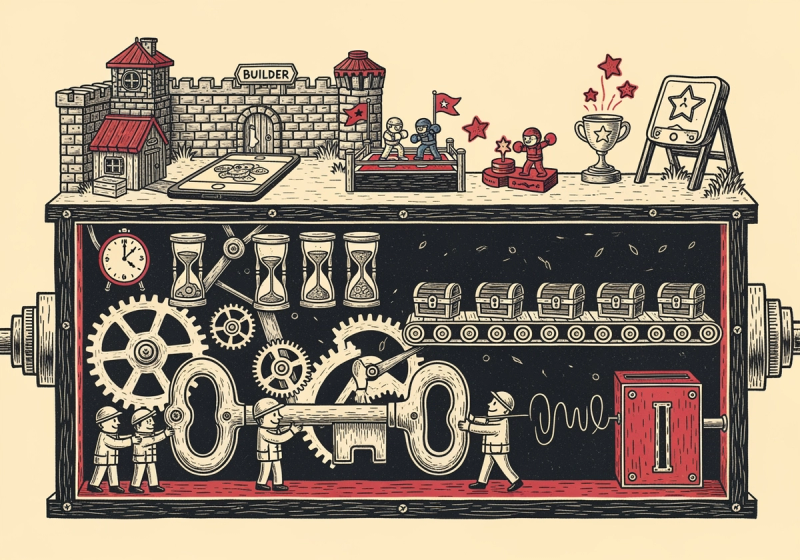
Strip the cartoon art off a Supercell game and you find a remarkably consistent engine underneath. The same handful of mechanisms appear across Clash of Clans, Clash Royale and Brawl Stars — each one a well-studied lever on human behaviour. Here are the main ones, and the design risk each maps to in the Ludograph rating rubric.
1. The appointment clock (R3 — temporal pressure). This is Supercell's signature move. In Clash of Clans, buildings take real hours to construct and troops take real time to train; in Clash Royale, chests unlock on three-, eight-, and twelve-hour timers. The genius is that nothing demands a long session — it demands a frequent one. The game trains a child to check in on a schedule, the same way a slot of homework or a meal does. And every timer comes with a quiet exit: pay a few gems to skip the wait. Time pressure is converted, smoothly, into spending pressure.
2. The variable reward (R1 — dopamine design). Clash Royale's chests don't just take time to open — you don't know what's inside until they do. Card contents are randomised by rarity, the exact structure of a slot machine's variable-ratio schedule, which psychology has known for decades is the single most effective way to keep a behaviour going. It's worth being fair here: Brawl Stars used to sell randomised Brawl Boxes, and in 2021 Supercell removed them in favour of a system where you can see what you're buying. That was a genuinely consumer-friendly change, and we credit it. But the broader pull of "open it and see" remains woven through the genre.
3. Social obligation (R3 — social pressure). Clans, donations, clan wars, club leagues. Once a child joins a clan, logging in stops being a personal choice and becomes a duty to other people. Miss the war and you've let the team down. This is loss aversion pointed at a nine-year-old: the fear of letting friends down is a far stronger motivator than the promise of fun, and the design knows it.
4. The progression treadmill (R1 + R2 — monetisation pressure). Trophy roads, ladders, infinite upgrade ceilings. There is always a next tier, and the gap to it widens exactly as your child's free progress slows — the precise point where a "small" purchase feels reasonable. Card and troop levels can be bought up, which means the ladder is never purely about skill.
5. The season and the offer (R2 — monetisation pressure). Battle passes (Pass Royale, the Brawl Pass), seasonal resets, and limited-time bundles with a countdown timer and an anchored "discount." Every one of these manufactures urgency: the season ends, the offer expires, act now. For a child with no developed sense of sunk cost, a ticking clock on a deal is genuinely hard to resist.
6. The notification (re-engagement). "Your village is under attack." "Your chest is ready." The push notification is the machine reaching out of the phone to restart the loop when a child has actually managed to put it down.
None of these is a trick in the cheap sense. They are well-built, and most adults can hold them at arm's length. The reason they matter for parents is that the developing brain they're aimed at can't — impulse control and the sense of future cost are the last things to mature.
The part that isn't a trap
A guide that stopped there would be dishonest, and Ludograph is gaming-positive for a reason. Clash of Clans is a genuine real-time strategy game. Planning a base layout, managing resources, timing an attack, coordinating a clan war — these are real cognitive and social skills, and the rubric sees them. That's why, of the four Supercell titles in our catalogue, Clash of Clans carries the highest benefit score.
Which makes it the perfect illustration of how Ludograph rating actually works.
How Ludograph scores the catalogue
Real numbers, pulled from the live catalogue:
- Clash of Clans — Ludograph rating 33 · benefit 0.75 · risk 0.79 · 15 min/day, not recommended (13+).
- Brawl Stars — Ludograph rating 29 · benefit 0.44 · risk 0.78 · 15 min/day, not recommended (13+).
- Clash Royale — Ludograph rating 32 · benefit 0.41 · risk 0.74 · 15 min/day, not recommended.
- Hay Day — Ludograph rating 40 · benefit 0.35 · risk 0.52 · 30 min/day max.
Look at Clash of Clans again. Its benefit score (0.75) is the highest of the group — higher than plenty of games we recommend warmly. And it still lands at 15 minutes, not recommended. That is not a bug; it's the whole design of the formula. Ludograph rating is deliberately asymmetric: real benefits cannot buy back a high-risk design. When the appointment clocks, the chest randomness, the clan obligation and the season pass all stack up, the risk intensity climbs past the point where good strategy gameplay can rescue the recommendation. The same rule produces the short numbers in How much game time is healthy, by age.
Hay Day is the gentle end of the same studio — a farming game with far less competitive and social pressure — and the score reflects exactly that, landing at a relaxed 30 minutes.
What to actually do
Ordered by how much they move the needle:
- Lock purchases at the platform level. Set the App Store or Google Play account to require a password for every purchase, or disable in-app purchases entirely on the child's device. Most of the monetisation pressure above evaporates the moment gems and bundles can't be bought on impulse.
- Mute the notifications. "Your village is under attack" is not information your child needs; it's a hook. Turning off a single game's push notifications quietly breaks the re-engagement loop.
- Talk about the clock on purpose. When your kid says "I have to log in or the clan war's lost," name it gently: that feeling is the design working, not an actual emergency. Letting one war or one season pass expire, once, on purpose, is a surprisingly powerful reset.
- Read the per-game Parent Tip. Each scored game's page names the specific currency, the specific timer, and the specific store toggle that matters for that title.
The honest summary
Supercell makes excellent games. The studio's discipline — ship almost nothing, polish it relentlessly — is genuinely admirable, and the strategy underneath Clash of Clans is real. But the same discipline is aimed squarely at retention, and the mechanics that produce these revenue numbers are the mechanics that make the games hard for a child to put down. Knowing the parts of the machine doesn't mean banning it. It means you get to decide where the off-switch goes.
Read next
- Loot boxes, battle passes, and what the law says — the regulation and research behind the mechanics described above.
- How much game time is healthy, by age — the asymmetric formula that produces the short recommendations here.
- Voice chat, party chat, and stranger contact — the social-risk dimension that clans and clubs lean on.